


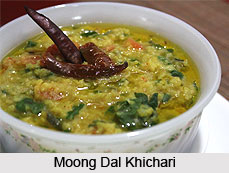
 Khichari is an exceedingly healthy, wholesome and nutritious preparation, which is widely eaten in India. People of all ages are suitable for this dish, owing to its very little use of fiery spices or masalas that might make a preparation rich. Khichari is hugely admired in every corner of India that is eaten and also perfect for anytime snack - breakfast, lunch or dinner. The dish is lovingly called by different names, depending on the province and its population, like khichri, khichdee, khichadi, khichuri, khichari and umpteen other versions. Indian Khichari is commonly made from rice and lentils (Dal). The dish led to the creation of Anglo-Indian version of 'kedgeree', another specialty during the British Raj. Khichari is an exceedingly healthy, wholesome and nutritious preparation, which is widely eaten in India. People of all ages are suitable for this dish, owing to its very little use of fiery spices or masalas that might make a preparation rich. Khichari is hugely admired in every corner of India that is eaten and also perfect for anytime snack - breakfast, lunch or dinner. The dish is lovingly called by different names, depending on the province and its population, like khichri, khichdee, khichadi, khichuri, khichari and umpteen other versions. Indian Khichari is commonly made from rice and lentils (Dal). The dish led to the creation of Anglo-Indian version of 'kedgeree', another specialty during the British Raj.
The history of evolvement of Khichari into India is mixed, with time reminiscing back to erstwhile years. Khichari is distinguished in the writings of Afanasiy Nikitin, a Russian adventurer, who travelled to the Indian subcontinent during the 15th century. Khichari was unanimously popular with the Mughals, especially Jahangir. Ain-i-Akbari, a 16th century document, written by Mughal Emperor Akbar's vizier, Abu'l-Fazl ibn Mubarak, cites the recipe for Khichari, which lists down seven variations. Khichari is most often served with another Indian dish called 'kadhi' (a traditional North Indian dish resembling soup, that is eaten with rice and roti). Other common additional courses include papads, beguni (deep fried eggplants in a besan batter), ghee (clarified butter), achar (oil based pickle) and yogurt. Khichari is a marvellously popular dish in eastern, northern and western India. The dish is extensively cooked in several Indian states like Gujarat, Maharashtra and West Bengal, where it is curiously called khichhuri. Vegetables like cauliflower, potato and green peas are mixed, to make a perfect blend. Khichari is specially prepared for children and people with stomach problems, due to its easily digestible quality, compared to other fiery, spicy and tangy Indian dishes, containing meat. In Bengali tradition, it is expected that one will cook khichhuri during wet and drizzly days. It is also traditional in Bengal to make khichhuri as a lunch during Saraswati Puja - summoning of the goddess of learning. It is also a festive custom to cook khichhuri for lunch in other popular pujas like Durga Puja. 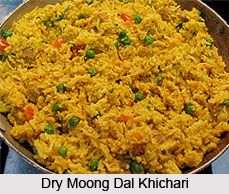
While khichhuri is cooked as a relatively rich gourmet delicacy in Bengal, it is cooked pretty otherwise in North and Western India. The khichari here consists of a very plain flavourless dish, typically served to people who are in poor health. Khichari is also the first solid food that babies are introduced to, in Indian custom. Rice and lentils are simmered till turning a mush, seasoned with turmeric and salt and fed to infants. . Another kind of khichari, popular predominately in western Maharashtra, is cooked with prawns The key to getting the perfect khichari is to add just enough water, so that the rice and lentils are well cooked without being sticky. The present amount mentioned, serves 4. * 100g red split lentils * 500 ml water * 1/2 teaspoon turmeric * 225g basmati rice * salt to taste * 25g butter * 1 small onion, finely chopped Put the red split lentils in a pan with 250ml of water and the turmeric. Bring to the boil. Skim off the scum which rises to the surface. Turn the heat very low and cook gently for approximately 10 minutes. Add the rice, another 250ml of water, salt to taste and bring to the boil. Then reduce the heat, cover the pan and cook over a very low flame. Once all the water has been absorbed, take the pan off the heat and wrap in a towel. Leave in a warm place for 10-20 minutes to allow the rice to expand fully. Meanwhile, fry the onions in the butter until browned and sprinkle over the rice and lentils when it is served. Khichari when well cooked with a small amount of oil is considered a light and nourishing dish and is particularly popular amongst people who follow an Ayurvedic diet or nature cure. There are different recipes of moong dal khichari for different doshas. There is moong dal Khichari for vata dosha, moong dal Khichari for pitta dosha and moong dal Khichari for kapha dosha. There is a special moong dal khichari for tridosha also. |
| |||



Moong Dal Khichari
| Moong dal Khichari is the best of all Ayurvedic diet and is tridoshic in nature. |
| ||||||||||||||||||||||||||||

