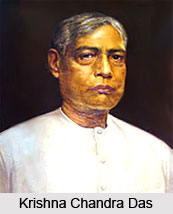
 Krishna Chandra Das was the only issue of Nabin Chandra Das. He is popularly known as K.C. Das - the unrivalled king in the world of sweets. He had inherited his father`s skill and finesse in preparing sweets. Moreover, he was a brilliant innovator. He made `Rosomalai` by treating Rosogolla with dense milk while his father was alive. Despite its novity and superb taste, `Rosomalai` was eclipsed at that time by the tremendous popularity of `Rosogolla`, which was reigning supreme. But Krishna Chandra Das was desperate to preserve the difference of Rosomalai as an exclusive sweet. So, he set up a new shop at Jorasanko in 1930. In the interim, Nabin Chandra Das`s shop shifted its address twice - at the north of Raja Ballabh Street and then towards its south in a small, unimpressive house. Today, that house has given way to a palatial building, which is the residence of the descendants of Nabin Chandra Das. After the demise of Nabin Chandra, Krisha Chandra`s sons viz. Tarini Charan, Bama Charan and Ambika Charan used to look after the original shop. However, the shop was later closed down on account of some legal hassles.
People outside Calcutta were very eager to have a taste of `Rosogolla`. But the earthen vessels had many inconveniences to bring `Rosogollas` from Calcutta. They are frail and could not be sent elsewhere by bearers. Krishna Chandra realized that if the sweets were packed in some metallic container, it would not diminish either the taste or aroma of the Rosogollas. Soon, he thought of a device and did not use any heavy container for that purpose. Thus came the famous tinned Rosogollas` of K.C. Das, which became popular not only in India but was sent abroad in large quantities.
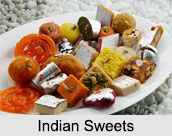
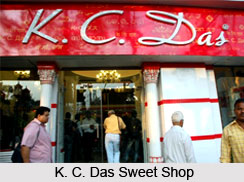 K.C. Das created a sensation in the world of sweets and confectioneries. Their popularity was far-flung. All the sweetmeats in K.C. Das`s shop, are made from cow`s milk. The posset or casein made from buffalo`s milk, cannot make such palatable sweets as those made from cow`s milk. The sweets from the farmer`s milk are also very hard. Even curd and sandesh made from buffalo`s milk, are not fine enough or soothing to the taste-buds. As a result, there are umpteen syrup sweets in K.C. Das`s shop, such as `Singara`, `Nimki`, `Lalmohan`, `Chamcham`, `Mihidana`, `Seeta Bhog`, `Jilipi`, `Amriti`, `Darbesh`, `Ksheermohan`, `Rosomalai` etc. The shop also sells curds and `Sandesh`. Another remarkable feature of K.C. Das`s shop is the `Diabetic Sweet` which has impressed the diabetic patients highly. The milk for K.C. Das`s factory, comes from some renowned cow-sheds. Clarified butter/ghee made from cow`s milk, comes from Khurza in U.P. Besides, the factory has its own arrangements of making ghee from the liquid extracted from posset.
K.C. Das is in Calcutta since antiquity (for 10/11 generations). During this time, they have had interactions and exchange of techniques with different types of sweetmeats. As a result, the original mode and style of preparing sweets have undergone several changes and novelty in cuisine related to sweets, have been really spectacular. Above all, K.C. Das`s factory has an impeccably scientific and hygienic method of making sweets. It takes utmost care about neatness - such as protection from files and other germ-carriers. The factory also has an improved technology for making posset or casein from milk. The succeeding stages in making sweets are not done manually. After they are made, the sweets come on loaded trucks to the K.C. Das shop at Dharmatala. K.C. Das is the only establishment in the kingdom of sweets, where sweetmeats are not made on red-hot ovens but with the help of steam.