


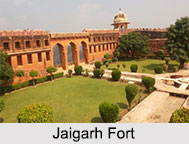
 The Jaigarh Fort was originally built in 1036 AD but was reconstructed in 1726 by Maharaja Jai Singh II, after whom the fort was named. It is a magnificent palace located on the Hill of the Eagle, also known as Cheel ka Teela is on the Aravalli Mountain Range in Jaipur, Rajasthan. The fort was designed by an architect named Vidyadhar, and was built to depict the affluent culture of the city of Jaipur. Since the fort is located at an altitude, a panoramic view of the entire city of Jaipur can be seen from the top. Initially, the fort mainly served as the residential building of the kings but later on, was also used as the artillery warehouse. The Jaigarh Fort was originally built in 1036 AD but was reconstructed in 1726 by Maharaja Jai Singh II, after whom the fort was named. It is a magnificent palace located on the Hill of the Eagle, also known as Cheel ka Teela is on the Aravalli Mountain Range in Jaipur, Rajasthan. The fort was designed by an architect named Vidyadhar, and was built to depict the affluent culture of the city of Jaipur. Since the fort is located at an altitude, a panoramic view of the entire city of Jaipur can be seen from the top. Initially, the fort mainly served as the residential building of the kings but later on, was also used as the artillery warehouse.
History of Jaigarh Fort The opulent structure of the Jaigarh Fort was built in the early 18th century. It is said that the fort was built by the Meenas during their rule in Amber. From the early 10th century the city of Amber was taken over by the Kachawahas during the Mughal period. During this period, the Jaigarh Fort became the empire's main cannon foundry and was also used as storage stronghold to store ammunition and other metal required for war. During the successive wars that broke out in that period in 1658, the cannon outpost at the Jaigarh fort was protected until the protector, Dara Shikoh, was defeated and executed by his own brother, Aurangzeb. Later, the fort was handed over to Jai Singh II. 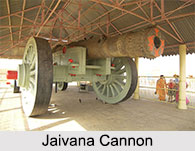 Architecture of Jaigarh Fort Architecture of Jaigarh Fort
The architectural features of the fort are of Indo-Persian style with thick cyclopean walls made of red sandstones and plastered with lime mortar. The Jaigarh Fort is highly fortified spreading over a length of 3 km and a width of only 1km. The fortified walls with triple arched gateways are painted with red and yellow colours. There are sloped ramparts in every corner, which provide access to the upper level structures. The fort has an impressive square garden within it along-with palaces with court rooms and halls with screened windows. There is also a central watch tower on a raised ground which provides excellent vistas of the surrounding landscape. The Aram Mandir and the garden within its courtyard, on the northern side of the fort complex, has a triple arched entrance called The Awani Darwaza which was refurbished in recent times to get the magnificent view of the artificial lake called Sagar Lake. Water from this lake used to be transported to the fort in pouches loaded on elephant backs and also by humans carrying water pots. There are two temples within the fort precincts, the Ram Harihar temple and the Kal Bhairav temple built on 10th and 12th centuries respectively. The fort also has a huge palace complex which includes the Laxmi Vilas, Lalit Mandir, Aram Mandir and the Vilas Mandir. The fort also has water supply facilities which was made by creating water harvesting structures in the vicinity of the Aravalli catchment and conveying water through a canal on the west side of the fort over a 4 km distance. This water is stored in 3 underground tanks below the central courtyard and out of these the largest tank has a capacity to hold almost 6 million gallons of water. This fort was a centre of artillery production for the Rajputs, and thus has an armoury chamber which has a display of swords, shields, guns, muskets and hefty cannonballs weighing 50 kg and 100 kg respectively. The Jaivana cannon, known to be the largest cannon on wheels of the Early Modern Era are a part of this fort. Jai Singh II used the cannon foundry of the fort and molded the great Jaivana cannon. Other than these, there is also a museum in the fort which exhibits photographs of the royalty of Jaipur, stamps and many artifacts, which include a circular pack of cards. A vintage spittoon of 15th century and also hand drawn plan of the palaces are seen in the museum. Visiting Information on Jaigarh Fort The nearest railway station is the Jaipur Railway station at a distance of 15 km from the fort. While, the Jaipur International Airport is at a mere distance of 13 km from the city of Jaipur. |
| |||



Home > Art & Culture > Indian Monuments > Indian Regional Monuments > Monuments of Rajasthan > Monuments in Jaipur > Jaigarh Fort
Jaigarh Fort
| Built in the early 18th century, the Jaigarh Fort was constructed to strengthen the defense of the Amber Fort in the state of Rajasthan. |
| ||||||||||||||||||||||||||||

