Bhim Nag Sweets
|
One of the popular sweet shops in Kolkata, Bhim Nag Sweets was set up by Paran Chandra Nag in the year 1826 in Bowbazar. A pioneer in making sandesh, the shop continues to retain its popularity till date.
|
|
|
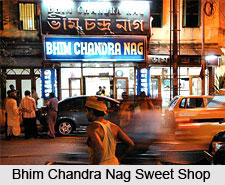 Simple 'Sandesh', 'Pantua' and sweets of that ilk, were available in Calcutta in the early days. 'Rosogolla' and the different types of superior sandesh, arrived in Calcutta much later. Sweets made of 'Ksheer' or thickened milk was not in vogue and people in general, were not fond of such delicacies brought from Burrabazar. Simple 'Sandesh', 'Pantua' and sweets of that ilk, were available in Calcutta in the early days. 'Rosogolla' and the different types of superior sandesh, arrived in Calcutta much later. Sweets made of 'Ksheer' or thickened milk was not in vogue and people in general, were not fond of such delicacies brought from Burrabazar.
At this time, Paran Chandra Nag, a confectioner and owner of a small sweet shop in the village of Janai, Hooghly came to Calcutta to set up a shop. He started with a sweet shop at Bowbazar. His shop did not sell a multitude of sweets. On the contrary, Paran Chandra only sold 'Sandesh' as he had specialized on this sweetmeat. He wanted to grab the market at first with his unique 'Sandesh' so that later on, while diversifying into other sweetmeats, the customers would flock in to buy them, keeping his reputation in mind.
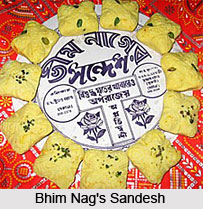 Later Bheem Nag, who integrated this shop, excelled in the art of making sweets. His shop at Bowbazar, hogged the attention of the opulent 'Babus'. Business started flourishing in laps and bounds. Since then, there has been no looking back for the 'Bheem Nag' shop. To this day, the 'Bheem Nag' shop takes utmost care in the preparations of its special 'Sandesh' and is unfurling to compromise with their standards. Above all, the Nags are very enthusiastic and ever innovative to make their special 'Sandesh' more palatable.
Incidentally, it derives mention that Bheem Nag's 'Sandesh' is different from the general 'Sandesh' found in every confectionery attempt to render perfection to it. The Nags have always tried sincerely to do justice shop. The house of Nags has conducted all possible experiments, in an to the glorious tradition of Bengal in the department of sweets and confectioneries. Sandesh is made in different moulds as of various fruits. 'Bheem Nag' is also famous for its 'Diabetes Sandesh' a sweetmeat made by special process for the diabetics, which is devoid of sugar or treacle. Queen Rashmoni used to be one of the regular customers of this shop in her days. Palatable 'Sandesh' from this shop, was also sent to Sri Ramkrishna in Dakshineswar.
LADYCANNIE - On the eve Lady Canning's birthday, Lord Canning's men came .to Bheem Nag's shop and ordered a special sweetmeat, which would be entirely different in shape and size than the existing range of sweets and would also outclass them in taste The Nags after pondering over it for days made a new kind of sweetmeat, much above the expectation of Canning's men. It was partially a 'Pantua' and partially a 'Lancha'. It resembled both to some extent but at the same time, was different from them. From the name of Lady Canning, this sweet came to be known in Bengal as Ladycannie and is very popular even to this day.
|
|
|
|





