


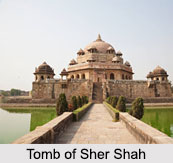
 The tomb of Sher Shah Suri is located in Sasaram, Bihar. Sher Shah Suri, basically a Pathan ruler, was the emperor of Suri dynasty. The most famous creation of Sher Shah is the Grand Trunk Road. He also had a refined taste in architecture; it is evident in the Rohtas Fort built by him. Humayun, on Sher Shah’s death entitled him as "Ustad-I-Badshahan", the teacher of kings. Sher Shah Suri was succeeded by his son Jalal Khan who later adopted the name of Islam Shah. Beside the tomb of Sher Shah Suri, there is located the tomb of Hasan Shah Suri his father. The astounding mausoleum inside an artificial lake mesmerizes its visitor’s eyes. The tomb of Sher Shah Suri is located in Sasaram, Bihar. Sher Shah Suri, basically a Pathan ruler, was the emperor of Suri dynasty. The most famous creation of Sher Shah is the Grand Trunk Road. He also had a refined taste in architecture; it is evident in the Rohtas Fort built by him. Humayun, on Sher Shah’s death entitled him as "Ustad-I-Badshahan", the teacher of kings. Sher Shah Suri was succeeded by his son Jalal Khan who later adopted the name of Islam Shah. Beside the tomb of Sher Shah Suri, there is located the tomb of Hasan Shah Suri his father. The astounding mausoleum inside an artificial lake mesmerizes its visitor’s eyes.
Architecture of Sher Shah Suri’s Tomb Sher Shah’s tomb was built by the master architect Mir Muhammad Aliwal Khan. He was first commissioned to erect the tomb of Hasan Shah Suri and later he built the tomb of Sher Shah Suri. A path or a link is made between the two tombs to go from one to the other. This three-storied mausoleum rises to a height of 122 feet and was originally planned to be a typical island tomb with no access to the mainland. There are stairways on each side of the tomb that lead to the water. There is a landing platform on the eastern side and a causeway between the tomb and the guardroom. The guardroom or the entrance porch on the edge of the northern side of the lake is flanked by two mosques and was meant to provide crew and rafts to the serious visitors willing to see the tomb. A bridge of arches linked the entrance porch and the tomb. The bridge did not last and the visitors used rafts made of earthen pots till 1881, until the present causeway was constructed. The mausoleum appears perfectly symmetrical but its base has a slight deviation at the cardinal points. However, these have been skillfully adjusted to give the impression of perfect alignment. The mausoleum is built on a large square terrace. The corners support the octagonal pavilions with small kiosks between them. The entrance gives way to a wide verandah on all sides, which is shaded by 24 small domes supported on arches and each corner of the verandah has a cupola. The tomb chamber is plain with faded inscriptions on the western wall. The interior is well ventilated and the light comes through the large windows on the top of the walls fitted with jalis. The exterior was originally glazed and painted with a colour combination of red, blue, gold and white. Traces of these colours can still be seen on the parapets and battlements. Visiting Information to the Suri’s Tomb By railway the city can be reached via Sasaram railway station. By road the city is approachable by accessing the National Highway 2 or ‘The Grand Trunk Road’. By air, one can go to the city by reaching Patna airport. |
| |||



Home > Art & Culture > Indian Monuments > Indian Regional Monuments > Monuments of Bihar > Tomb of Sher Shah Suri
Tomb of Sher Shah Suri
| The tomb of Sher Shah Suri at Sasaram, Bihar is of exceptional beauty, which offers an exquisite example of Indo-Islamic architecture. |
| ||||||||||||||||||||||||||||

