


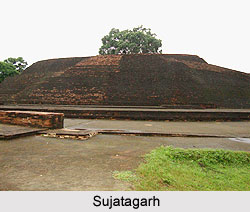
 The ancient site of Bakraur (Sujata-Kuti), is located on the right bank of the river Niranjana in Gaya District. The site, north of the village, is known by names like, Sujata Kuti, Sujatagarh and Sujata Quila, named after the maiden Sujata, the daughter of the chief of the village. She had offered milk-rice to the Buddha after the severe austerities for six years to gain Enlightenment. The ancient site of Bakraur (Sujata-Kuti), is located on the right bank of the river Niranjana in Gaya District. The site, north of the village, is known by names like, Sujata Kuti, Sujatagarh and Sujata Quila, named after the maiden Sujata, the daughter of the chief of the village. She had offered milk-rice to the Buddha after the severe austerities for six years to gain Enlightenment.
The Sujatagarh of Gaya district , is in her memory and is 11m above the ground level. It is in a damaged state several baked bricks, caskets and reliquaries were destroyed. Plaques of the Buddha in bhumisparsha-mudra, is made in plaster and light in weight were found close to and away from the stupa. The stupa was built in three stages. The pradakshina-path is made of baked bricks in the early stage. It was surrounded by a enclosure wall also of baked bricks. Later the diameter as well as the height of the stupa was increased covering the original pradakshina-path. And a 5 metre wide pradakshina-path, of thick lime plaster was added. Moulded bricks were used to surface the stupa. In the third stage a enclosure wall of baked brick covered in lime plaster, railings and gateways for all the cardinal directions.. On the side of the gateway was a baked brick platform, possibly for addressing the congregation. The purpose of two brick structures at the back of the gateway could not be determined. Completely covered in lime plaster, the diameter of the stupa was 65.50 m. Mud and mortar was used as a binding material. The railings and pillars are made of stone. The last phase of the stupa was made in eighth and tenth century A.D., according to the terracotta sealing and plaques. The Pala Kings were responsible for the enclosure wall, railing and the gateway. The earliest occupation of the site was in the second century BC on the basis of fragments of dark grey polished ware found in a partially exposed monastery-like structure to the north-east of the stupa. The important finds of the excavation included a fragment of a ear-ornament made in gold; small terracotta plaques; beads of agate and terracotta; a punch-marked coin; head, torso and many Buddhas in stone; ornamental pieces; and a terracotta sealing. The Sujata-kuti needs to be completely excavated. It dates back to 2nd century B.C. here the Buddha was offered milk rice prior to his attaining Enlightenment by Sujata. |
| |||



Home > Art & Culture > Indian Monuments > Indian Regional Monuments > Monuments of Bihar > Sujatagarh
Sujatagarh
| Bakraur is located on the right bank of the river Niranjana in Gaya District. This region is also known as Sujata Kuti, Sujatagarh and Sujata Quila, named after the maiden Sujata, the daughter of the chief of the village. |
| ||||||||||||||||||||||||||||

