


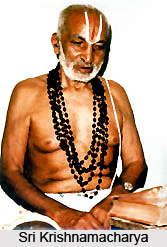
 Sri Tirumalai Krishnamacharya was born on November 18, 1888 in the Chitradurga district of Karnataka, India. He lived more than hundred years. His father was Sri tirumalai Srinivasa Tattacharya, a well-known teacher of the Vedas, and mother was Shrimati Ranganayakamma. He was the eldest of six brothers and sisters. During his young age Krishnamacharya spent much of his time by traveling through India studying the six darshanas of Indian philosophies: Vaishesikha, Nyaya, Samkhya, Yoga, Mimansa and Vedanta. His students were later renowned as India's most influential teachers, like Sri BKS Iyengar, Sri K, Pattabhi Jois, Indira Devi and his own sons TKV Desikachar and TK Sribhasyam. His knowledge and teachings influenced Yoga throughout the world though he never left his motherland in his life. Krishnamacharya learnt to read, speak and write Sanskrit from his father before the age of five and claimed that before attaining the age of twelve he had received the ancient teaching of Yoga Rahasya, which was a long lost Yogic text, from the vision of the ancient sage Nathamuni, who was said to be related to Krishnamacharya. After returning his family moved to Mysore, the second largest city in Karnataka and Krishnamacharya started his formal schooling. At the age of eighteen, Krishnamacharya left home and attended University of Benaras. In the University he focused at the studies on Logic and Sanskrit. He had worked with Brahmashri Shivakumar Shastry, one of the greatest grammarians of the age. After completing University he returned to Mysore and studied Vedanta. He also learned to play Veena, an ancient stringed instrument in India. In the year 1914, he again left for Benaras to attend classes at Queen's college, where he earned a number of teaching certificates. During the first year he had no money or support from his family. So to survive he followed the rules assigned for religious beggars. He used to approach seven households only for alms and offered a prayer "in return for wheat flour to mix with water for cakes." Thereafter Krishnamacharya left queen's college to study six darshanas or schools of thought according to Vedic philosophy in Patna University. During all this time Krishnamacharya continued the practice of Yoga, which he learned from his father when he was a young boy. Many of his teachers were aware about his ability in Yoga and supported his progress as well as asked him to teach their children the process of yoga. During his vacations Krishnamacharya used to go in the pilgrimage into the Himalayas. In one such trip Krishnamacharya decided to find Sri Ramamohan Brahmachari, an eminent yoga teacher who was said to live in the mountains. Finally Krishnamacharya was able to find out Sri Brahmachari's school that was situated in a cave at the foot of Mount Kailash. He spent seven years there studying the yoga Sutras of Patanjali, learning asanas and pranayama and also studied the therapeutic aspects of yoga. A tradition says that at the completion of the education Krishnamacharya asked his Guru Sri Rammohan Brahmachari that what he should pay for the remuneration? The Guru asked his disciple to marry, raise children and be a teacher of Yoga. 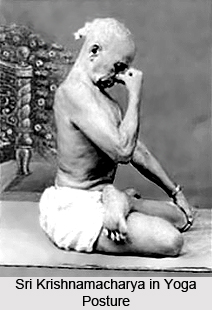 From Tibet Krishnamacharya returned to Southern India to study Ayurveda, the traditional medical practice of India. He also studied Nyaya, a school of Indian philosophy concerned with logic. In 1924, Maharaja of Mysore asked him to open a yoga school, where he taught until 1955. The Maharaja was so impressed with Krishnamacharya that he was hired to teach the royal family. He opened a school or Yogashala in the wing of the palace. Most of his students were young boys and so he could develop a vigorous style that aimed at building strength and stamina that is today popularly known as 'Ashtanga Vinyasa Yoga'. Krishnamacharya soon became trusted advisor of Maharaja in Yoga as a healing therapy. After India got independence, Krishnamacharya lost his royal support as the Maharaja of Mysore was dethroned.
Krishnamacharya left Mysore and moved to Bangalore for two years. Then he again relocated in Chennai as he was invited by a famous lawyer whom he helped to be cured from a stroke. Even at the age of sixty Krishnamacharya was considered as a very disciplined and strict advisor and much concerned about teaching and practicing. Also he possesses a gentle and compassionate side. Krishnamacharya lived and taught in Chennai until he went into a coma and died in 1989 at the age of one hundred years. He was considered as the great Yoga master of India but he introduced himself as a student as he always 'studying, exploring and experimenting' with the practice. Krishnamacharya believed that Yoga was the greatest gift of India towards the world. Although many people approach yoga as a spiritual aspect, Krishnamacharya also put emphasis on physical healing by Yoga as illness causes greater discomfort that will hinder spiritual growth. Krishnamacharya realized that every person is absolutely unique from the teachings of his father and from his own experience. He also understood that most important part of teaching Yoga is that a student must be taught according to his her individual capacity at a given time. This clearly indicates that the path of yoga will be different for different people and each person must be taught in the manner which he/ she understands most easily. Because of this individualistic approach, it is not possible to explain Krishnamacharya's teaching process in full. Krishnamacharya was not only the Yoga instructor; he was the physician of Ayurvedic medicine and had enormous knowledge of nutrition, herbal medicine, use of oils and other remedies. He approached individual's problem in a well-organized manner. When he started working with a person, first he accumulated all the information through a detailed examination to determine the most efficient path of teaching Yoga and the remedy of Yoga. He used to examine the person's pulse, color of skin, breathing rate and quality and many other things. During the time of diagnosis, Krishnamacharya would search for something that "upset or hindered the harmonious union of the body, mind, and spirit". Even he knew about a disease in a particular area he knew that it could affect the other system of the body which might be mental or physical. During or after the examination krishnamachary asked the person a compulsory question if he or she will be able to follow his guidance. He asked this question because he believed that if the person did not trust him fully, he/ she cannot be completely cured. If the answer was 'yes', 'Healing relationship' would begin. But if the person showed hesitation he refused to help him/her. Once a person had started following Krishnamacharya's teaching, he would work with him/ her on different aspects including adjusting their diet, creating herbal medicines and determining a series of Yoga postures that would be most beneficial for the subsequent person. When instructing a person for the practice of yoga, he stressed on the importance of combining Yoga postures (asana) with the meditation (dhyana) and breath work (pranayama). He would continue to see the person once a week to monitor his/ her progress until the patient is completely healed. Krishnamacharya preferred traditional Yoga Sutras of Patanjali, Nathamuni's Yoga Rahasya and the Mahabharata's Bhagavad Gita as the most important Yoga text . He understood that his greatest strength was the ability to intake ' the ancient teaching of Yoga and Indian Philosophy' and coalesce it in a modern framework. Thus Krishnamacharya was the perfect yoga teacher of india who was able to represent Yoga as accurate and powerful tool for the betterment of physical and spiritual life. |
| |||



Sri Krishnamacharya
| Krishnamachrya was a wise and erudite person who represented Yoga as the procedure of spiritual and physical uplift. |
| ||||||||||||||||||||||||||||

