Shree Manudevi Temple - Informative & researched article on Shree Manudevi Temple
  Indianetzone: Largest Free Encyclopedia of India with thousand of articles Indian Temples


in  
Art & Culture | Entertainment | Health | Reference | Sports | Society | Travel
Forum  | Free E-magazine
Indian Temples : Indian Temples l Arts and Crafts of Hindu Temples l Indian Religious Temples l Churches in India l Mosques in India l Shiva Temples In India l Krishna Temples in India l Hanuman Temples in India l Durga Temples in India l Vishnu Temples in India l North Indian Temples l Central India Temples l West India Temples l East India Temples l Indian Regional Temples l Indian Temple Managements l Styles of Worship in Indian Temples l Indian Temple Architecture l Indian Temples by Religion l History of Indian Temples l Hindu temples in India l Gurudwaras in India
Home > Reference > Indian Temples > West India Temples > Temples of Maharashtra > Shree Manudevi Temple
Shree Manudevi Temple
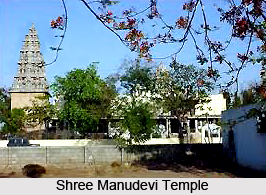
Nestled in the lush green ranges of Satpuda Mountains, on the banks of the river Tapti is Shree Manudevi Temple.


Shree Manudevi TempleIt is the supreme family deity of many families who reside in the vicinity. The temple is accessible via road by taking an exit of the Yaval Chopra State Highway. After passing through Adgaon-Kasarkheda, the temple is around 10 km approximately. The temple sis located at a height of 500 metres. The best time to visit the temple is between October to December. Every year `Navchandi Yagna` is performed on `Chaitra and Magh Shuddha Ashtami`. On the month of `Margashirsha` and `Pethodi Amavasya`, of `Sharavan` (rainy) months, i.e. the Pola Festival, a grand procession of the Devi is taken out. A `Navratri Utsav` procession is taken out on the month of `Ashwin`.

A member of the Ingle family, Shri K Pandu Jeevan around 1259 AD/BC, first discovered the temple. Evidence from excavations proves the temple to be seat of culture of ancient times. Magnum trees greets a visitor to the temple, which are believed to be the manifestations of Lord Parashurama welcoming the pilgrims to `darshan` of Shree Manudevi. Around 4 to 5 km from the temple is remnants of another medieval structure, Gawli Wada. King Ishwarsen who was the ruler at that time, took pains to initiate the basic construction of the temple. Even today the wall measuring 13 sq. ft. and 2 km in length is in a watchworthy condition. There are about 7 to 8 wells in the precincts of the temple. The sanctum hall measures 86 x 50 feet and the sanctorum is 22 x 14 feet wide respectively.

In the Devi Bhagwat Puranas, the folklore mentioned is associated with the legendary stories of the temple. Lord Vishnu, Lord Shiva and Lord Brahma were hit with a grave and nasty problem. The menace of the rakshasas had to be addressed and people staying on Earth, had to be relieved of this pain. The trinity of these supreme Gods thus met in a cave location in the Satpuda ranges, where the temples is said to be located today. While in deep meditation to find a solution to the problem of the rakshasas, the powerful breathing and environment that was created inside the cave due to their presence and meditation, there appeared a very bright illumination of Shakti (power and energy inherent in goddess) in the form of lightning. These illuminated rays culminated into a combined form of Goddess Manudevi. She thus, signifies the combined strength, intelligence and power of the Trinity-Lord Brahma, Lord Vishnu and Lord Shiva. On appearing the Goddess asked the assembled gods the motive behind their call to her. They explained to her the rampage of the demon Mahishasur on earth and its beings and the plight they are in after such pain infliction. On earnest request from the Gods, Goddess Manudevi relented to destroy and kill the demon Mahishasur, and gained the form of Shree Sapthashrung Devi to proceed in her mission immediately. She reached the banks of the river Tapti, and the battle took place in an area known as Shrigadh. This place came to be known as `Shri Ashtabhujaa Devi`. From this location Goddess Manudevi moved to Nandra (Bajara) for the next battle. Here also is a temple in the form of Ashtabhujja Devi. From here the Goddess moved to an area known as Paatna, where a temple has also been erected going by the name of `Paatna Devi`. Tired of continuous battles, the goddess had taken rest here. The final battle took place on Sapthashrung Mountains, where the goddess battled the demon for seven years. In the battle between dharma and adharma, the goddess took the form of Sapthashrunga Devi, feared by the wrong doers. Thus, Mahishasura was defeated and destroyed forever. This place is believed to be the abode of the Devi, called Khandesh.

The trustee board `Satpuda Niwasini Manudevi Seva Pratistan, Aadgaon`, was established in 1991-92. The founder trustee as well as President Vasant Shankar Chaudhari and Sopan Shankar Wani had taken immense pain in building Shree Manudevi temple as it is today.
(Last Updated on : 23/01/2009)
  More Articles in Temples of Maharashtra
 
Temples In Aurangabad Temples in Amravati Temples of Jalgaon
Temples in Kolhapur Temples In Mumbai Temples in Nagpur
Temples in Nanded District Temples in Nasik Temples in Pune
Temples in Sangli Temples in Satara Temples of Thane
Pandharpur Temples Walkeshwar Temple Jain temple
Mahalakshmi Temple Siddhivinayak Temple Mumba Devi Temple
ISKON Temple Babulnath Temple Balaji Temple
Ghrishneshwar Temple Shri Vyankatesh Temple Ramtek Mandir
Tekdi Ganapati Temple Shri Saibaba Temple Shri Balaji & Shri Kartikeya Temple Complex
Trimbakeshwar Temple Sundarnarayan Temple Naroshankar Temple
Modakeshwar Temple Gondeshwar Temple Ramkund
Bhimashankar Temple Bhuleshwar Temple Pataleshwar Cave Temple
Jejuri Temple Alandi The Dehu samadhi temple
Chaturshringi Temple Kasaba Ganapati Temple Parvati Hill and Temple
Tambadi Jogeshwari Kopineshwar Temple Mahadevi Mahalakshmi Mata Temple
Thakurdwar Mandir Shri Mahalakshmi Temple Jyotiba Temple
Khidrapur Temple Bhavani Mandap Tryambuli Devi Temple
Shri Siddheshwar Temple Tuljabhawani Temple Akkalkot Swami Samarth Maharaj Temple
Temple in Solapur Shree Manudevi Temple Shri Ambadevi Temple
Shirdi Temple Bhatkuli Jain Temple Renuka Devi Temple
Shri 1008 Mahaveer Digambar Jain Atishaya Kshetra Thair Shri Ganpati Devasthan Tasgaon Ganesh Temple
Mandher Devi Temple The Dragon Palace Temple Narasimha Wadi
Vithoba Temple Ambarnath Temple Ballaleshwar Temple
Varada Vinayak Temple Kapaleshwar Temple Grishneshwar Temple
Recently Updated Articles in Indian Temples
  • Temples of West Bengal
    Temples of West Bengal attract a number of pilgrims throughout the year, especially the Kalighat and Bishnupur group of temples.
  •  
  • ISKCON Mayapur
    ISKCON Mayapur is a famous pilgrimage spot and is one of the popular places in the Nadia District in West Bengal.
  •  
     
  • Our Lady of Snow Church
    Our Lady of Snow is a Roman Catholic Marian church in Kallikulam, Tirunelveli district of Tamil Nadu.
  •  
  • Poondi Madha Basilica
    Poondi Madha Basilica or Our Lady of Lourdes Basilica is a Catholic pilgrimage centre that is located in Tamil Nadu.
  •  
  • Basilica of Our Lady of Good Health
    Basilica of Our Lady of Good Health is located at the small town of Velankanni in Tamil Nadu.
  •  
    E-mail this Article | Post a Comment
    RSS Feeds
    Forum
    Forum on Indian Temples

    Free E-magazine
    Subscribe to Free
    E-Magazine on Indian Crafts
     
     
    Shree Manudevi Temple - Informative & researched article on Shree Manudevi Temple
    Sitemap
    Contact Us   |   RSS Feeds
    Copyright © 2008 Jupiter Infomedia Pvt. Ltd. All rights reserved including the right to reproduce the contents in whole or in part in any form or medium without the express written permission of Jupiter Infomedia Pvt. Ltd.