Performance of the Manipuri Dancers
|
The traditional Manipuri style of dancing pre-eminently embodies delicate, lyrical and graceful movements.
|
|
|
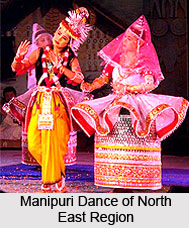 The traditional Manipuri style of dancing pre-eminently embodies delicate, lyrical and graceful movements, which enhance the audience in its beautiful and colourful costumes and presentation. The Manipuri dance whether folk, classical or modern, is devotional in nature. The folk dances of people captivate the beholders with their exotic costumes and simple but graceful rhythm. Their folklore is rich in quality. The dances are ritualistic and recreational, religious and temporal. The ritual dances are performed at a particular rite or ceremony or sacrifice and these dances naturally have a spiritual and religious basis. The dancers begins with the movements known as the chali. It is a movement, which suggests basic ways of walking and covering space. The dancers moves first to the front and back with hands held horizontally at the chest level and then moves these hands vertically in an up-and-down direction. She then covers space in side-ways walking, ending by weaving circles and spirals. A genuine Manipuri dance performance offers a glimpse of a rare and ancient civilization still extant. The traditional Manipuri style of dancing pre-eminently embodies delicate, lyrical and graceful movements, which enhance the audience in its beautiful and colourful costumes and presentation. The Manipuri dance whether folk, classical or modern, is devotional in nature. The folk dances of people captivate the beholders with their exotic costumes and simple but graceful rhythm. Their folklore is rich in quality. The dances are ritualistic and recreational, religious and temporal. The ritual dances are performed at a particular rite or ceremony or sacrifice and these dances naturally have a spiritual and religious basis. The dancers begins with the movements known as the chali. It is a movement, which suggests basic ways of walking and covering space. The dancers moves first to the front and back with hands held horizontally at the chest level and then moves these hands vertically in an up-and-down direction. She then covers space in side-ways walking, ending by weaving circles and spirals. A genuine Manipuri dance performance offers a glimpse of a rare and ancient civilization still extant.
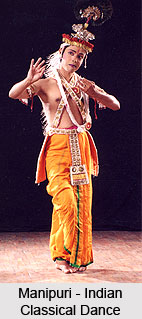
The palpating beats of dhol laced with the magnificence of the body movements' envelope the viewers whilst the colorful costumes and that neat presentation bewitch them. With the typical folk elements subdued in it, the Manipuri dance has therefore a remarkable charm. The dancer begins with the movements known as the chali. Chali suggests the fundamental basics of walking and covering space. The dancer moves first to the front and back with hands held horizontally at the chest level and then moves these hands vertically in an up-and-down direction. She then covers space in side-ways walking, ending by weaving circles and spirals.
In this movements the diverse types of Brahmaris are also introduced. Uplai and the longlai are the two distinct varieties of the Brahmaris. Although jerks are avoided yet "Achingana of the jumping movements are introduced in the Tandava part of any Manipuri dance. The movements of challis again form the various types of parengs. All the Lais are employed in Parengs and also Talas are used. The rajmela, the seven beats (rupaka), 15 beats (panchamsvari) and the 16 beats (tintala) out limns the parengs. Bhangis like ostha bhangi pareng, the gostha Vrindavan pareng and the gostha Khurumba pareng are ideally imbibed into the dance pattern and is eloquently uttered in the Rasa Leela dance styles.
The compositions from the Classical Sanskrit literature are illustrated in this dance style. Quite evidently therefore in the rasa dances, we find that all the four types of pindis mentioned by Bharata. The mellisonant melody of the Meera and Krihna are also in vogue . Girls, colorfully dressed begin the dance and then the men join in the middle.
|
|
|
|