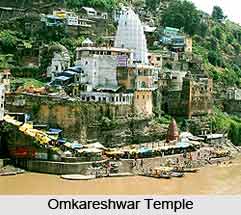
 Omkareshwar is a temple located in Indore in Madhya Pradesh, India. More specifically, this temple is situated in a holy town called Mandhata or Shivapuri or Omkareshwar, on the river Narmada. This town is basically an island, about 2 km long and 1 km wide. The shape of this island resembles the Hindu religious symbol of "Om". This place is a pilgrimage site, as there are a number of Hindu and Jain temples located here. Omkareshwar is a Hindu temple dedicated to Lord Shiva. It is one of the 12 revered Jyotirlinga shrines of Shiva.
Jyothirlingas at Omkareshwar
The creation of jyothirlingas is an important event in Hindu Mythology. Jyothirlingas are consecrated symbols of Shiv, which are spread almost throughout the Aryavarta (ancient name of undivided India). They are pillars of light and are known to have no beginning and end. According to Shiv Mahapuran, Brahma (the Hindu God of creation) and Vishnu (the Hindu God of protection and care) had once indulged themselves in an argument in terms of supremacy of creation. Lord Shiva intervened to test them. He pierced the three worlds as a huge endless pillar of light- the jyotirlinga. Vishnu and Brahma had to find the end of this light. Brahma and Vishnu parted their ways in opposite directions. Vishnu moved downwards, whereas Brahma started his journey upwards. Brahma lied that he found the end, whereas Vishnu honestly accepted his defeat. Shiva again manifested as a second pillar of light and cursed Brahma that he would have no place in ceremonies while Vishnu would be worshipped till the end of eternity.
The jyothirlinga shrines are located where Shiva appeared as a fiery column of light. Initially it was believed that there were 64 jyothirlingas. However, 12 of them are considered to be very auspicious and holy. Each of the 12 jyothirlinga sites is dedicated to different manifestations of Shiva. At all these sites, the primary image is lingam. The Stambha pillar represents the infinite nature of Shiva.
History of Omkareshwar Jyothirlingas
The establishment of Omkareshwar Jyotirlinga is associated with three prominent stories.
The first story is about Vindhya Parvat (Mountain). Son of Lord Brahma, Narada, as a part of his non-stop cosmic travel visited Vindhya Parvat. He praised Mount Meru for its greatness in front of Vindhya Parvat. Resultantly, Vindhya became jealous of Meru and desired to be bigger than Meru. In order to achieve this goal, Vindhya started worshipping Lord Shiva. It is said that Vindhya Parvat practiced severe penance and ardently worshipped parthivlinga (a linga made from physical material) along with Lord Omkareshwar. He continued his practice for nearly 6 months. Finally, Lord Shiva acknowledged his devotion and determination and fulfilled his desire. On a request from all the Gods and sages, Lord Shiva made two parts of the lingas. One half is called Omkareshwara and the other Mamaleshwar or Amareshwar. Lord Shiva blessed Vindhya to grow, but in exchange took a promise, that Vindhya would never be a problem to Shiva`s devotees. Lord Shiva`s boon was in effect, but Vindhya failed to keep his promise. It became so big that it started obstructing the sun and the moon. To attain relief from this problem, sage Agastya was approached by all deities. Agastya decided to visit Vindhya along with his wife and convinced Vindhya that he would not grow until the sage and his wife returned. It is believed that they never returned and Vindhya stood in its place, without further growth. The sage and his wife stayed in Srisailam, which is regarded as Dakshina Kashi and one of the Dwadash Jyotirlinga.
The second story is about Mandhata and his son`s repentance. According to Hindu scriptures, King Mandhata of Ikshvaku clan (an ancestor of Lord Ram) worshipped Lord Shiva in Omkareshwar till the Lord manifested himself as a Jyotirlinga. His sons Ambarish and Muchukunda have also received a mention in Hindu mythology for practicing severe penance in Omkareshwar, in order to please Lord Shiva.
The third story relates to a great war between Devas and Danavas (demons). In this battle, the Danavas were victorious, which was a setback for Devas. Consequently, they worshipped Lord Shiva. Lord Shiva blessed them with His emergence as a Jyotirlinga and the Danavas suffered a huge defeat.
Architectural Design of Omkareshwar Temple
The Omkareshwar temple is made of sandstones, which is locally found in Omkareshwar. This temple can be defined as a blend of natural as well as the human artistry. The stone roof of this temple is intrinsically carved. The frieze figures carved on the walls appear very descriptive. Encircling the shrine are verandahs with columns, which are carved in circles, polygons and squares. There is detailed carving in the front chamber and mesmerizing wall paintings on the upper parts of the structure.
Visiting Information
Nearest airport to Omkareshwar is in Indore, at a distance of about 77 km. The Omkareshwar Road railway station on the Ratlam-Khandwa section of the Western Railway is the nearest railway station to Omkareshwar. It is at a distance of about 12 km. Omkareshwar is connected to major towns and cities of Madhya Pradesh. There are regular bus services from Ujjain (133 km), Indore (77 km), Khandwa (61 km.) and Omkareshwar Road (12 km) to Omkareshwar.
Related Articles:
Madhya Pradesh Temples
Khajuraho Temples
Lakshmi Narayan Temple
Bada Ganapati Temple
Kaanch Mandir
Chausat Yogini Temple
Kakanmath Temple
Vankhandeshwar Temple
Mata Renuka Temple
Sun Temple