|
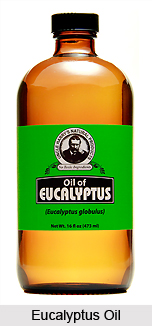 Eucalyptus is one of the most commonly used essential oils. Eucalyptus is grown in southern Europe, North Africa and Australia. Only 15 of its many varieties are used to make essential oils. Eucalyptus oil has a pungent taste with heating and moisturizing energies. It acts as diaphoretic, decongestant, stimulant, antiseptic, antispasmodic, alterative, diuretic, expectorant, antipyretic and regenerative. These properties lower blood sugar, disinfects the air, increases concentration, and acts as deodorant and germicidal. Eucalyptus is one of the most commonly used essential oils. Eucalyptus is grown in southern Europe, North Africa and Australia. Only 15 of its many varieties are used to make essential oils. Eucalyptus oil has a pungent taste with heating and moisturizing energies. It acts as diaphoretic, decongestant, stimulant, antiseptic, antispasmodic, alterative, diuretic, expectorant, antipyretic and regenerative. These properties lower blood sugar, disinfects the air, increases concentration, and acts as deodorant and germicidal.
It is currently used in many allopathic medical preparations. It is one of the three best oils for use with any respiratory tract problem because the component eucalyptol is mucolytic (it relaxes the flow of mucous). It excretes the eucalyptol out through the lung surface. Even if it is taken internally in a tea form, eucalyptus will very quickly pass out of the body through the lungs, having its relaxing effect to the mucous membranes. As it is inhaled it gives an immediate effect; then again as it circulates out of the body.
It is also wonderful for acne because it reduces oil production and dries the tissue. It is thought to increase insulin production and helps to balance the blood sugar. It also mixes well with the oils like Rosemary, Wintergreen, Juniper, Lavender, Mint, Cedarwood, Citri Nella, Geranium, Tea Tree, Niaouli, Angelica and Elecampane. However, care should be taken while using it and one should not take more than one or two drops a day, internally.
 Benefits of Eucalyptus Oil
Soothes respiratory tract and is helpful in coughs and colds, croup, pneumonia, asthma, tuberculosis, bronchitis, sinusitis and influenza.
Useful in cases of cystitis.
Reduces temperature in illnesses such as measles, typhus and malaria.
Good for neuralgia and migraine headache.
Good for rheumatic conditions.
Useful in diabetes.
Very effective against cavities, dental plaque and gingivitis.
Can be used for treating fever and reducing body temperature.
Removes exhaustion and mental sluggishness and creates a cooling and refreshing effect.
Used as a fragrance component to impart aroma in soaps, detergents, lotions and perfumes.
Caution about Eucalyptus Oil
Eucalyptus oil should not be taken by mouth or applied to the skin full-strength. It must be diluted for safety.
|





