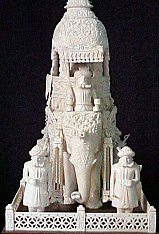
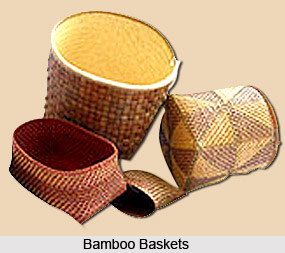
Madhya Pradesh has a rich tradition of crafts, which have undergone transformations since its origin but still has a distinctive creative touch and stands out from the rest of the lot. The crafts of Madhya Pradesh have attained a commercial proportion and are available in emporiums and shops around the country.
History of Crafts of Madhya Pradesh
Madhya Pradesh is the cradle of ancient craft in India. Since centuries the region witnessed a rich amalgamation of art, tribal culture, and tradition. This age-old treasure has stitched up the artistic tapestry of Madhya Pradesh. Arts and crafts of Madhya Pradesh can be traced back to 35,000 years in countless prehistoric paintings and medieval temple sculptures. The sculptures of Khajuraho and Jai Vilas palace exemplify the exquisite stone crafts of the region. Other ancient crafts of the state include embroidery, weaving, jewellery making, etc.
Stone craft
Stone craft is a popular craft of Madhya Pradesh. It is usually done on a lovely green stone to make small items like animal figures, boxes, trays etc. However, it is more often used for making images of gods and goddesses.
Leather craft
Another craft variety is the leather work out of which a variety of products are made. Chanda was earlier famous for the red leather embroidered with gold, with occasional spell of coloured silk. Rhinoceros skin was used to make shields and the carvings were copied from structures such as palaces and mosques. Gwalior, Indore, Bilaspur and Dewas are famous for making shoes, jutties and bags.
Glass craft
The carvings on glass surface are another form of craft. The designs consist of leaves, creepers that are distinctly tribal in essence. The glass tumblers are attractively made and come in a wide range.
Papier – mache craft
Madhya Pradesh is known for papier - mache items and Ujjain is a main center for this product. Craftsmen from Bhopal and Gwalior possess the skill to make statues of birds, animals and decorative panels. The products are attractive and realistic.
Lac craft
The craftsmen of the Rewa and Indore region are known for making intricate lac jewellery. Ornaments like chokers, earrings, rings, hair ornaments and large octagonal bead chains are made in traditional styles. The `lauang kasauthi` is a traditional jewellery of Madhya Pradesh. It is actually an attractive anklet of clove shaped beads all cast in one piece.
 Doll making craft
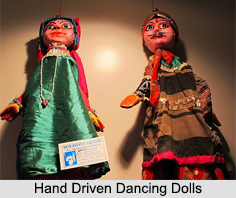
Gwalior is specialized in making rag dolls. The dolls are well decorated and ornamented. These dolls are popularly called battubai dolls and the dolls are dressed in a traditional manner. A new entry in the world of crafts in Madhya Pradesh is the leather toy mainly animals. Real skins of animals are stuffed and given a very realistic anatomy, which is the major attraction of the craft.
Weaving craft
Weaving is a traditional craft of Madhya Pradesh and the state is famous for a special variety of saree called Maheshwari saree, which originated in Maheshwar. It is a cotton saree, which is either plain or has stripes or checks with several variations. A specialty of the Maheswari saree is that it has reversible borders because of which there is no `wrong` side. In local language it is called bugdi. The borders have floral designs; the best among the lot is the karnaphool pattern. Today these sarees are woven in cotton, artificial silk and pure silk. Chanderi near Gwalior is famous for producing Chanderi sarees, where the silk is used as the warp and the cotton as the weft.
The bandhanis of Madhya Pradesh have their own distinct style. The most common bandhani design is the chains of grains represented by dots on the body called dana pattern while there are elaborate designs on the borders and pallus. Tarapur, Umedpura and Bhairongarh are famous for bandhani works. The craftsmen of Madhya Pradesh are also known for producing tassar silk and handloom fabrics. Printed textiles of Madhya Pradesh are as refined as the weaving. Rogan printing, screen-printing, etc. are practiced in the Malwa region for printing on fabrics. The important places where this craft is practiced are Jawad, Bhairongarh, Tarapur, Umedpura and Sheopur.
Durries in Madhya Pradesh are mainly manufactured in Jobat and Tipgaon. Weaving in Jobat is done on pit looms with panja. The durries of Madhya Pradesh are very colourful and attractive.
Embroidery craft
The dexterity and the artistic skill of the craftsmen are also well reflected in a variety of zari-embroidered articles. There are zari wall hangings, handbags, saris and splendid brocade borders. Although this craft is on the verge of decay, Bhopal still remains an important center for this specialized embroidery.