


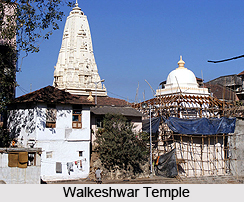
 Walkeshwar Temple is an ancient shrine nestled in Walkeshwar in the city of Mumbai. It is situated in Walkeshwar Road, close enough to Malabar Hill. Also called the Baan Ganga Temple, this holy shrine is dedicated to Lord Shiva. The Portuguese destroyed Walkeshwar Temple during their rule of Mumbai in the 16th century. A Mumbai businessman and philanthropist, Rama Kamath, (a Saraswat Brahmin, known as 'Kamati' in the British era) rebuilt it in 1715. It has been thoroughly reconstructed ever since. Prominent Saraswats and the Mumbai Municipal Corporation look into the maintenance of the Walkeshwar Temple on a regular basis. Walkeshwar Temple is an ancient shrine nestled in Walkeshwar in the city of Mumbai. It is situated in Walkeshwar Road, close enough to Malabar Hill. Also called the Baan Ganga Temple, this holy shrine is dedicated to Lord Shiva. The Portuguese destroyed Walkeshwar Temple during their rule of Mumbai in the 16th century. A Mumbai businessman and philanthropist, Rama Kamath, (a Saraswat Brahmin, known as 'Kamati' in the British era) rebuilt it in 1715. It has been thoroughly reconstructed ever since. Prominent Saraswats and the Mumbai Municipal Corporation look into the maintenance of the Walkeshwar Temple on a regular basis.
The temple is normally busy during the full moon and at the amavasya (no moon) days. In the earlier days, it had been a favourite with the Malabar pirates, who used to frequent the island in the 16th and 17th centuries. Currently, it is the venue of an annual Hindustani classical music festival, which featured classical singers like Rajan and Sajan Mishra, and santoor maestro Shivkumar Sharma, in their gala in 2005. Legend of Walkeshwar Temple The legend has it that Ram and Lakshman had arrived here in search of Sita. According to the legend, Hindu God Ram had paused at this particular spot on his way to Lanka from Ayodhya, in pursuit of the demon Ravana, who had kidnapped his wife, Sita. He had constructed a lingam (phallus representing Shiva), made of sand, having been tired of waiting for his brother, Lakshman to bring a lingam for puja (worship). The name is derived from the Sanskrit name for an idol made of sand- Valuka Iswar. There was no availability of fresh water in that area, so, when Ram was thirsty, he shot an arrow and brought the Ganga over there. While this legend unfolds the Ram- Sita story, another legend again unfurls the fact that how Parashuram, fired an arrow, straight from the mainland. However, Walkeshwar Temple's nearness to the sea, the water that feeds the tank here comes from an underground spring at that spot. The attached freshwater Banganga Tank was built in 1127 AD by Lakshman Prabhu, a minister in the court of Silhara Dynasty Kings who ruled Thane and the islands of Mumbai during 810 to 1240 AD. Attractions of Walkeshwar Temple One of the oldest and attractive structures on the site is the Venkateshwar Balaji Mandir, a Peshwa era temple with a wooden canopy, dating back to 1789. Another elegant structure is the Rameshwar Mandir, probably built in 1825. But all of this is in urgent need of repair and cleaning. On its western side of the bank, a branch of the Shri Kashi Math, a famous religious seat of Saraswat Brahmins, is located. Banganga is located at the end of the Walkeshwar Road. It is found in the lane beyond Ghanshyamdas Sitaram Poddar Chowk. Around the Banganga, several shopping spots can be seen, providing excellent opportunity for a tourist to dive in for their favourites. Crawford market is very popular for its fruits and flowers. The Mereweather Road behind the Taj Mahal Hotel has a unique collection of colourful and innovative carpets. The Central Cottage Industries Emporium and Khadi Village Industries Emporium are also located here. |
| |||



Walkeshwar Temple
| Walkeshwar Temple, dedicated to Lord Shiva, is situated in Walkeshwar Road, close enough to Malabar Hill. In the earlier days, it had been a favourite with the Malabar pirates, who used to frequent the island in the 16th and 17th centuries. |
| ||||||||||||||||||||||||||||

