


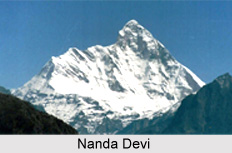
 Nanda Devi, a part of the Garhwal Himalayas is the highest mountain in Uttarakhand and the 2nd highest mountain peak in the country. It is located in the state of Uttarakhand between the Rishiganga valley in the west and the Goriganga valley on the east. The inhabitants of the region consider the peak sacred and the name of the peak literally means "Bliss Giving Goddess". The peak is regarded as the patron-goddess of the Uttarakhand Himalaya. In 1988, Nanda Devi National Park was declared a UNESCO World Heritage Site, "of outstanding cultural or natural importance to the common heritage of humankind". Nanda Devi, a part of the Garhwal Himalayas is the highest mountain in Uttarakhand and the 2nd highest mountain peak in the country. It is located in the state of Uttarakhand between the Rishiganga valley in the west and the Goriganga valley on the east. The inhabitants of the region consider the peak sacred and the name of the peak literally means "Bliss Giving Goddess". The peak is regarded as the patron-goddess of the Uttarakhand Himalaya. In 1988, Nanda Devi National Park was declared a UNESCO World Heritage Site, "of outstanding cultural or natural importance to the common heritage of humankind".
Features of Nanda Devi The Nanda Devi is a two-peaked massif, which forms a 2 km long high ridge in the east-west direction. Perched at an altitude of 7, 817 meters above mean sea level, the Nanda Devi is a rare example of twin peak. The western summit is higher, and the eastern summit is called Sunanda Devi formerly known as Nanda Devi East is the lower one. The peaks are together referred as the "Twin Peaks of The Goddesses Nanda and Sunanda". These goddesses have occurred together in ancient Sanskrit literature "Srimad Bhagvatam" and are worshipped together as twins in the Kumaon, Garhwal and as well as elsewhere in India. The main summit is guarded by a barrier ring which comprises of some of the highest peaks in the Indian Himalayas. In the interior of the ring there is the Nanda Devi Sanctuary, which is guarded as the "Nanda Devi National Park". In the northern side of the massif lies the "Uttari Nanda Devi Glacier". This flows into the Uttari Rishi Glacier. In the southwest there is the "Dakshini Nanda Devi Glacier", which flows in the Dakshini Rishi Glacier. All of these glaciers are located within the Sanctuary and drain in the west direction in the Rishiganga. In the east there is the Pachu Glacier, and to the southeast lie the Nandaghunti and Lawan Glaciers. These glaciers drain into the Milam Valley. To the south is the Pindari Glacier, draining into the Pindar River. Climbing History of Nanda Devi Nanda Devi is known for its steep slopes and therefore only few mountaineers have succeeded in capturing the peak. Owing to the uneven terrain it is difficult for the climbers to reach even the foothills, as the entrance is surrounded by long and deep gorges. The ascent of Nanda Devi necessitated fifty years of arduous exploration in search of a passage into the Sanctuary. However, the symmetry of the peaks is a treat for the eyes, which keeps attracting thousands of tourists every year. |
| |||



Nanda Devi
| Nanda Devi, a part of the Garhwal Himalayas is the 23rd highest independent peak in the world. |
| ||||||||||||||||||||||||||||

