


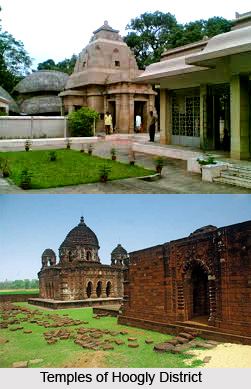
 Hooghly District had been colonized by different civilization from the pre historic times. However the history of the region was recorded from the time it existed to be the kingdom of the Suhmas, a valiant tribe who were the juxtaposition of the Angas, Vangas & Pundras. In Mahabharata, mention of these tribes has been made. The reference of the Suhmas in Mahabhasya of the 2nd century B.C clearly designates the existence of the region in the 2nd century B.C. Hooghly District had been colonized by different civilization from the pre historic times. However the history of the region was recorded from the time it existed to be the kingdom of the Suhmas, a valiant tribe who were the juxtaposition of the Angas, Vangas & Pundras. In Mahabharata, mention of these tribes has been made. The reference of the Suhmas in Mahabhasya of the 2nd century B.C clearly designates the existence of the region in the 2nd century B.C.
In the 3rd century B.C, when Ashoka of the Maurya dynasty rose into power and augmented his expedition, the major part of the region came under his sway, leaving almost none in the control of the Suhmas. The jurisdiction of Ashoka includes the whole area of Bengal, along the Gangetic plains, which even extends upto Tamralipta. However the region with the rest of Bengal was conquered by the successful campaign of Samudragupta and was attached in the territory of the Gupta Empire in the 4th century B.C Being a part of the magnificent Guptas for several centuries, the region suffers a set back and immense loss when Sasanka, the vigorous king of Gaur expedite against the former princes and conquered Bengal, covering the region of present Hooghly. But Sasanka could maintain his kingdom, not for long and in the second half of the same century, Siladitya Harshavardhana became the domineer of whole area of Bengal. But the northern and eastern part of the present Hooghly was under the control of the Sena Kings, powerful in Bengal at that time. The region was under the influence of the indigenous rulers till the 13th century when the Muslim invaded Bengal and established their supremacy suppressing the native rulers. The Muslim supremacy was followed by the gradual uprising of the colonial forces in all over India, including the vast tract of Bengal. The Portuguese, Dutch and French, Danes and the English establish "Kuthis" in the district to serve the purpose of the business. It was the Portuguese, who build up the first port at the bank of the river Bhagirathi-Hooghly at the middle of the 16th century. The district progressively transmuted as the "window" for the foreign settlers. The trading race found the place profitable for carrying out their business allover the country, hence settled here with the latent desire to capture the political power. Chandernagore subdivision was under the French since 1696 to 1950 and the Chinsurah and Serampore sub division were under the influence of the Dutch and Danes respectively. After the Battle of Plassey, when Mir Kasim, according to an agreement donated the zamindari areas of Burdwan, Midnapore and Chittagong to the British East India Company, the English rose into power. Having all the Zamindary areas of Bengal in clutch, it became somewhat effortless for the British to establish their political hold. The British, with the aim to install a firm hold, drive away the other races, formerly controlling Bengal. Consequently the areas around the Hooghly district, which was once used to be a transaction seat for the Portuguese and the Dutch, continued to exist within the territory of the British. For administrative conveniences the district of Burdwan was split into two parts in 1795.The northern division being called Burdwan and the southern part came to be identified as Hooghly. The Bengal Presidency was divided into 14 subdivisions at that time of which Hugli was one. Hooghly became separate Collectorate in the year 1822 and Mr.W.H Belli was appointed as the first Collector. However the Collectorate came to be functioned as the separate district only after the independence. |
| |||



Home > Travel > States of India > West Bengal > Districts of West Bengal > Hooghly district > History of Hooghly District
History of Hooghly district
| The rich history of Hooghly unveils the verity that the district was a suitable trading site for fetching settlers. |
| ||||||||||||||||||||||||||||

