Hill Myna, Bird - Informative & researched article on Hill Myna, Bird
  Indianetzone: Largest Free Encyclopedia of India with thousand of articles Flora & Fauna


in  
Art & Culture | Entertainment | Health | Reference | Sports | Society | Travel
Forum  | Free E-magazine
Flora & Fauna : Indian Birds l Indian Animals l Indian Flowers l Indian Reptiles l Indian National Parks l Indian Shrubs l Indian Tress l Bird Sanctuaries in India l Indian Herbs l Indian Plants l Indian Medicinal Plants l Indian Flora and Fauna l Indian Biosphere Reserves l Indian Wildlife Sanctuaries l Indian Fruits l Indian Wildlife
Home > Reference > Flora & Fauna > Indian Birds > Hill Myna
Hill Myna, Bird
The Hill Myna or Gracula religiosa as it is scientifically called is known for making loud shrill descending whistles.

Hill MynaThe Hill Myna is a member of the starling family, which resides in the hill regions of South Asia. The myna resides in the lower Himalayas from Kumaon, India extending eastwards in Sikkim, and Arunachal Pradesh. It is also found in Thailand, Indonesia and parts of Southeast Asia.

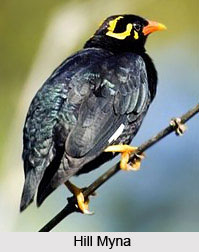
The Hill Myna lives in the trees moving in large noisy groups. It has a stocky jet-black body with bright yellow patches of naked skin and fleshy wattles on the side of its head, the backside of the neck and under the eye. This distinguishes the Hill Myna from the Common Myna or the Bank Myna. It is about twenty-nine centimeters in length and is somewhat larger than the common Myna. It has green-glossed black feathers with a tinge of purple on the head and neck. There are large white wing patches, which are visible when the bird flies. The bill and the legs of the bird are bright yellow in colour. There is no distinction mark in the male and the female but the adolescent myna has a comparatively duller bill.

This Hill Myna is known for making loud shrill descending whistles, gurgles, and wails which is followed by other calls. It is heard mostly at dawn and dusk when it is found in small groups. The male and the female both make such loud calls and even makes melodious human like calls. Like most starlings, the Hill Myna is omnivorous and feeds on nectar, fruits and insects. The Hill Myna always builds a nest in the hollow of trees. The normal clutch is two to three eggs.

(Last Updated on : 18/10/2010)
  More Articles in Indian Birds
 
Birds Common birds in India Chakravaka
Sarika Indian Roller Great Hornbill
Hill Myna Black crested Bulbul Greater Flamingo
Black Francolin Black Necked Crane Asian Koel
Asian Paradise, flycatcher Green Imperial pigeon Hume`s Pheasant
Great Indian Bustard Blood Pheasant Emerald Dove
White throated Kingfisher Sarus Crane Himalayan Monal
Goshawk Sooty Tern Peafowl
Endangered Species in India Babblers Bee Eaters
Weaver Birds Woodpeckers Waders
Warblers Quails Thrushes
Partridges Iora Flycatcher
Stork Bats Peacock
Recently Updated Articles in Flora & Fauna
  • Indian Tress
    Indian trees are correlated with the immortality and wisdom of the country. The various species of trees are used for several purposes as well as they have medicinal value.
  •  
  • Uses of Rose
    Uses of rose, including rose petals, leaves and the hips, are included cosmetics, culinary practices as well as alternative medicines since antiquity.
  •  
     
  • Natural Vegetation in India
    Natural Vegetation in India includes the Tropical Rain Forests, the Tropical Deciduous Forests, the Temperate Forests and Grasslands, the Alpine and Tundra Vegetation
  •  
  • Indian Birds
    Indian birds are of many types and can be seen throughout the country. Some birds are found only in certain specific regions.
  •  
  • Indian Fruits
    Indian Fruits are of various types and rich in nutritious ingredients. They are considered as the most popular fruits all over the world.
  •  
    E-mail this Article | Post a Comment
    RSS Feeds
    Forum
    Forum on Flora & Fauna

    Free E-magazine
    Subscribe to Free
    E-Magazine on Indian Crafts
     
     
    Hill Myna, Bird - Informative & researched article on Hill Myna, Bird
    Sitemap
    Contact Us   |   RSS Feeds
    Copyright © 2008 Jupiter Infomedia Pvt. Ltd. All rights reserved including the right to reproduce the contents in whole or in part in any form or medium without the express written permission of Jupiter Infomedia Pvt. Ltd.