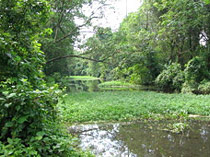
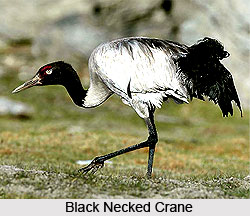
 The Black Necked Crane is scientifically known as Grus nigricollis. It is the inhabitant of open marshlands, wet plains, prairies and occasionally sandy flats. This bird is available in abundance in India and breeds mainly near the high altitude. The Himalayan regions of India serve as a habitat for this bird. The crane has taken the Tibetan Plateau for procreation. In addition to that a small population is found in the adjacent Ladakh, Arunachal Pradesh and Kashmir. As a result, Black necked crane has been designated as the "State bird of Kashmir". It prefers wintering areas of Jammu and Kashmir and Tso Kar Lake, Ladakh. The bird thus is a summer breeder in Ladakh and winter visitor to Sikkim
The areas of China, Bhutan and Vietnam also serve as the breeding ground of Black Necked Crane. It is a large bird with a medium sized whitish-gray body. The adults of the species posses nearly bare red crowns and lores which are thinly covered by black hairlike feathers. The rest of the head and the upper part of the neck are black, except for a small white or light gray spot extending backward from the rear and lower edges of each eye. The tail of this bird is black and the upper tail coverts are grayish. The crane bears black primaries and secondaries. It has yellow eyes and black legs and toes. Though males and females are almost indistinguishable yet males are likely to be slightly larger in size. Younger birds have yellow brown feathers on the crown and a gray abdomen. They also have black primaries and secondaries, the feathers of the back are grayish yellow, whereas black and white feathers alternate on the neck. Juveniles grow quite first and within one year the bird resembles the adult. The bird is around 140 centimetre long, the wingspan includes 235 centimetre or 7.8 feet. The bird weighs around 5.35 kilograms or 12 lbs.
Black Necked Crane is popular as Tibetan Crane in India; however it is also known as `saras` in India. All cranes are omnivorous. Food habit of the crane includes a great variety of animal and vegetable matter. The diet contains grams, berries, small fruits, tender roots, insects, insect larvae, worms and snails. In addition to that the bird takes supplements with small amphibians, reptiles, birds and mammals but very few fish. During winter season the cranes feed on succulent roots and grubs. They fly a long distance from roost-ponds to grain fields to feed, probing and digging their bills into the soft ground. They drink by dipping their bills into the water up to their nostrils; they swallow water after raising their heads.
The estimated population of the Black-necked Crane is between 5,600 and 6,000. This species at present has become an endangered type. The main threat posing its survival is the loss and degradation of their habitat. The species has faced both natural and man- made dangers. In the wintering areas, this problem is most serious, where wetlands are extensively affected by human activity such as irrigation, dam construction, draining, and grazing pressure. High altitude wetland systems depend heavily on water derived from melting snows, since the rainfall in this region is virtually non-existent. Thus, the cranes are subjected to suffering from the unavailability of marshland food, the absence of boggy marshes, and safe nesting sites. However, various measures are being employed to conserve the rare species. Many regions have changed in the traditional agricultural practices and have reduced the availability of waste barley and spring wheat.
Black-necked Crane occupies a special religious position among the Buddhists. This spectacular long-legged bird is associated as harbinger of good luck. These birds are considered to be the symbol of peace and hence several ways and means are undertaken to preserve these birds.