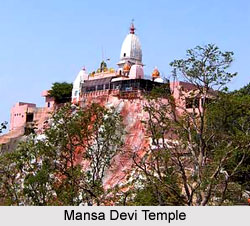
In the state of Haryana, the Mansa Devi Temple is situated in the Bilaspur village, about three kilometers east of Mani Majra in Chandigarh. It has two temples dedicated to the Goddess. According to the popular belief, the ruler of Mani Majra built the older temple. The Mansa Devi Temple at Panchkula exhibits Himalayan culture and faith. There is a shrine located in the foothills of Shivalik. It is an epitome of age-old tradition of Shakti. The present temple is about two hundred years old and stands as a witness to the exciting past of the Shivalik region.
The main temple of these two is dedicated to Devi Manasa. She is worshipped here both in the form of `pindi` (stone pebbles) and in her anthropomorphic form executed on a marble. Devi Saraswati and Lakshmi are also worshipped with Devi Manasa. Originally, the devotees worshipped the `pindis`. Later, in modern times, a marble bust of the deity was sculptured to give an attractive human look to the deity. Crown and other ornaments decorate her beautifully.
Surprisingly enough, the architecture of the main Manasa temple is not in consequence with the Shivalik region. In the Shivalik region a typical Nagara or curvilinear spiral temples were erected. In contrast to these, the main temple manifests a typical Moghul architecture represented by domes and minarets. The temple is built in the Panchayatana pattern with four shrines standing at four cardinal corners and the fifth or the main shrine at the center.

As found in the history, Maharaja Gopal Singh of Manimajra constructed the present main temple during the period 1811-1815. The Raja of Manimajra appointed Pujaris as `Khidmatuzar` to worship the deity. But after the merge of the Princely States into Pepsu, the aid of the State Government ended and the temples remained neglected. Then the Pujaris started controlling and managing the affairs of the temple and the surrounding land attached to the temple. They failed to maintain the temple and provide necessary facilities for the pilgrims, especially during the `Navaratra Meals`. Until the establishment of the Managing Board, the temple and the complex were under huge negligence.
Legend states that the former territory of the princely state of Nahan constituted the shrine. It was some hill people who cut off the stream, which supplied water to the pilgrims visiting the temple. It caused distress to the pilgrims. Thereupon, the Goddess appeared in the dream of Gurbaksh Singh, the ruler of Manimajra and ordered him to build a temple for her on that place.
There are thirty-eight panels of wall paintings in the temple. In addition to these, there are beautiful floral designs painted all over the ceiling and the arches. The drawings are not of a high standard but a great variety of themes are illustrated.
On the other hand, Maharaja Karam Singh of the former Patiala state had constructed the other temple. It was constructed to commemorate his success in the battle against the Gurkha.
(Last Updated on : 7/10/2009)