


 History of Assam appears to be ambiguous. In the ancient Indian epics like Ramayana and Mahabharata, Assam was known as 'Kamarupa' or 'Pragjyotish'. In the Mahabharata, the Puranas, the Tantras there are references of the kingdom known as Kamrupa kingdom. The inhabitants of Assam comprises of the migrants from Myanmar and China who came from Punjab through Bihar and North Bengal. Assam presents a fusion of Mongol-Aryan culture. The renowned king Narakaxura ruled Kamrupa from his capital at Pragjyotishpura. The early history of Assam is believed to be of the Varman dynasty. Among the early sources, there are references of the visit of Hiuen-tsang, who was aChinese traveller came to India in the ancient times had visited the court of King Bhaskar Varman. History of Assam appears to be ambiguous. In the ancient Indian epics like Ramayana and Mahabharata, Assam was known as 'Kamarupa' or 'Pragjyotish'. In the Mahabharata, the Puranas, the Tantras there are references of the kingdom known as Kamrupa kingdom. The inhabitants of Assam comprises of the migrants from Myanmar and China who came from Punjab through Bihar and North Bengal. Assam presents a fusion of Mongol-Aryan culture. The renowned king Narakaxura ruled Kamrupa from his capital at Pragjyotishpura. The early history of Assam is believed to be of the Varman dynasty. Among the early sources, there are references of the visit of Hiuen-tsang, who was aChinese traveller came to India in the ancient times had visited the court of King Bhaskar Varman.
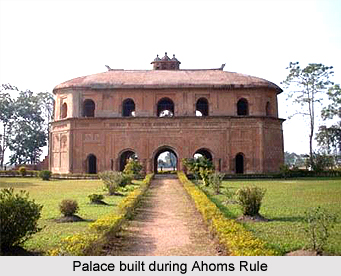
The inscriptions on stone and copper show that the Hindu dynasties ruled over in Assam. The Ahoms (1228-1826) ventured into Assam in about 1228 AD. By 15th century, the kingdoms of Ahoms were established. In 1228 AD the Ahoms (a Shan tribe from which the name Assam is probably derived) crossed the Patkai hills from Myanmar. By the sixteenth century, the Ahoms absorbed the Chutiya and Kachari kingdoms and subdued the neighbouring hill tribes. During the latter part of the sixteenth century, the Ahoms revolted a succession of Mughal invasions. The kingdom of the Ahom reached its height under Rudra Singha. During the latter half of the sixteenth century, the Assamese saint and teacher, Shankara Deva, motivated the Vaishnavites, who wanted to reform the practices of Tantric Hinduism and to limit the privileges of the Brahmins attached to the Ahom Court. Shankara Deva's Vaishnavism appealed to the tribal base on which the Ahom had erected their state because of their denial of caste privilege. Under the leadership of religious leaders, the disaffected population of the kingdom took part in a series of rebellion against the Ahom rule. The leader of this rebellion was Ragha Maran. It is said that his two wives also had participated in the battle. After victory his son, Ramakata became the king. At the request of King Gaurinath Singha the Governor General of British Empire in India, dispatched a mission to the Ahom capital to restore peace. As a result, peace was restored but civil strife persisted. Meanwhile the Burmese in 1817 took advantage of the rebellion within the Ahom nobility. They came at the invitation of the Governor, conspired against the king and killed many in Assam over a period of five years. Fearing danger of extinction in their territory, the British drove the Burmese from the Brahmaputra River Valley, and seized the Ahom kingdom in 1826. In 1838, all of northeast India became part of the Bengal Presidency of British India. The British dismantled the Ahom ruling structure and employed educated Bengali Hindus and made Bengali the official language. The government offered incentives to European entrepreneurs to start plantations as the natives of Assam were rich and hence, unwilling to do plantation labour. The British recruited tribal people from southern part of Bihar, Orissa and Andhra Pradesh. In 1874, Assam was separated from Bengal. It was comprised into a separate province with its capital in Shillong, now the Capital of Meghalaya. In 1905, on the initiative of one of the most prominent British Viceroys of Indiaduring the time of Swadeshi Movement, Lord Curzon, the province was amalgamated with East Bengal following the partition of Bengal into the West and the East. In 1911, the partition of Bengal was nullified, and Assam was made a separate province once more. In the twentieth century, the government of India, offered vast tracts of land to Muslim farmers (from East Bengal) for settlement and cultivation.  People from Nepal were employed as diary workers and were encouraged to colonize new lands. The migration of Indian traders, merchants and small-scale industrialists stimulated capital development in Assam and strengthened its ties to India. As a result, Assam became the fastest-growing region of the Indian sub-continent throughout the twentieth century. It transformed the racial composition of the state and hence diminished the political and economic rights of the native Assamese. As a result, ethnicity and migration have become prominent issues in Assamese politics.
During the Indian Independence in 1947, the Assamese won control of their state assembly and bought forth a campaign to improve employment opportunities for the natives and to reassert the dominance of Assamese culture, which led to the alienation of some tribal districts. Many tribal districts meanwhile demanded for independence from India. Therefore, the Indian Government partitioned Assamese territories into the tribal states of Nagaland, Mizoram, Meghalaya, Manipur and Arunachal Pradesh. The Assamese leaders were completely against this and they saw this as a deliberate division of their constituency. During the Pakistan Civil War in 1971, nearly two million Bengali Muslim refugees migrated to Assam. Their unlawful settlement and their support for Indira Gandhi's Government increased Assamese fear for Bengali cultural domination. In the late 1970s and early 1980s, there were constant disputes between the government and Assamese students over the rights of illegal immigrants to citizenship and suffrage. The natives supported this move and considered it as war for survival against the attack of uncontrolled migration of millions from Bangladesh and elsewhere. The State government and the Central Government of India responded by the use of force to suppress the movement. This became India's worst communal violence since Partition. In 1985, the Assamese (Specially the Bodo tribe) and the Government of India signed a treaty. This was followed by an election in which a student-led government by the Asom Gana Parisad (AGP) party came to power. Constant internal strife and charges of corruption, led to the downfall of the party but they again came to power in 1990. In the 1990's there was a demand for the Independence of Assam from the centralized Indian government by organizations such as the militarized group called ULFA, the United Liberation Front of Assam, an extremist organisation in Assam. Many other groups came up demanding independence. The Indian government responded with widespread use of bizarre force and other measures. There have been many armed encounters between the Indian Army and the ULFA for seeking independence. |
| |||



History of Assam
| In the ancient Indian epics like Ramayana and Mahabharata, Assam was known as `Kamarupa` or `Pragjyotish`. In the Mahabharata, the Puranas, the Tantras there are references of Assam as Kamrupa kingdom. |
| ||||||||||||||||||||||||||||

