


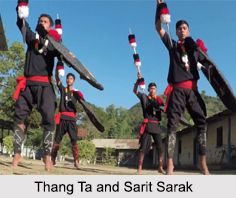
 Part of the Indian martial art of Manipur called the Huyen langlon, Thang Ta and Sarit Sarak are the two main components of this martial art form. Thang Ta is the armed combat, where ‘Thang’ means sword and ‘Ta’ means spear and Sarit Sarak is the unarmed fighting. The method of Sarit Sarak carries the basics that must be learnt by every beginner. These are the same movements that are used later with weapons, but a stripped down version, focusing on fundamentals such as rolling on the floor, footwork, kicks and hits. Part of the Indian martial art of Manipur called the Huyen langlon, Thang Ta and Sarit Sarak are the two main components of this martial art form. Thang Ta is the armed combat, where ‘Thang’ means sword and ‘Ta’ means spear and Sarit Sarak is the unarmed fighting. The method of Sarit Sarak carries the basics that must be learnt by every beginner. These are the same movements that are used later with weapons, but a stripped down version, focusing on fundamentals such as rolling on the floor, footwork, kicks and hits.
Legend of Thang Ta and Sarit Sarak According to legend, the dragon god king named Lainingthou Pakhangba, predestined King Mungyamba, in order to kill the fiend Moydana of Khagi by a sword and spear. Thus, the god constructed the sword and spear at the time of creating the world. This amazing wealth of Manipuri martial arts has been well preserved, since the days of god king Nongda Lairel Pakhangba. History of Thang Ta and Sarit Sarak The origin of Thang Ta and Sarit Sarak can be traced back to the 17th century and both are old ritualistic martial arts of Manipur. The history of martial art form of Huyen langlon originates from hymns and legends. Earlier records state that this sport was not a death duel but usually ended once first blood was drawn. Over the centuries, the sport of Thang Ta and Sarit Sarak evolved as it was modernized and adoption of Christianity killed off much of the native culture, particularly after the Second World War. This art form also survived at the time of the integration of Manipur with the Indian Union in the year 1949. The art was displayed in festivals and performance platforms out of the country since 1976. The people of Manipur not only excelled in the use of weapons but also they were trained well in the unarmed warfare of Sarit Sarak. Currently, Thang Ta and Sarit Sarak has been promoted as a sport all over India and as a self defence tactical subject practiced by both men and women. It is most often seen through demonstrations in cultural programs. Training of Thang Ta and Sarit Sarak To indulge in the form of Thang Ta and Sarit Sarak, the participants require a great deal of dexterity and practise. This is needed to perform the elaborate and precise rituals of the battle craft of Thang Ta and Sarit Sarak, as it involves spears, swords and shields. Thang Ta can be practiced in mainly three ways; ritual, demonstration and combat. It also shares a connection with certain war dances, often blurring the line between dance and combat forms, such as thangkairol or sword dance and khosarol or spear dance. While practising Thang Ta, each participant was to be trained perfectly in the special form of unarmed war called Sarit Sarak. This unarmed form of combat is so effective that the most offensive and evasive moves are very much effective to check any form of attack without or with weapons. The martial art form of Thang Ta and Sarit Sarak has its roots in the history and culture of the north eastern state of Manipur and is one of the popular sports in the state. |
| |||



Thang Ta and Sarit Sarak
| Thang Ta and Sarit Sarak are two of the main aspects of the Manipuri martial art form of Huyen langlon, where Thang Ta is the armed combat with spears, swords and shields and Sarit Sarak is the unarmed fighting. |
| ||||||||||||||||||||||||||||

