Pallanguli, Indian Traditional Sport - Informative & researched article on Pallanguli, Indian Traditional Sport
  Indianetzone: Largest Free Encyclopedia of India with thousand of articles Traditional Sports


in  
Art & Culture | Entertainment | Health | Reference | Sports | Society | Travel
Forum  | Free E-magazine
Traditional Sports : Traditional Indian Sports l Traditional Games l Playing card in India l Kabaddi l Gatka l Kho-Kho l Archery l Naga Wrestling l Polo in India l Shooting in India l Wrestling in India l Kambala l Chaturanga l Indian Traditional Sports Tournaments l Management of Indian Traditional Sports l History of Traditional Sports in India
Home > Sports > Traditional Sports > Traditional Indian Sports > Pallanguli
Pallanguli, Indian Traditional Sport
Pallanguli is a game of women, mostly played by the women of Tamil Nadu and Sri Lanka. Pallanguli may also be known as a number game.

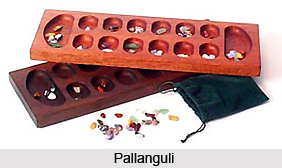
PallanguliPallanguli is a game played mostly played by Tamil women, both in Southern India and Sri Lanka and it is known as the number game. Men also sometimes play it for gambling purposes. The board has 14 cups, each player controlling seven.

In this game six seeds are placed in each cup. The player starting first, picks up the seeds from any of her holes and, moving anti-clockwise, places one seed in each hole. If she reaches the end of her cups she goes on the other side of the board. When the player drops her last seed, she takes the seeds from the next cup and continues placing them in this way. If the last seed falls into a cup with an empty cup following it, the player captures the seeds in the cup. That player then continues play from the next cup containing seeds. If the last seed falls into a cup with two empty holes beyond, she captures no seeds and her turn is over. The next player continues play in the same way. If, after having a seed dropped into it, a cup contains four seeds, those become the property of the player who dropped the seed. The round is over when no seeds remain.

Once the first round is over, players take the seeds from their stores and fill as many of their holes as possible with seeds. The winner will have a surplus of seeds, which are kept in his store. The loser of the first round will be unable to fill all of his holes. These unfilled holes are marked as "rubbish holes." In the next round play continues as before, but without the rubbish holes being included and the player who went first in the previous round going second. During the game if a player has enough seeds to fill any of his rubbish holes, they are again used during play. The game is over when a player is unable to fill any cups with six seeds at the end of a round.

(Last Updated on : 7/01/2011)
  More Articles in Traditional Indian Sports
 
Thoda Kalari Payattu Chaupar
Pallanguli Gilli Danda Asol Aap
Vallamkali, Boat Race Gella - Chutt Hiyang Tannaba
Inbuan Insuknawr Kang Shanaba
Lamjei Mallakhamb Mizo Inchai
Mukna Thang-Ta and Sarit-Sarak Yubee - Lakpee
Sagol Kangjei Jallikattu Aivarnaatakam
Carrom in India    
Recently Updated Articles in Traditional Sports
  • Rules of Bridge
    Rules of bridge have been formulated to make the game more advanced and appealing to the players.
  •  
  • History of Bridge
    History of Bridge has a long story that began in the 1900. The name Bridge may have been derived from the Russian card game Biritch which is not in vogue now.
  •  
     
  • Contract Bridge
    Contract bridge is played with the standard deck of 52 playing cards. Four players can play this game with two competing partnerships, where partners sit opposite to one another around a table.
  •  
  • Bridge
    Bridge is a popular card game and is divided into many important types.
  •  
  • Kho-Kho
    Kho-Kho is a traditional Indian sport where the participants chase and catch their opponents in order to win the game.
  •  
    E-mail this Article | Post a Comment
    RSS Feeds
    Forum
    Forum on Traditional Sports

    Free E-magazine
    Subscribe to Free
    E-Magazine on Indian Crafts
     
     
    Pallanguli, Indian Traditional Sport - Informative & researched article on Pallanguli, Indian Traditional Sport
    Sitemap
    Contact Us   |   RSS Feeds
    Copyright © 2008 Jupiter Infomedia Pvt. Ltd. All rights reserved including the right to reproduce the contents in whole or in part in any form or medium without the express written permission of Jupiter Infomedia Pvt. Ltd.