





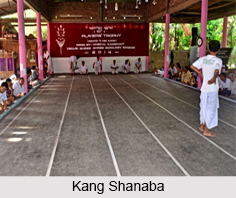
 The game of Kang Shanaba is played during the period between the Manipuri New Year and the Kang Chingba festivities. It is an indoor game, which is played by both the males and females of the Meitei community on the mud floor of a mandap. The game of Kang Shanaba is played during the period between the Manipuri New Year and the Kang Chingba festivities. It is an indoor game, which is played by both the males and females of the Meitei community on the mud floor of a mandap.
Origin of Kang Shanaba According to the Manipuri people, the indigenous game of Kang Shanaba was played by their deity Panthoibi. It is also believed that the Manipuris began to play this game well before Vaishnavism came to Manipur. The word Kang means a circular object and throwing it is known as Kang Shanaba. As per the people of Manipur, Kang is symbolic of the ‘Field of Life’. Sport of Kang Shanaba There are two teams with seven players on either side representing the seven days of the week. The chekphei and lamtha kangkhul are 15 per side and the two teams together represent the 30 days of a month. The first chekphei signifies darkness and the second chekphei a day. As and when the play begins, the lamtha has to be thrown by each player in their own area called kangkhul and in the right direction. Once the kang crosses the last boundary, it means the boundary of life has been crossed. And the player responsible for this is considered dead or shiba. The game is played on a rectangular court, which has an outer and inner line of 42 ft in length and 16 ft in breadth. Outer line is called lamtha kangkhul and has seven target points whereas the inner line, called chekphei kangkhul has eight target points. Kang is played over a span of 4 hours with a break of 5 minutes. At the end of 2 hours and 15 minutes, the teams interchange sides. Each player has his individual kang and they cannot use others kangs, exception is granted if referee decides so. In chekphei, player throws from standing position and in lamtha from sitting position to hit the target. In lamtha, if a player hits the target, he or she can throw again. This is called Marak Changba. Points are scored when the kangkhul or target point is hit by two chekpheis and a lamtha continuously. Depending upon the number of throws and the frequency of the players hitting the target, the score is measured and the player with the maximum hits is declared the winner. Presently, the game of Kang Shanaba is played in several tournaments throughout the year. Rules and regulations have been modified to suit the improved process of the game. |
| ||||||||||||||||||||||||||||

