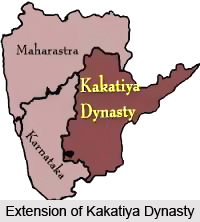
 Kakatiya Dynasty was an empire of Southern India that dominated over those areas, which constitutes of present day Andhra Pradesh, during 1083CE to 1323CE. Kakatiya Dynasty has been acclaimed to be one of the great Telegu empires that had survived for several centuries. As per the experts, the rulers of Kakatiya had the belonging to the Durjaya family or clan. The rise of Kakatiya dynasty has been traced to the rule of Western Chalukyas. A `subordinate` of Amma II, namely, Kakartya Gundyana had laid the foundation of Kakatiya Dynasty.
Etymology of Kakatiya Dynasty
Some experts tracked down the possibilities from where the Kakatiya Dyansty might have derived its name. Either the Kakatiya Dyansty got its name from a town called Kakatipura, with whom Kakatiya kings were closely associated or it might have been taken from the deity Kakati.
Rulers of Kakatiya Dynasty
Prola II is one of the kings of this Kakatiya Dynasty. He dominated during 1110 A.D. to 1158 A.D., extending his influence to the south and acknowledged his independence. His successor Rudra ruled during A.D.1158 to 1195. He is also a renowned ruler in Kakatiya Dynasty. He stretched the empire to the north as far as the `Godavari delta`. In order to serve as a second capital, he constructed a fort at Warrangal.
The next king of Kakatiya Dynasty was Mahadeva; he made an extension of empire up to the coastal region. Ganapati, another king of Kakatiya Dynasty, came after him. He was the supreme one amongst all the other rulers of Kakatiya Dynasty. There is another reason for which this ruler of Kakatiya Dynasty has gained recognition as after the Satavahanas, Ganapati played the pioneering role of consolidation of the whole of the Telugu region under one rule. It was due to his capability that order has been established in the huge kingdom. Trade practices also had been promoted by this ruler of Kakatiya Dynasty.
 The succeeding phase of the Kakatiya Dynasty is quite remarkable. Since Ganapati did not have any son, his daughter Rudramba ascended the throne and took the charge of the kingdom. She ruled in A.D 1262. Amongst the generals who disliked of being dominated by Rudramba, broke up into rebellion. However with the aid of some of the regal subordinates, this ruler of Kakatiya Dynasty suppressed all forms of disputes brought about due to domestic insurrections and also foreign intrusions. Even the Yadavas and Cholas faced tremendous blows from Rudramba.
The grand successor of Rudramba is Prataparudra. This king of Kakatiya Dynasty came to power in A.D.1295. His domination continued till A.D.1323. Under his rule, the Kakatiya Dynasty saw extension of the western border till Raichur. On his initiative, certain administrative reforms have been introduced. For instance, he segregated his empire into seventy five `Nayakships`. Later the `Rayas of Vijayanagara` took in the Nayakships and made them grow to a great extent. During this time the Muslims invaded this empire of Kakatiya Dynasty comprising of Andhra Pradesh for the first time.
Decline of Kakatiya Dynasty
The Delhi Sultan Ala-ud-din Khilji, the famous ruler of the Delhi Sultanate sent an army for plundering the empire in A.D.1303. Upparahalli, a place in the district of Prataparudra overpowered them. In A.D 1310, Malik Kafur sent another army for invading Warangal. At that time Prataparudra had agreed to give a huge homage. Ala-ud-din Khilji passed away in A.D.1318 and afterwards Prataparudra stopped paying tribute further.
Another invasion of Muslims also took place in the Kakatiya Dynasty. In order to capture the `Tilling`, Ghiaz-ud-din Tughlaq, the famous ruler of Tughlaq Dynasty sent out a huge army under Ulugh Khan in A.D.1321. He laid cordon to Warangal. However after facing blockade due to some internal rebellions he withdrew and went back to Delhi. He came back only after a short while with a huge army and Prataparudra put a gallant fight against them. After his surrender Prataparudra had been taken as prisoner. On his way to Delhi he passed away. This marked the end of the Kakatiya Dynasty.
Contributions of Kakatiya Dynasty
The rule of Kakatiya Dynasty has been regarded as the most promising period of the history of Telugu. Apart from managing the kingdom, the rulers of Kakatiya Dynasty also gave patronage to the Art and literature. Also due to the initiative of Kakatiya Dynasty, the language of Sanskrit had seen revival. Prataparudra even promoted other literature as well.
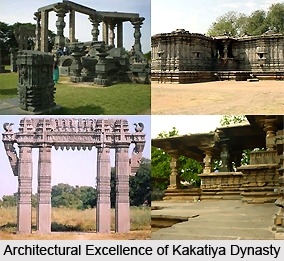
Kakatiya Dynasty is extremely rich in religious art. The temples of Kakatiya Dynasty were built in commemoration to Lord Shiva. In fact these are the examples of perfect blending between the styles form of northern and Southern India, which also molded the political scenario of the erstwhile Deccan areas.