


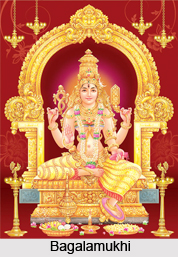
 Bagalamukhi is one of the ten Mahavidyas who smashes the devotee's misconceptions and illusions by her cudgel. Bagala Puja is performed as Vedic ritual. It is performed to defeat the enemies. The power of the enemies decrease and they become helpless. Energized or 'Abhimantrit Bagala Mukhi Yantra' is used for the same purpose and it protects the worshipper from the enemies and the evils. The name literally means 'crane faced', though it is a misnomer. The name 'Bagala' is a distortion of the original Sanskrit root 'Valga'. The goddess has a golden complexion, wearing yellow color dress and a crescent moon decorates her head. She is seated in a golden throne in the midst of an ocean of nectar full of yellow lotuses. Bagalamukhi is one of the ten Mahavidyas who smashes the devotee's misconceptions and illusions by her cudgel. Bagala Puja is performed as Vedic ritual. It is performed to defeat the enemies. The power of the enemies decrease and they become helpless. Energized or 'Abhimantrit Bagala Mukhi Yantra' is used for the same purpose and it protects the worshipper from the enemies and the evils. The name literally means 'crane faced', though it is a misnomer. The name 'Bagala' is a distortion of the original Sanskrit root 'Valga'. The goddess has a golden complexion, wearing yellow color dress and a crescent moon decorates her head. She is seated in a golden throne in the midst of an ocean of nectar full of yellow lotuses.
There are two descriptions of the Goddess found in different texts and she is depicted as 'DwiBhuja' (two-handed) and the 'Chaturbhuja'(four handed). The Dwibhuja form of the Goddess is more common, which is considered as 'Soumya' or milder form. She holds a sharp club in her right hand with which she beats the demon, while pulling his tongue out with her left hand. This form of Devi is interpreted as an exhibition of 'Stambhana' (the power to stun or paralyze the enemy into silence). Bagala Mukhi's followers worship her to get the boon of stunning the enemies. Other Mahavidya Goddesses are also thought to represent similar powers, which are used to defeat the enemies and the powers are invoked by worship and rituals observed by the devotees. There is one legend behind the origin of Goddess Bagala. Once in the ancient period a devastating storm broke through. As the storm threatened the existence of all the creatures, the Gods assembled in the Saurashtra region of India. There goddess Bagala emerged from the 'Haridra sarovara'. The other gods appeased her by prayers and she calmed down the storm. A demon named Madan underwent a tough penance and got the boon of 'Vak Siddhi', by which anything he said came about. He abused this boon by harassing innocent people. The Gods worshipped Bagala Devi to free them from the rampage of the demon. The Goddess appeared and stopped the demon by holding his tongue and stilling his speech. She was about to kill the Demon but he asked her pardon. Henceforth the Demon is depicted with Goddess Bagala. Major temples dedicated to the goddess are situated in the Himachal Pradesh, Assam and Madhya Pradesh. Sadhana of Bagalamukhi is considered as life's greatest achievements. |
| |||



Home > Society > Indian Religion > Types of Religion in India > Hinduism Religion > Hindu Goddesses > Bagalamukhi
Bagalamukhi
| Bagalamukhi or Bagala is among ten great Hindu Goddesses or `Dasa Maha Vidya` who is worshipped to defeat the enemies. |
| ||||||||||||||||||||||||||||

