


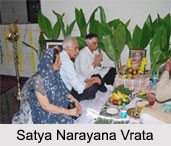
 Satya Narayana Vrata is the most popular amongst the vratas that are prevalent in India. It is the easiest and most inexpensive way of self-purification and self-surrenders in the lotus feet of 'Hari'. It is a religious worship of the Hindu god Vishnu. It is usually done on a full moon day or Purnima of every month. Satya Narayana Vrata is a popular ritual in most parts of India including Karnataka, Andhra Pradesh, Gujarat, Bihar, Bengal, Odisha, Maharashtra, Assam, and Goa. One who observes the vrata with full devotion and faith is sure to fulfil his or her desire. Satya Narayana Vrata is the most popular amongst the vratas that are prevalent in India. It is the easiest and most inexpensive way of self-purification and self-surrenders in the lotus feet of 'Hari'. It is a religious worship of the Hindu god Vishnu. It is usually done on a full moon day or Purnima of every month. Satya Narayana Vrata is a popular ritual in most parts of India including Karnataka, Andhra Pradesh, Gujarat, Bihar, Bengal, Odisha, Maharashtra, Assam, and Goa. One who observes the vrata with full devotion and faith is sure to fulfil his or her desire.
Etymology of Satya Narayana Vrata Satya means "truth" and Narayana means, "The highest being", thus Satya Narayana means "The highest being who is a personification of Truth". Legends of Satya Narayana Vrata Satya Narayana Vrata is first mentioned in Skanda Purana. It is believed that Narada Rishi was a divine saint who used to move in the three world of universe (Triloka Sanchari). When he visited the earth, there was great misery among common people. Unable to find a way to relieve human suffering, Narada at once approached Lord Narayana (Vishnu) and described him the wave of sadness in earth. Lord Narayana said to Narada " O venerable rishi, let people observe the Satya Narayana Vrata in the evening of Sankranti or Purnima. Let them all hear the story (katha) of Satya Narayana. All their miseries will come to an end. There is no doubt of this." Rishi Narada then returned to earth and advocated the glory of Satya Narayana Vrata. There are several stories connected with this Vrata, which speaks about the glory of Lord Narayana and the enormous benefit derived by observing this Vrata. The Story of a Poor Brahmin- There was a poor Brahmin who used to live on alms. Narayana appeared before him in form of an old Brahmin and advised him to observe Satya Narayana Vrata and assured him that he will be free from his poverty. The poor Brahmin acted accordingly and all his desires were fulfilled. The Story of a Wood-cutter- The same poor Brahmin then started doing this Vrata in a grand scale. One day a poor woodcutter entered the garden of the Brahmin to drink water and heard the Katha of Satya Narayana with rapt attention. He was also inspired to observe the vrata in his house. He took some prasad and ate it. When he went to the market place and sold the wood he got double price than the usual amount. He immediately purchased the things that were necessary for the vrata and observed it with intense faith and devotion along with his family members. All his desires were fulfilled too. After his death the woodcutter attained the supreme abode of Satya Loka. 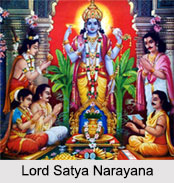
The Story of a Merchant- Once, Ulkamukha and his queen, who were very pious devotee of Satya Narayana were observing fast and performing vrata on the bank of holy river Bhadrasheela. A merchant named Sadhu was passing by then. He came to know about the vrata from the King. When the merchant went home he narrated it to his wife Lilavati. Both took the resolution to observe the vrata and soon were blessed by a girl child. The merchant couple brought up their daughter, whose name was Kalavathi. They thought that they will postpone the vrata till their daughter was married. In course of time Kalavathi got married but the merchant forgot his resolve. He went to foreign countries for business with his son-in-law. Lord Narayana felt that it was high time to remind them of their resolve. One night the merchant and his men were suddenly arrested and imprisoned by the royal police as they were suspected to be thieves. At the same time thieves have stolen all properties of the merchant in his native place. Now Leelavati and Kalavathi were leading miserable life in the streets. One day Kalavathi went to get alms and received the prasad of Lord Satya Narayana from a temple. She came home and persuades her mother to start observing the vrata of Satya Narayana. The very day, the king of Ratnasarpur dreamt that the merchant and his party were not guilty and they should be released immediately, otherwise he would be destroyed along with his families. The king at once released the merchant and his son-in-law and other men from the prison giving them double values of the merchandise. The merchant was way back to his village when Lord Satya Narayana appeared before him in the guise of a mendicant and asked him what he has in the boat. The merchant thought that the mendicant will ask for money, so he answered that there were only bundle of leaves in the boat. That night the merchant found that all his contents in a boat, including the jewelleries, have turned into leaves. He realized that it was due to uttering false to the mendicant. He quickly went out to search the friar and found him in a secluded spot. The merchant begged his pardon. The mendicant reminded him of his promise to observe the vrata. Then Lord revealed his true identity to the merchant gave him words of consolation and disappeared. The merchant came back to his boat and found the bags contained jewels again. He thanked God with intense faith and devotion. After five days the merchant reached his native place. He sent a messenger to inform his wife and daughter about his arrival. At the time when messenger arrived the two women were hearing Satya Narayana Katha. When they finished worshipping, they went to meet the merchant and his son-in-law in a great hurry. Thus they forgot to take the prasad of the lord. Lord Satya Narayana again wanted to point out their carelessness in not taking the prasad. The boat with its wealth along with the son-in -law sank. He was struggling in desperation for his life. Kalavathi went to home hurriedly and took the prasad. When she returned she found that both her father and husband were saved miraculously. Even the boat with the jewelleries was saved. The merchant narrated what had happened during their travel and how the lord saved him when he was in distress. Thereafter, the merchant and his family regularly observed Satya Narayana Vrata during Purnima and Sankranti and happily lived ever after. They attained the blissful abode of Lord Narayana. The Story of King Tungadhwaja- One day, king Tungadhwaja went out for hunting. After walking for a long distance he became tired and took rest under a banyan tree. Some boys of cowherd class were performing the vrata of Satya Narayana nearby. They offered him the prasad but the king refused to neither take it nor prostrate before the lord. When he returned to his kingdom he got the news that his sons and daughters died and the whole property was destroyed. The king at once realized that this was due to the disrespect he had shown to the lord and his prasad. In a repented heart, the king returned to the banyan tree and performed the worshipping of Lord Satya Narayana with great faith and devotion. Lord Satya Narayana showered his grace on the king. The king got back his kingdom and children. Thereafter he observed the vrata regularly and happily led rest of his life. Rituals of Satya Narayana Vrata The Satya Narayana Vrata involves the worshipper to present some wheat, flour and sugar as 'prasad' along with curd and some fruit. The devotee begins by purifying himself or herself. This allows even the poorest to observe this vrata. A lot of people fast throughout the day, but it's not obliged to. A major parallel of this ritual is the narration of the Satya Narayana Katha, consisting of a few stories that speak of the glory of Lord Vishnu and the benefit of observing the vrata. It is believed that devotees who pay attention to these stories with a focused mind and try to learn the moral lessons implanted in them get the blessings of the Lord Satya Narayana. ‘Sirni’ (a special type of food offering) and groundnuts, cashews, cherries, crushed coconuts/ fruits etc, kumkum powder, turmeric powder, rangoli, camphor are also offered along with thirty betel leaves, thirty betel nuts, two coconuts. Five almonds, flowers to present, one thousand tulsi leaves; banana tree as a covering, one square shaped wooden platform, two copper jars, two plates are offered. A mixture of milk, curd, honey, sugar, ghee to make the ‘panchamritam’, sandal paste is also given. The puja ends with an Aarti, which consists of lighting camphor in the area of an image of the Lord. After the puja is over, participants and observers of the puja are required to have the prasad that was offered and blessed by the Lord Satya Narayana. |
| |||



Home > Society > Indian Religion > Types of Religion in India > Hinduism Religion > Hindu Rituals > Vrata > Satya Narayana Vrata
Satya Narayana Vrata
| Satya Narayana Vrata is performed to remember the grace and glory of Lord Narayana through his story or `Katha` and eating his prasad. It is usually performed on a full moon day or Purnima of every month. |
| ||||||||||||||||||||||||||||

