 Pradosha Vrata is a Hindu Vrata for the worship of Lord Shiva and Parvati. This Vrata is based on the mystic psychology of the ancient sages who experienced the evening twilight to be the most efficacious in appeasing the deity. Pradosha Vrata is observed in the evening twilight on the thirteenth day of each lunar fortnight. Hindus, who are especially engaged in the motivated type of worship, select this Vrata, because this is the time when God is in his most pleasant aspect. Pradosha Vrata is observed on every thirteenth lunar day after full and new Moon, by the wife and husband jointly with the hope of being free from, miseries or for gaining material prosperity.
Myths of Pradosha Vrata
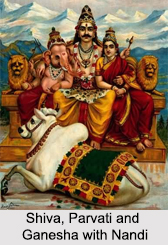
The ancient story behind the Pradosha Vrata is very interesting. When demons repeatedly defeated the Gods in wars, then Gods went to Lord Shiva for his blessings at the time of sunset on the thirteenth day of lunar fortnight. They found him in a blissful company with his consort Parvati. When Gods glorified Shiva with sacred hymns, he was so satisfied that he immediately granted their request. From then, this moment is considered extremely auspicious.
Skanda Purana gives hint of another story of how Shandilya Muni prescribed this Vrata to a Brahman lady. The lady came to the sage with two boys; one was her son Suchivrata and the other was an orphan prince, Dharmagupta. Dharmagupta`s father was killed in a battle and the enemies conquered the kingdom. Shandilya Muni asked the woman and the two boys to do the Pradosha Vrata with great devotion. After some days, Suchivrata obtained a pot of nectar and drank the divine ambrosia. Lord Shiva ordered the celestial king himself to help Dharmagupta to win back his kingdom and defeat his enemies. Then Dharmagupta attained the Lord`s supreme abode. Thus by performing this Vrata one can please Lord Shiva.
Types of Pradosha Vrata
Following are the different types of Pradosha Vrata:
•Nitya Pradosh- It is the evening time on all days, between just 3 ghatis (72 minutes) before sunset and the time when the stars rise or become visible in the sky.
•Paksha Pradosh- It is the Sandhya (evening) time of Shukla Paksha Chaturthi (4th Lunar day after New Moon) of every month.
•Maasa Pradosh- It is the Sandhya Krishna Paksha Trayodashi of (13th lunar day after Full Moon) every month.
•Maha Pradosh- It is the Sandhya time of Krishna Paksha Trayodashi which falls on a Saturday.
•Pralaya Pradosh- The time when the entire universe gets annihilated of merged with Lord Shiva.
Rituals of Pradosha Vrata
To perform Pradosha Vrata, one has to fast on the day and keep vigil at night after the fasting is over. The worshipper first performs a preliminary worship after taking the bath one hour before sunset and worships Lord Shiva together with his family i.e. with Parvati, Ganesha, Skanda and Nandi. After worshipping of Lord Ganesha, Shiva is evoked in a special `Kalasha` placed on a square "Mandala" with a lotus on it and spread over with "Durba" grass. When the formal worship is completed, a Pradosha story is read and heard by the devotees. This is followed by a recitation of "Maha Mrityunjaya Yantra" for 108 times. At the end, the holy water of the sacred "Kalasha" is shared, the sacred ash is applied to the forehead and the water, which was used to bathe the lord, is drunk. At the conclusion a gift of a pot, a cloth and an image of Lord Shiva is given to the Brahmin. Pradosha lasts for 3 muhurtas from the sunset hour.
Significance of Pradosha Vrata
Pradosha is a highly exceptional time in Shiva temples. Pradosha Puja has become very popular across all the Shiva temples. The most important highlights of the Pradosha Puja at temples include "Abhishekam" to Lord Shiva and Nandi (sacred bull) idols, procession of Lord Shiva mounted on Nandi around the temple premises and the chanting and singing at the temples. It is believed that those who observe Pradosha fasting shall be blessed with prosperity, children, peace and happiness in the families. Women who search for to have progeny observe this Vrata so eagerly and are blessed with children.