


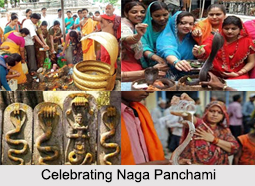
 Naga Panchami is a traditional belief of worshipping snakes or serpents observed by Hindus all over India. According to the Hindu calendar, the ritual is observed on the fifth day of the lunar month of Shraavana which corresponds to the Gregorian calendar months of July or August. Since the day of worship always falls on the fifth day of the moon's waning in Shraavana, the day is called Nag Panchami, where nag means serpent. Naga Panchami is a traditional belief of worshipping snakes or serpents observed by Hindus all over India. According to the Hindu calendar, the ritual is observed on the fifth day of the lunar month of Shraavana which corresponds to the Gregorian calendar months of July or August. Since the day of worship always falls on the fifth day of the moon's waning in Shraavana, the day is called Nag Panchami, where nag means serpent.
Naga Panchami is a Hindu Vrata, which is celebrated during the onset of monsoons and believed to counter the increased possibility of snake biting during this time. Hindus deify snakes and regard them with veneration. The day of Nag panchami is dedicated to snakes and they are worshipped with milk and fruits. Myths of Nag Panchami In the Hindu mythology and ancient folklore, legends or myths are in aplenty narrating the importance of worshipping snakes. Serpents are an inseparable part of Hindu religion and have been mentioned in Holy Scriptures like the Agni Purana, Skanda Purana, Narada Purana and even the Mahabharata. Serpents are associated with some Gods like Lord Shiva, Goddess Manasa etc. ‘Sesha’ or ‘Ananta’ is the thousand headed king of nagas, who forms the couch for Lord Vishnu. Vasuki naga adorns the neck of Lord Shiva like a necklace. According to the Puranic myth, Brahma's son Kashyapa had 4 wives, who gave birth to Gods, Garuda, Nagas and demons respectively. The third wife of Kashyapa was Kadru, who gave birth to Nagas. Nagas are thus also known as ‘Kadrooja’ and are the rulers of the 'Patal Loka'. In Mahabharata, Janamejeya, son of King Parikshita of Kuru Empire performed a snake sacrifice known as ‘Sarpa Satra’, to avenge his father’s death from a snake bite of Taksaka, who was the serpent king. The sacrifice performed in the company of Janamejaya was so powerful that it caused all snakes to fall into the yagna. When the priests found that only Taksaka, who had bitten and killed Parisksihita had escaped to the world of Indra looking for his protection, the sages boosted the tempo of reciting the mantras to drag Taksaka and also Indra. Taksaka had coiled himself around Indra’s cot but the force of the sacrificial yagna was so powerful that even Indra along with Taksaka was dragged towards the fire. This scared the Gods and they appealed to Goddess Manasa for help. She then requested her son Astika to go to the place of the yagna and request to Janamejaya to stop the ‘Sarpa Satra’ yagna. Astika impressed Janamejaya with his knowledge of all the Sashtras and was thus granted a boon. It was then that Astika requested Janamejeya to stop the ‘Sarpa Satra’. The yagna was then stopped and thus the life of Indra and ‘Taksaka’ and his other serpent race were spared. This day, according to the Hindu calendar, happened to be ‘Nadivardhini Panchami’ and since then the day is a festival of nagas. Rituals of Naga Panchami The day of Naga Panchami is observed by worshipping the serpents with milk, sweets, flowers, lamps and even conducting sacrifices. On this day, devotees pour milk into all the holes in the ground around the house or near the temple to satisfy the snakes. Sometimes, a small pot of milk with some flowers is placed near the holes so that the snakes can drink it. The five Nagas worshipped on Nagpanchami are Ananta, Vasuki, Takshak, Karkotaka and Pingala. People visits temples specially dedicated to snakes and worship there. Shiva temples are the most favoured place for worship of Nagas. In South India people sculpt images of snakes made up of cow dung, which are then placed at the either side of the entrance to the house. In some other parts of Southern India, people draw figures of snakes with red sandal wood paste on wooden boards. And on other times clay images of snakes that are coloured yellow or black are purchased. These are then worshipped and offered milk, as snakes are believed to be fond of milk. Some go find the holes of anthills to worship the snakes. On Naga Panchami, snake charmers wander about with their snakes to which people offer milk. They are also offered some money for allowing this serpent worship. In the ‘Ashyalayana Grihasutra’, the ‘Paraskara Grihasutra’ and other ‘Grihasutras’ , a ritual called 'Sarpabali' or offerings to serpents were performed on the full moon night of Shraavana. However, the reason for shifting the actual day of Vrata from full moon day to fifth night of the bright fortnight is may be due to the slight change of time on the onset of the rains. Celebration of Naga Panchami Naga Panchami is observed by both married and unmarried women and girls. Young married women visit their premarital homes for celebrating the festival. On the other hand, unmarried women perform the Naga Panchami in the act of achieving good and loyal husbands. Naga Panchami is observed from sunrise with the devotees fasting the entire day and broken only after sunset. Salt and deep fried foods are avoided during the vrata. The Punjabis celebrate Nag Panchami as ‘Guga Navami’ and is observed by making a huge snake from flour. People generally believe that by observing this vrata, they would be blessed with a long life, fame, wealth and intelligence. The main psychology behind worshipping snake-God in Nag Panchami is people's fear of serpents for which they want to satisfy them to save the life of their family. In Central India, the name of the city of Nagpur is derived from the word Naga which means snakes as the place was infested with them. During the early period, Nagpur was the homeland of the 'Naga' people who embraced Buddhism and supported it with great efforts and propagated it throughout India. In the western part of India, Naga Panchami is known as the Ketarpal or Kshetrapal, meaning, a protector of his domain. Here, the snake is referred to as the Bhujang, which is the Sanskrit name of the snake in the Kutch region. And, in the east and north eastern India, Manasa is worshipped, who is the snake goddess. On the occasion of Naga Panchami, a twig of manasa plant symbolising the goddess is fixed on the ground and worshipped, not only in the month of Shravan but also in the month of Bhadra. The ritual is celebrated with an ardent devotion and fervour among the people all over the country. |
| |||



Home > Society > Indian Religion > Types of Religion in India > Hinduism Religion > Hindu Rituals > Naga Panchami
Nag Panchami
| The Hindu ritual of Nag Panchami worships the snakes or serpents and is significant mainly in the north and eastern states of India. |
| ||||||||||||||||||||||||||||

