


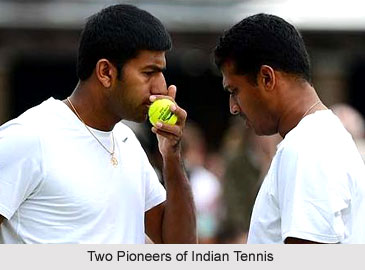
 History of Tennis in India is only two centuries old. Like cricket, the origins of tennis can also be traced to England. History says that tennis in its current form was played in the British nation in 1870s. A decade later, the British Army and Civilian Officers familiarised India with the game. And in no time, tennis tournaments too were being played in the country: "Punjab Lawn tennis Championship' at Lahore in 1885; 'Bengal Lawn Tennis Championship' at Kolkata in 1887 and the All India Tennis Championships at Allahabad in 1910. History of Tennis in India is only two centuries old. Like cricket, the origins of tennis can also be traced to England. History says that tennis in its current form was played in the British nation in 1870s. A decade later, the British Army and Civilian Officers familiarised India with the game. And in no time, tennis tournaments too were being played in the country: "Punjab Lawn tennis Championship' at Lahore in 1885; 'Bengal Lawn Tennis Championship' at Kolkata in 1887 and the All India Tennis Championships at Allahabad in 1910.
Early Years of Indian Tennis As expected, it was the British who dominated the championship in the early years. But along with time, India too began making their presence felt. Mohammad Saleem from Lahore was victorious in the Punjab Championship in 1915 and then did phenomenally well to win successive titles between1919-1926. Saleem's win in seem to inspire other Indians too. 1917 saw NS Iyer crowned winner of Bengal Championship and only a couple of years later in 1919, Mr. Nagu won the singles championships at the All India Tennis Championship at City's Gymkhana Club at Allahabad. The Indians never looked back after that and started dominating tournament after tournament. As time went along, the need for a tennis association was felt and so in 1920, the All India Lawn Tennis Association (AILTA) was formed at Lahore. Laws of the game were prepared keeping in mind those of the Lawn Tennis Association of Britain. Later in that same year, the first AGM of AILTA was conducted at Town Hall in Delhi and it also decided that the 'All India National Championship's would be held at Allahabad annually. AITA decided that each Province should have a Provincial Associations, which will be affiliated to the parent body. These Provincial Associations are today known as State Associations. 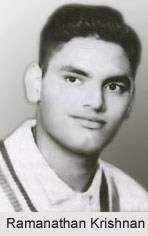 The inaugural Inter Provincial Tournament was held in 1922 with Punjab LTA led by Md. Saleem. The competition became a regular feature in India until the Second World War broke out in 1939. However, the most important decision made by the members was participation in the Davis Cup.
The first set of players to represent India in the Davis Cup in 1921 included prominent names like SM Jacob, Md. Saleem, LS Deane and AA Fayzee. Their performances were so impressive that they ended up beating the Frenchmen and made it to the semi-finals. Indian Tennis in 1900's In fact, from the year 1922-1929 India got the better of a number of strong nations like France, Romania, and Holland, Belgium. Spain and Greece. This was largely due to the efforts of greats like M. Sleem, the Fayzee brothers AH Fayzee and AA Fayzee, Cotah Ramaswamy and Krishna Prasad. India's participation in international tournaments also began in the mid 1900s. BK Nehru was the first Indian to play in the prestigious Wimbledon championship in 1905. In the years to follow, Sardar Nihal Singh, M. Saleem, Fayzee brothers and Jagat Mohan Lal also took part in the tournament. Ghouse Mohd. India's undisputed No.1 reached the quarterfinal at Wimbledon in 1939. Fayzee and M Saleem went on to represent the country in the 1924 Paris Olympics also with Saleem making it to the semi-finals in the singles. India continued to reap rich success repeated success at Davis Cup and as well as Wimbledon. And the world began to stand up and take notice. Once the World War ended, AILTA decided to hold one Grass court championship called the National Championships of India and one Hard Court tournament named All India Hard Court Championships. (Even foreigners could take part in the National Championships.) And so the first Grass Court National Championship was held at Calcutta in 1946. Sumant Misra won the inaugural championship beating Man Mohan Lal. But in the years to follow, the foreigners dominated the tournament. In fact till 1955, S. Misra Dilip Bose and a16-yr-old named Ramanathan Krishnan had captured the crown. There were some big names among the foreigners who won the championship. But Ramanathan Krishnan turned around India's fortuned winning the title for a record eight times in a row between 1953 and 1964. Other Indians to win the prestigious title comprised Premjit Lal, Vijay Amritraj, Jaidip Mukerjea and Ramanathan Krishnan's son Ramesh Krishnan. India was granted the honour of hosting the Asian International Championship in Kolkata (then Calcutta) in 1949-1950. Dilip Bose turned out to be the first Asian Champion. By the 1950s India's performance improved tremendously. Ramanathan Krishnan was crowned the Junior Wimbledon Champion, the first Asian to do so. The 60's belonged to Ramanathan Krishnan, Jaidip Mukerjea and Premjit Lal. Ramanathan Krishnan was seeded 4th in 1962 at Wimbledon. India kept performing well in the Davis Cup winning the Zonal Championships and also making it to the Inter - Zonal finals. Krishnan, Lal, SP Misra and Jaidip (RK Khanna was the non-playing Captain) were instrumental in India making it to the finals in 1966. They failed to capture the trophy but R Krishnan and J Mukerjea's win over New Combe and Tony Roche (Doubles Wimbledon Champions in 1965) was one of the major upsets in the history of the championships. Premjit Lal and Jaidip Mukerjea went on to win the National doubles and Asian doubles Championships four times each. 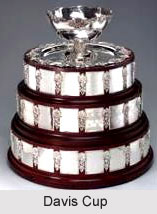 Indian Tennis in 1970's to 1990's
The 1970's saw Vijay Amritraj storming on to the scene. Amritraj along with Shashi Menon, Jasjit Singh and brother Anand Amritraj, helped India reach the World Cup Finals again in 1974. But India did not play South Africa in the Finals due to political reasons. Vijay Amritraj had a reasonable run in the Grand Slam tournaments though he never managed to win any. He made it to the quarterfinals of the US Open in 1973 and 1981 and Wimbledon in 1973 and 1974. Post the Amritraj era, Ramesh Krishnan kept India's flag flying high. Krishnan won both the junior Wimbledon as well as the junior French title in 1979 and climbed to the No.1 ranking in junior tennis. In the years to follow, he entered the quarters at Wimbledon in 1986 and the US Open twice. But like Amritraj before him, could not go all the way. But Krishnan played a pivotal role in helping India reach the Davis Cup finals for a third time in 1987. However, Krishnan played on for a few years before finally calling it quits in 1993. Post Krishnan period in Indian Tennis The exit of Krishnan meant the future of Indian tennis fell on the young shoulders of Leander Paes. And the youngster (a Junior Wimbledon and Junior US Open champion) did not let the country down. He has been exceptionally successful in Davis Cup for India pulling off outstanding victories. Leander has been instrumental in India making it to the qualifying round of the World group time and again. Leander also tasted Grand Slam success as he and compatriot Mahesh Bhupathi combined together. Their greatest achievement was making it to all the four Grand Slam Doubles Finals in 1999. Winning Wimbledon and US Open was more than just the icing on the cake. The duo went on to become the No. 1 doubles pair before splitting. Both continue to play doubles and mixed doubles with different partners and keep adding to their tally of Grand Slam trophies. In the late 1960's, tennis became more professional with Wimbledon and other tournaments offering prize money for the players. To keep up with the changing times, AITA too conducted some Grand Prix tournaments in 1970's but the idea flopped as the prize money was inadequate owing to the lack of funds. In the 1980's the All India Lawn Tennis Association changed its name to 'All India Tennis Association' (AITA). Come 1990's and tennis in India started to look refreshingly professional. Financially, AITA was much more stable and they even built a full-fledged modern National Stadium at Delhi having a capacity of 5000. The Association till then did not have a permanent headquarter, finally got one at the R.K. Khanna Tennis Stadium in 1996. Despite all developments, India has not been able to produce too many stars apart from Sania Mirza. Even she seems to be fading away of late. With Bhupathi and Paes nearing the end of the career, the time has come for youngsters like Rohan Bopanna, Prakash Amritraj and the others to pick up the gauntlet. |
| |||



History of Tennis
| History of Tennis in India is not so old. It is contemporary to cricket and football. |
| ||||||||||||||||||||||||||||

