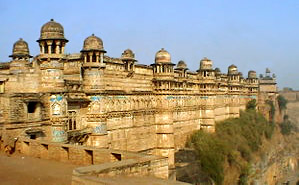
 Gwalior Residency was an administrative unit during the British rule in India. This unit was created in 1782, which continued till India achieved her independence in 1947. It comprised of a number of princely states of Central India. The principal unit was the State of Gwalior along with the states of Rampur and Benares, the Chhabra Pargana(district) of Tonk state the small states of Raghugarh, Khaniadhana, Paron, Garha, Umri, Bhadaura, and the small estates better known as thakurs or diwans of Dharmaoda, Sirsi, Khiaoda, Kathaun, and Agra Barkhera.
The population density of the Residency was 123 persons per square mile which grew to about 3.5 million by 1931. In 1901,this administrative unit consisted of 6820 villages and 16 towns. The chief towns of the unit were Lashkar, Morar, Gwalior, Guna, Bhind, Bhilsa, Narwar and Chanderi. Out of these, Bhilsa, Morena and Guna were the chief trading centres for the sale of grains and Chanderi for the manufacture of fine cloth.
The Treaty of Salbai was signed in 1782 between the British and Maharaja Mahadji Sindhia after which Mr. David Anderson was appointed as the resident of the Gwalior court. Mahadji`s successor Daulat Rao Sindhia fixed the headquarters of the court at Gwalior which was a moving camp until 1810. An important change came about in 1854. Previously, the Resident at Gwalior answered directly to the Governor -General of India. In 1854 the Gwalior Residency was placed under the authority of the Central India Agency. During the 1857 Uprising, the fort of Gwalior was occupied by the rebels which was again captured by the British troops in 1858. In 1888, Khaniadhana state was shifted from the Bundelkhand agency to the Gwalior Residency. In 1895, the districts of the State of Gwalior Bhilsa and Isagarh were transferred from the Central India Agency to the Gwalior Residency. In 1921, the Gwalior Residency was again detached from the Central India Agency and the residents were again responsible to the Governor- General. In 1936, the princely states of Benares and Rampur which were previously part of United Provinces was incorporated in the Gwalior Residency.
The Resident of the court was the means of communication between the ruler and other political officers. The Resident closely monitored the minor holdings of the residency, criminal cases of importance which required his sanction or approval. The seat of administration of the political officer was situated in The Residency, a piece of land spreading over an area of 1.17 square miles. The important highways traversing the Gwalior Residency was the Great Indian Peninsula Railroad, the Gwalior Light Railways and the Agra-Bombay and Bhind-Jhansi high roads.
After India attained her independence in 1947, the Gwalior Residency was abolished. The Gwalior Residency including the state of Gwalior came under the jurisdiction of the Government of India in the new Indian state of Madhya Bharat. The princely states of Rampur and Benares was incorporated in the state of Uttar Pradesh.