Gurmukhi script - Informative & researched article on Gurmukhi script
  Indianetzone: Largest Free Encyclopedia of India with thousand of articles Indian Languages


in  
Art & Culture | Entertainment | Health | Reference | Sports | Society | Travel
Forum  | Free E-magazine
Indian Languages : Languages of India l Origin of Indian Languages l Official languages of India l Indian Classical Languages l Scripts of South India l Indo - European languages l Indian Tribal Languages l Indology l Brahmic family Languages l Indian Spoken Languages l Languages of South India l Linguistic History of India l Indian Language Movements l Indian Regional Languages l Indian Scripts l Amara Kosha l English Language in India l Indian Language Families l Dogri Language
Home > Reference > Indian Languages > Indian Scripts > Gurmukhi script
Gurmukhi script
The second Sikh guru, Guru Angad Dev in the 16th century, designed the Gurmukhi script

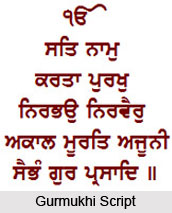
Text of the Mul Mantar, the holiest prayer in Sikhism, written in the Gurmukhi scriptDescending from the Later Sharada script, the Gurumukhi script was designed by the second Sikh guru, Guru Angad Dev in the 16th century for writing the Punjabi language. Gurmukhi is a style of writing called an abugida where each consonant has a natural vowel (a) that can be changed using vowel signs. One thousand four hundred and thirty pages of Guru Granth Sahib are written in this script. The modernized Gurmukhi script has forty-one consonants, nine vowel symbols, two symbols for nasal sounds and one symbol, which is the duplicate sound of any consonant. Gurmukhi has been adapted to write other languages such as Braj Bhasha, Khariboli, Sanskrit and Sindhi.

The name Gurmukhi came from an old Punjabi term `guramukhi` which means `from the mouth of the Guru`. With the penning of the Guru Granth Sahib in Gurmukhi, it became the principal script for the other literary works of the Sikhs. It was in the 20th century that the script was designated as the official script of the Eastern Punjabi language while for the Western Punjabi language the official script was Shahmukhi.

The Gurmukhi alphabet consists of thirty-five distinct letters. The Gurmukhi script has its own set of numerals, which is somewhat similar to the Hindu-Arabic numerals.

(Last Updated on : 9/09/2009)
  More Articles in Indian Scripts
 
Gurmukhi script Islamic Scriptures Jaina Scriptures
Zoroastrian Scriptures Language of Buddhist Scriptures Dharma Sastras
Ashvalayava Grihya Sutra Indus Script Brahmi Script
Kharosthi Script Siddham Script Nagari Script
Scriptural Characteristics in Indus Script Kashmiri Script Assamese Script
Chakma Script    
Recently Updated Articles in Indian Languages
  • Development of Tamil Scripts
    Development of Tamil scripts can be traced to the period just after the reign of Asoka. The Tamil script is believed to have developed from the Brahmi script.
  •  
  • Tamil Scripts
    Tamil ScriptS is used to write the Tamil language and other Dravidians languages. The Tamil script varies from other Brahmi-derived scripts in numerous ways.
  •  
     
  • Maturaikkanci
    Maturaikkanci is a Tamil poetic work which is included in the Pathinenkilkanakku anthology of Sangam literature dating between 100 BCE – 100 CE. It has 782 lines of poetry in the Achiriyappa meter.
  •  
  • Pure Tamil Movement
    Pure Tamil Movement or Thanittamil Iyakkam is a movement of linguistic purism which insisted on avoiding Sanskrit, English and Persian loan-words and attempting to imitate the original Tamil language.
  •  
  • Ancient Tamil Grammatical Works
    Ancient Tamil grammatical works includes Tolkappiyam, the earliest available literary work which was written around 3rd century B.C. There are other grammatical works as well, which precede the Tolkappiyam.
  •  
    E-mail this Article | Post a Comment
    RSS Feeds
    Forum
    Forum on Indian Languages

    Free E-magazine
    Subscribe to Free
    E-Magazine on Indian Crafts
     
     
    Gurmukhi script - Informative & researched article on Gurmukhi script
    Sitemap
    Contact Us   |   RSS Feeds
    Copyright © 2008 Jupiter Infomedia Pvt. Ltd. All rights reserved including the right to reproduce the contents in whole or in part in any form or medium without the express written permission of Jupiter Infomedia Pvt. Ltd.