Western Group Temples at Khajuraho - Informative & researched article on Western Group Temples at Khajuraho
  Indianetzone: Largest Free Encyclopedia of India with thousand of articles Indian Temples


in  
Art & Culture | Entertainment | Health | Reference | Sports | Society | Travel
Forum  | RSS Feeds  | Free E-magazine
Indian Temples : Indian Temples l Arts and Crafts of Hindu Temples l Indian Religious Temples l Churches in India l Mosques in India l Shiva Temples In India l Krishna Temples in India l Hanuman Temples in India l Durga Temples in India l Vishnu Temples in India l North India Temples l Central India Temples l West India Temples l East India Temples l Indian Regional Temples l Indian Temple Managements l Styles of Worship in Indian Temples l Indian Temple Architecture l Indian Temples by Religion l History of Indian Temples l Hindu temples in India l Gurudwaras in India
Home > Reference > Indian Temples > Indian Regional Temples > Madhya Pradesh Temples > Khajuraho Temples > Western Group Temples at Khajuraho
Western Group Temples at Khajuraho
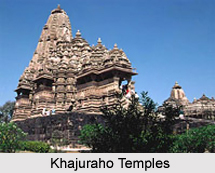
Western Group Temples at Khajuraho includes most significant and also the most magnificent of temples.

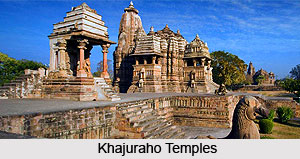
This group consists of the most significant and also the most magnificent of temples at Khajuraho. Built by the royalty themselves, they are now within an enclosure and a garden maintained by the Archaeological Survey of India. The temples are open to the public from sunrise to sunset and tickets cost a nominal amount. They are briefly described below, as they appear, in clock-wise order.

Devi , Khajuraho: This small structure faces the Lakshmana temple. It now contains an image of the goddess Brahmani, but originally it housed Vishnu`s mount Garuda, the solar bird.

Varaha (Boar), Khajuraho: The Varaha image dates to about AD 950 and was possibly installed by the Chandella king Yashovarman as a celebration of victory over his Pratihara overlord.

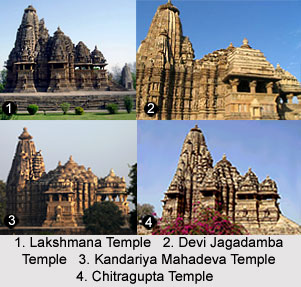
Lakshmana Temple , Khajuraho: The Lakshmana temple is a five-shrined or panchayatana complex and stands in the centre of a high platform along with its four subsidiary shrines in the corners.

Kandariya Mahadeva Temple, Khajuraho:One of the greatest monuments in India this cave-like temple gets its name from the word kandara (cave). This is the tallest temple at Khajuraho; with a height of 30.5 m. King Vidyadhara possibly built it, in about AD 1030, after his successful combat with Mahmud of Ghazni.

Mahadeva Temple , Khajuraho: On the same platform as the Kandariya Mahadeva, towards its north, lies this partially preserved structure, now called Mahadeva. A favourite theme in Chandella and other Rajput art, a sculpture of a Lion and Warrior, is housed here.

DeviJagadambaDevi Jagadamba: This temple, to the north of the Kandariya Mahadeva and on the same platform, was originally dedicated to Vishnu and was built between AD 1000-1025.. This is deduced from the central image of this god on the door header of its sanctum. However, the temple now enshrines an image of the Devi (Goddess), who is worshipped by the local people on festive occasions. In the mid nineteenth century, the Maharaja of Chhatarpur added a Yajna Kunda, meant for performing rituals. The temple is known for the graceful figure sculptures of mithunas, apsaras, vyalas, and images of deities on its exterior wall.

Chitragupta , Khajuraho: The only temple dedicated to the sun god on this site, the Chitragupta temple was built between AD 1000-1025.

Chopra Tank , Khajuraho: A little distance away from the Chitragupta temple, outside the fence of the western group of temples, is a small water tank, called the Chopra tank. It is a three-storeyed stepped tank. It is associated with the healing of diseases.

Parvati TempleParvati: Situated towards the east of Chitragupta temple, the Parvati temple is a small shrine, now ready for visitors after undergoing heavy restoration. It now houses an image of the goddess Parvati standing on an iguana but the sanctum door has a Vishnu in the centre.

Vishvanatha , Khajuraho: After the Lakshmana and the Kandariya Mahadeva, another prominent temple known for its grandeur is the Vishvanatha temple.

Statue of Bhairava: Outside the fenced enclosure, on the way to the Matangeshvara temple and on one`s right, under a tree, is a colossal statue of Bhairava, 1.98 m. (6.5 ft.) high and it belongs to the early-tenth century.

Matangesvara TempleMatangeshvara: One of the very few temples in Khajuraho that is still used for worship, the Matangeshvara stands outside the fenced enclosure, on the south of the Lakshmana temple, and close to the bank of the Shivasagar tank. The Matangeshvara or the Mrityunjaya Mahadeva temple has one of the largest lingas in India 2.53 m. (8.3 ft.) high and more than one meter in diameter. The roof of the Matangeshvara temple is pyramidal in structure and there is no sculptural decoration. This temple is dated to c. AD 1000. During Shivaratri, a festival sacred to Shiva, devotees bathe in the Shivsagar tank and then proceed with a water pot to the Matangeshvara temple for worship.

Chausath Yogini , Khajuraho: Towards the southwest of the Shivsagar tank, it is located this unique open-air sanctuary away from the main group of temples. It was dedicated to the sixty-four Yoginis, believed to be manifestations of the Great Goddess.
Lalguan Mahadeva: This small shrine, dedicated to Shiva, is situated on the bank of the Lalguansagar lake, about half a kilometre from the Chausath Yogini sanctuary. Facing west, it is based on a simple plan, comprising a sanctum and a porch, which is now missing. The sanctum is covered with a pyramidal shikhara (partly preserved). The doorway is plain, with only a diamond design carved on the doorsill.

Shivasagar-TankShivsagar Tank: Called `Sevamsagara` in inscriptions, the Shivsagar tank is an important landmark in Khajuraho. The Shivsagar tank is possibly `the large lake surrounded by towering temples`. This water tank extended about three-quarters of a mile to the north, during the late 1800`s, along the area behind the Matangeshvara, Lakshmana, and theVishvanatha temples. The Shivsagar plays an important part in the ritual life of Khajuraho village. During the Shivaratri festival, hundreds of pilgrims bathe in the tank and then head for the Matangeshvara temple for worship. In the month of November, women of the village come to the banks of the Shivsagar in the early hours to worship lord Krishna.

(Last Updated on : 14/11/2009)
  More on Khajuraho Temples...
 
History of Khajuraho Temple Southern Group Temples at Khajuraho Western Group Temples at Khajuraho
Chausath Yogini Temple Of Khajuraho Eastern Group Temples at Khajuraho  
Recently Updated Articles in Indian Temples
  • History of Jagannath Temple
    History of Jagannath Temple is ancient. It has witnessed the patronage and neglect of several rulers who had occupied Orissa during the ages.
  •  
  • Architecture of Jagannath Temple of Puri
    Architecture of Jagannath Temple is a visual wonder. It follows the classical school of architecture. The architecture and sculpture of Jagannath Temple has made the temple an epitome of art in the country.
  •  
  • Architecture of Sri Varadaraja Perumal Temple
    Architecture of Sri Varadaraja Perumal Temple is a product of the artistic genius of the Vijayanagara rulers.
  •  
  • Cave Temples of Mahabalipuram
    Cave Temples of Mahabalipuram are epitomes of architectural beauty. The carvings of the Cave Temples closely reflect the scenes from Indian mythology.
  •  
E-mail this Article | Post a Comment
Free E-magazine
Subscribe to Free
E-Magazine on Indian Temples

 
Western Group Temples at Khajuraho - Informative & researched article on Western Group Temples at Khajuraho
Sitemap
Contact Us   |   RSS Feeds
Copyright © 2008 Jupiter Infomedia Pvt. Ltd. All rights reserved including the right to reproduce the contents in whole or in part in any form or medium without the express written permission of Jupiter Infomedia Pvt. Ltd.