


 Temples of Bihar depict the ancient and rich cultural tradition of the state. The state of Bihar was famous for its Buddhist learning center in the past. This state is also one of the major Buddhist tourist centers in India and thus visited by a large number of devotees and general tourists throughout the year. The temples in Bihar form the major attractions during the tour of Bihar. People here are extremely religious and the temples in this state truly reflect their utter religious sentiments. The state of Bihar is also regarded as the starting point of Buddhism and Jainism and it is for this reason there are several Jain and Buddhist temples in this state. Temples of Bihar depict the ancient and rich cultural tradition of the state. The state of Bihar was famous for its Buddhist learning center in the past. This state is also one of the major Buddhist tourist centers in India and thus visited by a large number of devotees and general tourists throughout the year. The temples in Bihar form the major attractions during the tour of Bihar. People here are extremely religious and the temples in this state truly reflect their utter religious sentiments. The state of Bihar is also regarded as the starting point of Buddhism and Jainism and it is for this reason there are several Jain and Buddhist temples in this state.
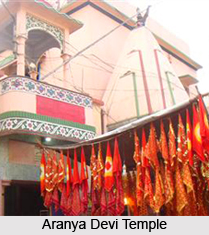
Aranya Devi Temple Aranya Devi Temple is dedicated to goddess Aranya Devi, who is recognized as the goddess of forest. This temple is located at Arrah near Patna. The two Aranya Devis in this temple will be evident to the visitors in standing pose. The figures of both the Devis are made of black stone. One of the figures is about 3 feet high and the other figure has a height of about is 2 feet. It is believed that both the Devis are sisters. The Aranya Devis are dressed in yellow saris with flower garlands and mukuts on their heads. This temple also houses the statues of Radha, Krishna, Rama, Sita, Lakshmana, Bharata and Satrughna. Vishnupad Temple Vishnupad Temple is recognized as one of the major Hindu pilgrimage sites of Bihar. This temple is situated on the banks of the River Phalgu in the district of Gaya. This temple was constructed by Queen Ahilya Bai of Indore in the year 1787. Here, one will be able to see a 40 centimeter long footprint of Lord Vishnu. There is a history behind this temple that this temple was constructed on the footprints of Lord Vishnu. The footprint of the Lord is imprinted on hard rock and it is also encircled by a silver basin in order to keep it at a distance from the devotees. There are several images and shrines inside the Vishnupad Temple. The delicately curved door frame of the small but attractive Narasimha Temple present inside the courtyard of Vishnupad Temple is one of the beauties of this place. Next to the Narasimha Temple to the north, there is also a Vishnu temple. This temple has brick walls and stone pillars. The eastern portion of the courtyard of Vishnupad Temple is devoted to Lord Shiva where the idol of Shiva is placed in the form of Phalgwisvara. Phalgwisvara is regarded as the Lord of Phalgu River. Durga Temple 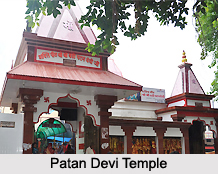 One of the notable temples of Bihar is the Durga Temple. It is evident from the name of this temple that it is dedicated to goddess Durga. Goddess Durga is regarded in Hinduism as the manifestation of strength or shakti. Devotees in large number visit this temple to offer prayer before their goddess and believe that she will take away all their pains and sufferings and bestow them with all the happiness in life. The design of this temple is primitive but it is very popular among the people living in this state. A pathshala or a village school was earlier situated in the Durga Temple premises where the great Indian poet, Kalidasa was engaged in learning. One of the notable temples of Bihar is the Durga Temple. It is evident from the name of this temple that it is dedicated to goddess Durga. Goddess Durga is regarded in Hinduism as the manifestation of strength or shakti. Devotees in large number visit this temple to offer prayer before their goddess and believe that she will take away all their pains and sufferings and bestow them with all the happiness in life. The design of this temple is primitive but it is very popular among the people living in this state. A pathshala or a village school was earlier situated in the Durga Temple premises where the great Indian poet, Kalidasa was engaged in learning.
Hariharnath Temple Hariharnath Temple is another remarkable Hindu temple in Bihar which is situated at Sonepur in the district of Saran. Devotees in large number visit this temple on the eve of the famous Sonepur Mela. This mela is held on the day of Kartik Purnima. People also visit this temple on Kartik Purnima to take a holy bath in the river at the meeting place of Ganga and Gandak. Mahaparinirvana Temple Mahaparinirvana Temple is located in a place called Kushinagar, at the back of the Nirvana Stupa. The huge figure of Lord Buddha which is 20 feet long was unearthed in the year 1876. This figure is exhibited in the temple. As per the inscriptions on the statue, it is understood that the statue was constructed in 5th century AD. This imposing statue in the Mahaparinirvana Temple is admirably placed on a platform made of brick. The remarkable thing is that the gigantic statue of Lord Buddha is carved out of a single red stone. This reclining statue is famous throughout the world. Mahabodhi Temple Mahabodhi Temple is located in Bodh Gaya. Bodh Gaya is regarded as one of the most sacred Buddhist pilgrimage centers. This temple complex has the distinction of being mentioned in the World Cultural Heritage list of UNESCO (United Nations Educational, Scientific and Cultural Organization). This temple has also received mention in the Chinese traveler Hiuen Tsang's writings. Mahabodhi Temple was founded by emperor Ashoka in the 3rd century BC. He came to India in 637 AD and described about the beauty of this temple in his writings. It exists from the later part of the Gupta empire in India. It is known to be one of the earliest Buddhist temples made of brick in India. There is a belief that Lord Buddha got enlightenment at this place and the diamond throne which lies in between the Mahabodhi temple and the Bodhi tree shows the exact spot of the enlightenment of Buddha. There is a spectacular image of Lord Buddha which is positioned on the temple wall and the footsteps of the Lord are arched in hard stone. This temple is visited by a large number of tourists and devotees for its religious importance as well as its beautiful architectural design. The Mahabodhi Temple is a masterpiece of great architectural design and it is one of the rarest examples of temple construction in India using bricks. Jal Mandir Jal Mandir is one of the most august places of pilgrimage for the Jains in Bihar. This temple complex is located in a place called Pawapuri. More specifically, this temple is situated in the middle portion of a lotus pond which marks the accurate location of the cremation of Lord Mahavira. Jal Mandir is made up of white marble. A large number of devotees visit this temple regularly. There is a common belief that those who pray here get rid of their worldly sins. There is another temple for the Jains close to the Jal Mandir, which is known as Samosharan Temple. Other Temples of Bihar Some of the other prominent temples of Bihar are Bari Patan Devi (Patna), Ma Paudi (Singhbhum), Chaubishi Jain Mandir (Gaya), Puran Devi (Purnia), Kurkihar Temple, Chutia Temple, Mundesvari Temple, Parasnath Temple, Vaishali Temple and Masarah Temple. |
| |||



Temples of Bihar
| Temples of Bihar act as mirrors to the great tradition and culture of the state and its religious sentiments. These temples form the major attractions during the tour of Bihar. Bihar is regarded as the starting point of Buddhism and Jainism and it is for this reason that several Jain and Buddhist temples are located in this state. |
| ||||||||||||||||||||||||||||

