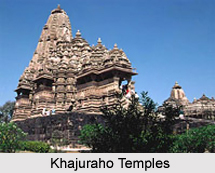
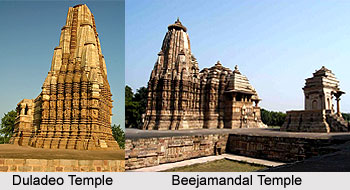
 Southern group of temples consists of Dhuladeo temple, Chaturbhuj temple and Beejamandal temple. These are described below: Dhuladeo temple or the Lord Shiva temple stands near the Khudar rivulet. This seems to be the last of Khajuraho`s great temples. It lies to the south of Ghantai temple. The powerful Chandella king Madanavarman possibly constructed it, in about AD 1130. It displays a marked change from the earlier temples in its architectural and sculptural style in that its figures have sharp features and angular postures, and wear typical trefoil crowns and leg ornaments. The figures are also heavily ornamented. This style was prevalent in the Chandella domain even outside Khajuraho, at Jamsot in the Allahabad region.
The temple shows influences of Western Indian architectural traditions. Its sanctum was built as if by rotating a square round a central axis. Such a plan is not found in any of the earlier temples of Khajuraho. Its mahamandapa is large and octagonal, with a furnished circular ceiling. It originally had twenty apsara brackets, grouped in bunch of two or three.
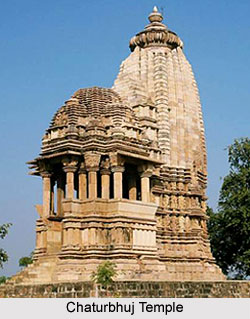
Chaturbhuja-temple: Located at some distance from the main group of temples, southwest of the Jatkari village, the Chaturbhuja temple is a sight to behold in the late afternoon, when the rays of the setting sun light its magnificent icon. The temple faces west, unlike most of the Khajuraho temples, which are oriented to the east. This temple is dated to around 1100 AD. This is a west facing temple.
 The temple has an image of lord Vishnu on its door lintel and enshrines in its specially built sunken sanctum one of the most majestic icons of northern India, a 2.75 m. (9 ft.) high statue of an unusual ascetic form of Vishnu. This god, with matted hair and ornaments, is Chaturbhuja (four-armed), hence the name of the temple. In a northern niche is a rare image of the goddess Narasimhi, with a lion`s face and a human body. Below is an image of Vishnu. Images of Ardhanarishvara and Surya are seen in the southern and eastern niches. It lacks the erotic sculptures unlike the other temples of Khajuraho. It was constructed by Emperor Lakshavarman to enshrine an image of four-armed `Chaturbhuja` Vishnu that was brought from Tibet.
Bijamandala (Vaidyanatha) Temple: The plinth that has been unearthed is 34 m. long, which is larger than the 30 m. plinth of the Kandariya Mahadeva Temple, so far the biggest temple at Khajuraho. This suggests that this excavated temple should be the largest at Khajuraho. The temple has an exquisite image of Sarasvati in a niche of its mandapa. Here, the images of Brahma, Vishnu, and Shiva as well as figures of apsaras and vyalas have been found.