


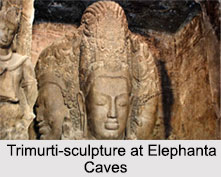
 The sculptures at Elephanta Caves are well known for its Hindus sculptures. The inner walls of the caves have various sculptures of the gods from the Hindu mythology that appear in almost same sizes. At the end of the north-south axis, the image of Trimurti, a manifestation of Lord Shiva is carved. The colossal 20-feet high image of Sadashiva Shankara is a three-headed structure called Trimurti. This famous statue depicts the three aspects of Shiva as creator, preserver and destroyer. The head from the left is believed as the life-giving Shakti of Shiva, Uma, while the head from the right shows him as Rudra or Bhairava, a fearful figure with hanging snakes in his hair and neck. The noteworthy face is the swarupa or true self of Shiva, who is calm and serene giving blessings with right hand. The sculptures at Elephanta Caves are well known for its Hindus sculptures. The inner walls of the caves have various sculptures of the gods from the Hindu mythology that appear in almost same sizes. At the end of the north-south axis, the image of Trimurti, a manifestation of Lord Shiva is carved. The colossal 20-feet high image of Sadashiva Shankara is a three-headed structure called Trimurti. This famous statue depicts the three aspects of Shiva as creator, preserver and destroyer. The head from the left is believed as the life-giving Shakti of Shiva, Uma, while the head from the right shows him as Rudra or Bhairava, a fearful figure with hanging snakes in his hair and neck. The noteworthy face is the swarupa or true self of Shiva, who is calm and serene giving blessings with right hand.
Illustrations of the sculptures at Elephanta Caves At the doorways, giant dwarapalas and their attendants work as guards. The appearance of the dwarapalas is carved with all minute details of sculptured image. The shrine itself has a meter- high lingam of Shiva. In the main mandapa, at the four corners various images depicting Shiva in different moods are noteworthy. The carving of Shiva as Ardhanarishwara seems to be important as in this form he combines the female and the male aspects in his own self. There is also a panel with Ardhanarishvara depicting the descent of the heavenly river Ganga to earth. Along with Ganga, Yamuna and Saraswati rivers are marked. In the vestibule of the cave one notices a carving of Lord Shiva in the form of Nataraja, the god of dance at the right and at the left Lakulisa is sculptured. This image is carved in the Buddhist mould that shows a 7th century priest engaging in an activity of reabsorbing Buddhism into Hinduism. 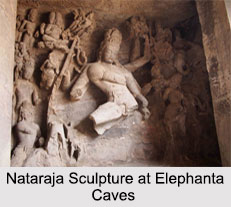 He is sculptured as seated on a lotus, which is the symbol of enlightenment. He is sculptured as seated on a lotus, which is the symbol of enlightenment.
Cave 1 is very rich with colossal, beautiful sculptures; some of these sculptures serve as symbols to entire ancient India. This cave has huge figures of the divinities and guardians and cube pillars with traditional capitals which in turn have Gupta architectural features as the depictions of mountains and clouds, women’s hairstyles. There is a Shiva shrine to the right from the entrance inside the mandapa with free-standing square cell and four entrances and linga in the centre. The most famous sculpture in mandapa of the Great Cave is Trimurti, a sculpture with three faces of Shiva. Trimurti resembles a Trinity of Brahma, Vishnu and Mahesh. Trimurti is one of the symbols of Indian culture, a masterwork of Gupta and Chalukyan art. Trimurti is edged by the sculptural groups called Ardhanarisvara on its left and Gangadhara to its right. Ardhanarishvara portrays a four-armed Shiva. Shiva is revealed as a half male - half female. The cave contains some more statues of general significance to world art history including a carving of Shiva and Parvati on Mount Kailash with many other characters and detailed landscape features. There are 15 huge panels containing art values. The eastern part of cave holds a huge statue of four-armed gate keeper with two demons. Cave No 2 is smashed and the interior has been damaged by water. The uneven chapel is supported by 4 eight-cornered columns. Traces of sculptures remain but most of earlier rich artwork has decomposed. Cave No 3 is in even poorer condition and is damaged by heavy water. Pillars in the front of rooms have been conserved; sculptures of door-keepers of shrine are partially preserved. There is a large cave chamber, Sitabai’s Temple in Cave 1. Behind the hall there are three chambers, middle chamber hosted shrine. |
| |||



Home > Art & Culture > Indian Sculpture > Types of Indian Sculpture > Indian Cave Temple Sculpture > Sculpture at Elephanta Caves
Sculpture at Elephanta Caves
| Sculpture at Elephanta Caves represents Shaiva Hindu Sect. Elephanta is a dark cave in a tiny island housing one of the most imposing examples of early rock- cut architecture. |
| ||||||||||||||||||||||||||||

