


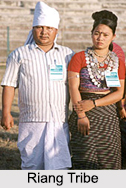
 Riang Tribes are mainly concentrated in the eastern hill and are found in Tripura. Riang tribes have been acclaimed as one of the 21 scheduled tribes of the sate of Tripura. Riang tribes like to classify themselves as ‘Bru’. Riang Tribes are mainly concentrated in the eastern hill and are found in Tripura. Riang tribes have been acclaimed as one of the 21 scheduled tribes of the sate of Tripura. Riang tribes like to classify themselves as ‘Bru’.
Society of Riang Tribes The societal structure of the Riang society is unique. In fact, the whole of Riang community can be segregated into 2 major groups - ‘Meska’ and ‘Molsoi’. They prefer to live in villages. Their traditional house is rectangular in shape. The size of a house depends upon the economic condition of the people and the floor is raised above the ground. Riang society is patriarchal. The father is the head of the family. A clan functions as a local group. Membership of a clan is acquired by birth. Marriage is a significant institution in the Riang community who follow endogamy where ‘Haloksai’and ‘Haloksam’ are the two marriage classifications of Riang. Marriage is arranged through the matchmaker ‘Andra’, who confers the bride price with the bride's parents. The Riang widower is not allowed to get marry a virgin. The women of Riang tribes are expert weavers. The economy of the Riang people is a mixed economy that comprises of hunting, fishing, foraging, shifting cultivation, basketry, weaving and horticulture but hunting is resorted. 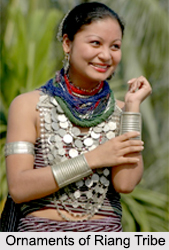
Culture of Riang Tribes Dance is an essential part of Riang life. The ‘Hojagiri’ folk dance of Riang tribe is well known all over the world. 'Buisu' is the most popular festival of Riang tribes; ‘naisingpara hojagiri’ group is the most popular groups all among them. Riang tribes speak ‘Riang’ which is a ‘Baric’ language. Costumes of Riang Tribes The traditional dresses of the Riang Tribes are very simple. Men conventionally wear a hand woven loin cloth and a piece of cloth as a wrapper for the upper body. The women wear a long cloth called ‘Mnai’, a wraparound, from the waist to the knees, ‘Rsa’ covering the chest, and ‘Rikatouh’ for covering the complete upper half of the body. The fabric of their costumes is generally woven by the Riang women. However, modernisation has its presence in Riangs and they no longer wear their habitual costumes. The Riang women like other Tripuris, wear different ornaments, flowers, and cosmetics. Silver ornaments, particularly the necklace of silver coins, the ‘Rangbauh’ have a pride of place among them. 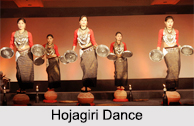
Festivals of Riang Tribes Festivals celebrated by the Riang Tribes include ‘Ker’, ‘Gonga mwtai’, ‘Goria’, ‘Chitragupra’, ‘Hojagiri’, ‘Katangi puja’, ‘Lampra uathop’. The ‘Garia Puja’ is an important festival which is organised in the month of April. These two occasional assume the character of festival and celebrated gorgeously with rites, rituals, feasting, dancing, singing and drum-beating. ‘Mainukma’ and ‘Khumaukma’ are the guardian goddesses of paddy and cotton crops. They are worshipped in October and this festival is also known as ‘Lakshmi Puja’ or ‘Kojagari’ or ‘Hojagiri’. ‘Hojagiri’ dance is witnessed in the ‘Hojagiri’ festival. It is ritualistic in nature. In the Tripuri ‘Hojagiri’ dance movement, styles do not crystallize the agricultural activities and is a dance of balance. The balance is used in a number of combinations. Each dancer stands upon a crock and whole weight is placed on the crock. The Riang possesses well organised political structure to ensure discipline into the whole community. There are three tier administrative structures - village level, zonal level and state level. The stale level council is the biggest superimposed unit in the political system. The chief of the whole community is known as ‘Kami Kachkao’. |
| |||



Home > Society > Indian Tribals > Indian Tribal People > North East Indian Tribes > Tribes of Tripura > Riang Tribes
Riang Tribes
| Riang Tribes are the second largest tribal community of Tripura. They are also found in Mizoram, Assam and the Chittagong Hill Tract. |
| ||||||||||||||||||||||||||||

