


 Dimasa Tribes are the most widely spread tribal groups in the north-eastern region of India. These tribes are mainly found in the North Cochar Hills, Cachar and Karbi Anglong district of Assam. Dimasa tribal community is said to be a component part of the Bodo-Kachari clan. Dimasa Tribes are the most widely spread tribal groups in the north-eastern region of India. These tribes are mainly found in the North Cochar Hills, Cachar and Karbi Anglong district of Assam. Dimasa tribal community is said to be a component part of the Bodo-Kachari clan.
Origin of Dimasa Tribe As per the history, the Dimasa tribes are said to be the earliest inhabitants of the Brahmaputra Valley. The word ‘Dimasa’ means ‘children of the big river’ that connotes Brahmaputra River. Dimasa tribes belong to the Indo-Mongoloid group which includes the Bodo Tribe and their allied tribes. They call themselves Bodo or Bodo-fisa in the Brahmaputra valley and Dimasa or Dima-fisa in North Cachar Hills and Karbi Anglong District. Society of Dimasa Tribe Dimasa tribal people build their houses on hill slopes with a river or streamlet flowing nearby. The houses are generally built on plinth of earth – in two rows facing each other with a sufficiently wide gap in between. An important institution of the village is 'Hangsao'. It is an association of unmarried boys and girls of the village. It is organized for the purpose of working together in cultivation and lasts only for one year. Throughout the year, the members of the Hangsao work together in the Jhum cultivation by rotation an area of land at every member's field. Religious Life of Dimasa Tribe 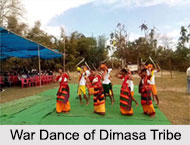 Dimasa tribal community is very much pious and religious minded. Festivals, musical melodies, religious rites and customs have enriched the culture of this tribal community. The supreme deity in the world is the Banglaraja as per the Dimasa tribal community. These tribal people worship several deities like Lord Banglaraja, Sibrai, spirits of ill- will and good wills, Sakainjeek, Madai. Dimasa tribal community is very much pious and religious minded. Festivals, musical melodies, religious rites and customs have enriched the culture of this tribal community. The supreme deity in the world is the Banglaraja as per the Dimasa tribal community. These tribal people worship several deities like Lord Banglaraja, Sibrai, spirits of ill- will and good wills, Sakainjeek, Madai.
The religious practices of the Dimasas are reflected in their Daikho system. A Daikho has a presiding deity with a definite territorial jurisdiction and a distinct group of followers known as Khel. Every Dimasa Kachari family worships its ancestral deity once a year before sowing the next paddy. It is known as Madai Khelimba. This is done for the general welfare of the family. They cremate their dead. The widow does not tie their hair till cremation. The dead body is cremated by the side of a river or stream. Festivals of Dimasa Tribe The Dimasa tribal people celebrate several occasions and festivals namely Bushu and Hangsao with playing instruments, traditional dance. Music and dance play an important role in the day-to-day life of the Dimasa people. The males and females of this community are dressed in their traditional dresses during these festivals and some of them take part in folk dances. By using their traditional musical instruments like Muri, Muri-wathisa, Supin Khram, Khramdubung, they present their traditional dances named - Baidima, Jaubani, Jaupinbani, Rennginbani, Baichargi, Kunlubani, Daislelaibani, Kamauthaikim Kaubani, Nanabairibani and many more. Costumes of Dimasa Tribe Among the traditional wears; Rikaosa, Richa, Paguri Rimchau and Rimchaoramai are worn by men and Rikhra, Jingsudu, Rijamfini, Rikaucha, Rijamfinaberen, Rigu etc. are worn by women. The women of this community wear different ornaments like Chandraral, Jingbri, Jongsama, Kamautai, Kaudima, Longbar, Rongbarcha, Panlaubar, Khadu, Enggrasa, Ligjao. The traditional dresses, costumes and festivals appositely depict the rich culture of Dimasa tribes. |
| |||



Home > Society > Indian Tribals > Indian Tribal People > North East Indian Tribes > Tribes of Assam > Dimasa Tribes
Dimasa Tribes
| Dimasa Tribe is one of the many different tribes of Assam. They are said to be the earliest inhabitants of the Brahmaputra Valley. |
| ||||||||||||||||||||||||||||

