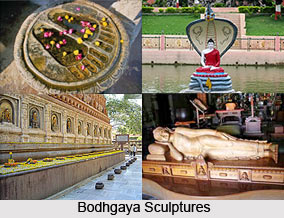
 Bodhgaya is one of the most important and sacred Buddhist pilgrimage center in the world. The temple is an architectural amalgamation of many centuries, cultures and heritages. Bodhgaya is a religious site and place of pilgrimage associated with the Mahabodhi Temple Complex in Gaya district in the Indian state of Bihar. The Temple Complex has direct associations with the life of the Lord Buddha as the place where in 531 BC he attained the "Enlightenment" while seated under the "Bodhi Tree". The site consists of the main temple and 6 sacred places within an enclosed area and a 7th one, the Lotus Pond outside the enclosure to the south.
King Ashoka visited Bodhgaya about 250 years after the Enlightenment took place and it is considered as he constructed the Maha Bodhi Temple. It is said that Ashoka with establishing a monastery erected a diamond throne shrine at this spot with a canopy supported by 4 pillars over a stone representation of the Vajrasana, the seat of enlightenment, for which the temple of Maha Bodhi is famous.
The Maha Bodhi Temple: The Mahabodhi Temple, one of the few surviving examples of early brick structures in India, has had significant influence in the development of architecture over the centuries. The present temple is one of the earliest and most imposing structures built entirely from brick in the late Gupta period. The sculpted stone balustrades are an outstanding early example of sculptural relics in stone.
The temple is built in the classical style of Indian temple architecture. It has a low basement with mouldings decorated with honeysuckle and geese design. Above this is a series of niches containing images of the Buddha. Further above there are mouldings and Chaitya niches, and then the curvilinear Shikhara or tower of the temple surmounted by Amalaka and Kalasha.
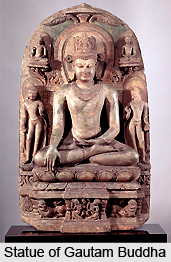
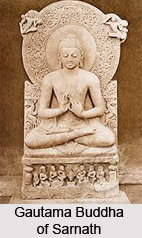
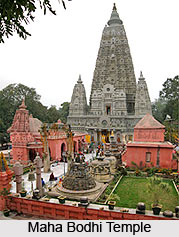 At the 4 corners of the parapet of the temple are 4 statues of the Buddha in small shrine chambers. A small tower is built above each of these shrines. The temple faces east and consists of a small forecourt in the east with niches on either side containing statues of the Buddha. Inside the temple there is a colossal image of the Buddha in sitting posture touching the earth by his right hand. In this posture the Buddha accomplished the supreme enlightenment. The entire courtyard of the temple is studded with large number of votive stupas. Most of them are extremely elegant in structural beauty.
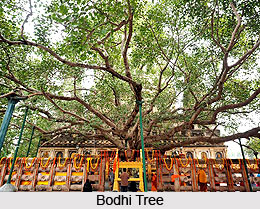
The Bodhi Tree: The most important of the sacred places is the giant Bodhi Tree. This tree is to the west of the main temple and is supposed to be a direct descendant of the original Bodhi Tree under which the Buddha spent his First Week and where he had his enlightenment.
The Animeschalochana Chaitya: To the north of the central path, on a raised area, is the Animeschalochana Chaitya where the Buddha is believed to have spent the Second Week.
Ratnachakrama: The Buddha spent the Third Week walking 18 paces back and forth in an area called Ratnachakrama, which lies near the north wall of the main temple. It is believed that wherever the Buddha put his feet lotus sprang up. This was built as a low platform adorned with nineteen lotuses, which are parallel to the Maha Bodhi temple on its north side.
Ratnaghar Chaitya: The Buddha spent one week here, where it is believed that five colors came out of his body. The spot where he spent the Fourth Week is Ratnaghar Chaitya, located to the north-east near the enclosure wall.
Ajapala Nigrodh Tree: Immediately after the steps of the east entrance on the central path there is a pillar which marks the site of the Ajapala Nigrodh Tree, under which Buddha meditated during his Fifth Week, answering the queries of Brahmins.
 Lotus Pond: Buddha spent the Sixth Week next to the Lotus Pond to the south of the enclosure.
Rajyatana Tree: Lastly in the Seventh Week under the Rajyatana Tree currently marked by a tree.
Next to the Bodhi Tree there is a place with a Buddha statue that stands on part of the polished sandstone Vajrasana (Diamond Throne), originally installed by Emperor Asoka to mark the spot where the Buddha sat and meditated. Granite pillars were added to enlarge the area in the 5th-6th centuries BC. Further up the central path towards the main temple to the south is a small shrine with a standing Buddha in the back and with the footprints of the Buddha carved on black stone, dating from the 3rd century BC, when Emperor Asoka declared Buddhism to be the official religion of the state. Further on the path towards the main temple is a building housing several statues of Buddha and Bodhisattvas.