


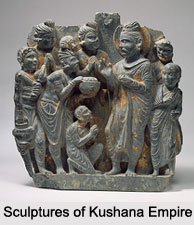
 Sculptures of Kushana Empire, especially those which belonged to the Gandhara region show a strong influence of Greek and Roman elements. Its images wear toga-like garments and have wavy hair and straight Roman noses. Sculpture is usually created from dark gray phyllite, schist, stucco, or terracotta. Sculptures of Kushana Empire, especially those which belonged to the Gandhara region show a strong influence of Greek and Roman elements. Its images wear toga-like garments and have wavy hair and straight Roman noses. Sculpture is usually created from dark gray phyllite, schist, stucco, or terracotta.
Sculpture of southern Mathura region was developed from indigenous Indian traditions, emphasizing rounded bodily forms. Its voluptuous sculptural images wear minimal garments and are usually carved from red mottled sandstone. During the Kushan period Mathura produced art for the Jains and the Hindus as well. History of the Sculptures of Kushana Empire The Kushans, ancestry of migrants from different parts of Central Asia, settled in present-day northern India. There were two artistic centres of the Kushan Empire, each with a characteristic style: a northern one in the Gandhara area centred in the region of Peshawar and later in Taxila and a southern one in Mathura, south of current-day New Delhi. It was under the Kushan rulers that the Gandhara School of Art developed. During the time of Kushans, Lord Buddha was first shown in human form in this region. Features of Sculptures of Kushana Empire The features of Kushan sculptures were highly influenced by the Greco-Roman architecture. The Kushan period was marked for setting the principles for making sculptural images that continued to influence the art of sculpturing for many years. There were major variations in style and quality among Kushan period Gandhara sculpture. The sculptures of Gandhara are significant of Hellenistic art. North India became popular for the Mathura School of Art while the Gandhara School flourished in South India. The sculpture in Mathura had more local flavour as these were inspired from local folk deities called Yakshas and Yakshis and other local gods and goddesses and themes from day-to-day life. The specialty of their art was the depiction of the beauty of the female in sculpturing forms of images. The artists of Mathura succeeded in creating the ideal Indian beauty, which can be marked by oval faces with ample breasts, slender waist and broad hips. The caves of Kushan Period were mainly recognized for their complicated sculptures. This form of sculpture also flourished in Mathura. Sculpture of Amravati Stupa, Jagayyapeta Stupas and Nagarjunikonda Stupas are well known. Mathura artists had a more varied repertoire as compared to Gandhara sculptors. The sculptures are stylistically rich that represented the three centuries in which Kushan Mathura period flourished. The smaller sculptures are well-designed. However, they are not as sophisticated as stone sculptures. Mathura also witnessed terracotta sculpture in the Kushan period. Metal sculptures of Kushan have a combination of Indian and Iranian styles. Popular Sculptures of Kushana Empire Following are the Popular Sculptures of Kushana Empire: Gajalakshmi: It is chronologically the most basic sculpture of Kushan Empire as it now stands propped up on the verandah of a private house in Kolkata. It is 1.22 m height. Ardhanarishwara: It is an exceptional depiction of the genderless form of Shiva and Parvati. The two halves are fluently differentiated along the vertical axis, the right half being male and the left female. |
| |||



Home > Art & Culture > Indian Sculpture > History of Indian Sculpture > Ancient Indian Sculpture > Sculptures of Kushana Empire
Sculptures of Kushana Empire
| Sculptures of Kushan Empire had two distinctive styles:; a northern one in the Gandhara region and a southern one in Mathura, south of present New Delhi. |
| ||||||||||||||||||||||||||||

