Indianetzone.com - Web Portal on Indian Culture & Lifestyle  Arts  •  Entertainment  •  Health  •  Lifestyle  •  Reference  •  Sports  •  Society  •  Travel
Home >> Water Therapy
Water Therapy

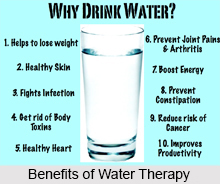
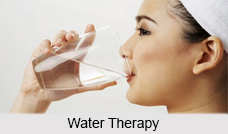
In modern times, water therapy was popularised by many European water-cure pioneers. They raised water cure to an institutional level and employed it successfully for the treatment of almost every known disease. Beneficial effects are exeted by water on the human system. It equalises circulation, boosts muscular tone and aids digestion and nutrition. It also tones up the activity of perspiratory gland and in the process eliminates the damaged cells and toxic matter from the system. Hence, in recent times, there are numerous spas in most all countries where water therapy is used as a major healing agent. The common water temperature chart used for water therapy is as follows:
Cold: 10 degree C to 18 degree C
Neutral: 32 degree C to 36 degree C and
Hot: 40 degree C to 45 degree C.
It should be noted that above 45 degree C, water loses its therapeutic value and is destructive. Let us discuss the usage of water in various therapeutic treatments.

Cold-Compress1. Cold Compress: This is a local application using a cloth, which has been wrung out in cold water; One just has to place essential aroma oils in 100 mI. cold water with six ice cubes in a bowl and use the cold compress. The cloth should be folded into a broad strip and dipped in cold water or ice water. Cold Compresses are used for headaches, sprains, inflammation, fever, swollen bumps, burns, blisters, sore feet, rashes, measles, chicken pox, sunburn or a hangover.

2. Enema: An enema involves the injection of fluid into the rectum and is also known as rectal irrigation, where only lukewarm water is used for cleaning the bowels, since it not only the safest system for cleaning the bowels, but also improves the peristalic movement of the bowels and thereby relieves constipation. In this form of nature cure treatment, the patient is made to lie on his left side extending his left leg and bending the right leg slightly. The enema nozzle, lubricated with oil or Vaseline, is inserted in the rectum. The enema can, containing the lukewarm water is then slowly raised and water is allowed to enter into the rectum. Generally, one to two litre of water is injected. The patient may either lie down on his back or walk a little while retaining the water. After five to 10 minutes, the water can be ejected along with the accumulated morbid matter.

Heating-Compress3. Heating Compress: This is a cold compress covered in such a manner as to bring warmth. It consists of three or four folds of linen cloth wrung out in cold water, which is then covered completely with dry flannel or blanket to prevent the circulation of air and help accumulation of body heat. The duration of the application is determined by the extent and location of the surface involved, the nature and thickness of the coverings and the water temperature; it is sometimes applied for several hours. The area should be rubbed with a wet cloth after removing the compress and then dried with a towel. A heating compress can be applied to the following organs of the body:
i. Throat Compress: It relieves sore throat, hoarseness, tonsillitis, pharyngitis and laryngitis.
ii. Chest Compress: Also known as chest pack; relieves cold, bronchitis, pleurisy, pneumonia, fever and cough.
iii. Abdomen Compress: It helps those suffering from gastritis, hyperacidity, , jaundice, constipation, diarrhoea, dysentery and other ailments relating to the abdominal organs.
iv. Joints Compress: It is helpful for inflamed joints, rheumatism, rheumatic fever and sprains.

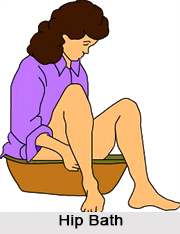
Hip-Bath 4. Hip Bath:This mode of treatment involves only the hips and the abdominal region below the navel for which a special type of tub is used. The tub is filled with water in such a way that it covers the hips and reaches upto the navel when the patient sits in it. Four to six gallons of water is required generally for the bath and a support may be placed under one edge to elevate it by two or three inches. (However, even a common tub may be used incase the special tub is not available.) A Hipbath is given in cold, hot, neutral or alternate temperatures, whereby the water temperature should be from 10C-18C. The duration of the bath is usually 10 minutes, but in specific conditions it may vary from one minute to 30 minutes.
i. Cold Hip Bath: If the patient feels cold or is very weak, a hot foot immersion should be given with the cold hipbath. The patient should then rub the abdomen briskly from the navel downwards and across the body with a moderately coarse wet cloth. The legs, feet and upper part of the body should remain completely dry during and after the bath.
ii. Hot Hip Bath: This bath is generally taken for eight to 10 minutes at a water temperature from 40C-45C. However, no friction should be applied to the abdomen. Before entering the tub, the patient should drink one glass of cold water and even a cold compress should be placed on the head. A cold shower bath should be taken immediately after the hot hipbath. Care should be taken to prevent the patient from catching a chill after the bath. The bath should be terminated if the patient feels giddy or complains of excessive pain.
iii. Neutral Hip Bath: The temperature of the water should be 32C-36C and the duration should be from 20 minutes to an hour. Friction to the abdomen should be avoided.
iv. Alternate Hip Bath: This is also known as revulsive hipbath. The temperature in the hot tub should be 40C to 45C and in the cold tub 10C to 18C. The patient should alternately sit in the hot tub for five minutes and then in the cold tub for three minutes. The duration of the bath is generally 10 to 20 minutes. The head and neck should be kept cold with a cold compress. The treatment should end with a dash of cold water to the hips.

Spinal-Bath5. Spinal Bath: Another important form of hydrotherapic treatment is the spinal bath. This bath provides a soothing effect to the spinal column and thereby influences the central nervous system. It is given in a specially designed tub with its back raised so as to provide proper support to the head. The bath can be administered at cold, neutral and hot temperatures. The water level in the tub should be an inch and a half to two inches and the patient should lie in it for three to 10 minutes.

6. Full Wet Sheet Pack: This is a procedure in which the whole body is wrapped in a wet sheet, which in turn is wrapped in a dry blanket for regulating evaporation. The blanket should be spread on the bed with its edges hanging over the edge of the bed. The upper end should be about eight inches from the head of the bed. Then spread a linen sheet wrung out in cold water over the blanket so that its end is slightly below the upper end of the blanket. The patient should lie on the bed sheet with his shoulders about three inches below the upper edge. The wet sheet should be quickly wrapped round the body of the patient, drawn in, tightly tucked between the legs and also between the body and the arms. The sheet should be folded over the shoulders and across the neck.

Now the blanket should be drawn tightly around the body and tucked in along the side in a similar manner, pulling it tightly. The ends should be doubled up at the feet. A turkish towel should be placed below the chin to protect the face and neck from coming into contact with the blanket and to exclude outside air more effectively. The head should be covered with a wet cloth so that the scalp remains cold. The feet should be kept warm during the entire treatment. If the patient`s feet are cold, place hot water bottles near them to hasten reaction. The pack is administered for half an hour to one hour till the patient begins to perspire profusely. He may be given cold or hot water to drink.

Hot-Foot-Bath7. Foot Bath: In this method, the patient should keep his or her legs in a tub or bucket filled with water and before taking this bath, a glass of water should be taken and the body should be covered with a blanket.
i. Hot Foot Bath:The duration of the bath is generally from five to 20 minutes, where, the legs of the patient should be kept in hot water at a temperature of 40C to 45C. And a blanket should be covering the body, so that no heat or vapour escapes from the footbath. The head should be protected with a cold compress. The patient should take a cold shower immediately after the bath.
Cold-Foot-Bathii. Cold Foot Bath: A cold footbath should be taken for one or two minutes by taking three to four inches of cold water at a temperature of 7.2C to 12.7C in a small tub or a bucket. The feet should be completely immersed in the water for one to five minutes. Friction should be continuously applied to the feet during the bath, either by an attendant or by the patient by rubbing one foot against the other.

8. Steam Bath:Steam bath induces perspiration in a most natural way, if taken generally for 10-20 minutes or so. The patient, clad in minimum loin cloth or underwear, is made to sit on a stool inside a specially designed cabinet. Before entering the cabinet, the patient should drink one or two glasses of cold water and protect the head with a cold towel. A cold shower should be taken immediately after the bath. If the patient feels giddy or uneasy during the steam bath, he or she should immediately be taken out and given a glass of cold water and the face washed with cold water. Very weak patients, pregnant women, cardiac patients and those suffering from high blood pressure should avoid this bath.

Immarsion-Bath9. Immersion Bath: Immersion Bath is also known as full bath. It is administered in a bathtub, which should be properly fitted with hot and cold-water connections. The bath can be taken at cold, neutral, hot, graduated and alternate temperatures. There are various types of the immersion baths. They are:
i. Cold Immersion Bath: This may be taken for four seconds to 20 minutes at a temperature ranging from 10Cto 23.8C. Before entering the bath, cold water should be poured on the patient`s head, chest and neck and the head should be protected with a cold moist towel. During the bath, the patient should vigorously rub his or her body- after the bath the body should be quickly dried and wrapped up in a blanket. If the climate is favourable, moderate exercise should be undertaken. This bath should not be given to young children or very elderly persons.
ii. Graduated Immersion Bath: The patient should enter the bath at a temperature of 31C. The water temperature should be lowered gradually at the rate of 1C per minute until it reaches 25C. The bath should continue until the patient starts shivering. This bath is intended to avoid nervous shock by sudden plunge into the cold water.
iii. Neutral Immersion Bath: This bath can be given from 15 to 60 minutes at a temperature ranging from 26C to 28C. It can be given for long duration, without any ill effects, as the water temperature is akin to the body temperature.
iv. Hot Immersion Bath: This bath can be taken from two to 15 minutes at a temperature from 36.6C to 40C. Generally this bath is started at 37C and the temperature is then gradually raised to the required level by adding hot water. Before entering the bath, the patient should drink cold water and also wet the head, neck and shoulders with cold water. A cold compress should be applied throughout the treatment.
v. Epsom Salt Immersion Bath: The immersion bathtub should be filled with about 135 liters of hot water at 40C. 1 or about one half kg of Epsom salt should be dissolved in this water. The patient should drink a glass of cold water, cover the head with a cold towel and then lie down in the tub, completely immersing the trunk, thighs and legs for 15 to 20 minutes. The best time to take this bath is just before retiring to bed.

Free E-magazine
Subscribe to Free E-Magazine on Indian Culture & Lifestyle.
Learn More
Jimtrade.com : India Business to Business Directory
Business Directory of Indian Suppliers Manufacturers and Products from India.
India`s leading Yellow pages directory.
Home | Sitemap | Contact Us