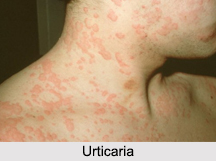
Urticaria, or hives (as it is popularly known in the layman`s terms) are a type of skin rash much striking for dark red, raised, scratchy bumps. Hives are frequently stimulated by allergic reactions, although there exists numerous non-allergic causes. For instance, most cases of Urticaria lasting less than six weeks (acute Urticaria) are the outcome of an allergic activation. Chronic Urticaria (hives lasting longer than six weeks) hardly ever occur due to an allergy. The majority of patients suffering from chronic hives have an unidentified (termed medically as idiopathic) cause. Possibly as many as 30-40 percent of patients with chronic idiopathic Urticaria will, in fact, have an autoimmune cause. A severe viral infection is another common cause of acute Urticaria (known as viral exanthem). Less common causes of hives incorporate friction, pressure, temperature extremes, exercise and harsh sunlight. It can also hold true that hives are more common amongst individuals who have been born with fair skin. As such, causes of Urticaria do amount to many severe and less-severe reasons that have to be identified as urgently as is possible.
The body`s immune system has been designed to produce various factors to combat foreign substances, including bacteria and viruses that the immune system comprehends as threatening. An allergic reaction takes place when the body`s immune system over-responds, or is hypersensitive to particles recognised as allergens. Common allergens consist of plant pollens, moulds, dust mites, animal dander, do suffer from hives or Urticaria. Important constituents of the immune system are the antibodies produced by lymph tissue. A key player in the allergic reaction is the antibody acknowledged as immunoglobulin E (IgE). IgE is overproduced in a specific group of people, usually those with inherited susceptibility.
Weals (raised areas encircled by a red base) from Urticaria can become visible anywhere on the surface of the skin. The activation can be allergic or non-allergic, which further depends upon a complex discharging of inflammatory mediators, including histamine from cutaneous mast cells. Such a process ensues in fluid leakage from superficial blood vessels. Weals can be pinpoint in size moving up to several inches in diameter. Angioedema is an associated condition of hives (also from allergic and non-allergic causes), though fluid leakage in this case is from much deeper rooted blood vessels. Individual hives that are excruciating lasts 24 hours, or leave a bruise. As they heal, they are more likely to be in an appalling condition, then recognised as urticaria pigmentosa. Hives caused by stroking the skin (often linear in appearance) is due to a benign condition, defined as dermatographism in doctoral terms. As such, there does exist even worse conditions and types of Urticaria, which needs further separate medication and treatment.
Urticaria or hives is a common inflammatory affectation, which is characterised by formation of weals on the skin, as has been stated above. The disease is also known as nettle rash, as the rash of hives resembles the sting of a nettle. The disease may be acute, chronic or recurrent and is deemed to be an allergic trigger like hay fever and asthma. The symptoms of Urticaria are red and white patches coming out on the skin, accompanied by burning, intense itching and stinging. Rubbing and scratching usually only aggravates the hives, since the latter relieves itching, resulting in new weals. The outbreak of Urticaria is sudden and the disease may affect either a part or whole of the body.
Other symptoms which accompany hives, comprise fever, digestive disturbances and prostration. The disorder lasts from a day or two to a week. Recovery is rapid and complete, though recurring attacks take place at varying intervals. If the rash also attacks the throat, there lies the danger of blockage of the larynx. In this context, a warning that comes to surface is that a different rash that germinates from poison ivy, poison oak and poison sumac contact, is usually mistaken for Urticaria. This rash is caused by contact with urushiol and results in a form of contact dermatitis called Urushiol-induced contact dermatitis and is distributed across by contact, but can be washed off with strong grease oil dissolving detergent and cool water and rubbing ointments.
Acute Urticaria usually shows up a few minutes after contact with the allergen and can last a few hours to several weeks. Food allergic reactions often fit in this category. The most common food allergies in adults results from shellfish and nuts. The most common food allergies in children are shellfish, nuts, peanuts, eggs, wheat and soy. It is however uncommon for patients to have more than two true relapsing food allergies. Chronic Urticaria refers to hives that continues for 6 weeks or more. There are no apparently visible differences between acute and chronic hives. However, drug-induced Urticaria has been known to result in severe cardio-respiratory failure.
Urticaria may result from digestive disorders like mechanical irritation in the digestive tract or toxemia. Drugs like aspirin, penicillin, serum, quinine, ipecac, turpentine and morphine can aid to aggravate it. Particular foods like strawberries, tomatoes, cucumbers, mushrooms, oatmeal, wheat, nuts, fish, eggs, chocolate, cheese, butter and sausage often induces hives in susceptible individuals. The bites of bed bugs, wasps, bees, mosquitoes, fleas and specific kinds of caterpillars may also produce the disease. Irritations of the uterus or associate structures can also cause the disease. It may also result from emotional excitement.

Treatment of Urticaria demands strict and solemn attention, which needs to be treated both from the internal and external physical body. As hives has its origin in the gastro-intestinal tract, the best way to commence the treatment is to adopt an all-fruit diet for approximately five days. In this regimen, the patient should have three meals a day intake, comprising fresh juicy fruits such as orange, apple, pineapple, grapes, pear, peach and papaya. A warm-water enema should be used daily during this period to cleanse the bowels. The patient is recommended to also drink a liberal amount of hot water. The patient suffering from such irritating disorder, is asked to spend two or three days on an all-fruit diet at regular intervals. This will further detoxify the system off morbid matters and help in speedy recovery.
After espousing such a diet, the Urticaria patient can embark upon a well-balanced diet consisting of seeds, nuts, grains, vegetables and fruits. The emphasis should be laid upon fresh fruits and raw vegetable salad. A glass of water containing the juice of half a lemon may be taken one hour before each meal and also between meals. The patient should however avoid tea, coffee and alcohol; all fleshy food items, refined foods and all foods which are rather complicated to digest must be avoided at any cost and instead he/she drink at least eight glasses of water daily between meals.
Certain home remedies have been found beneficial in the treatment of Urticaria. The use of salt is valuable in hives accompanied by digestive disorders. In such a condition, approximately 12 grams of salt should be dissolved in water and have by the sufferer. The throat should be tickled at times to induce vomiting for gaining respite. This will only lend relief and help in curing additional eruptions. Equal quantity of alum and red ochre are found beneficial in the treatment of hives. These two substances have been advised to ground together and the powder rubbed on the area of weals. The use of rosewater in vinegar is yet again considered useful in case of severe itching on the eruption. Approximately 35 ml. of rose water and 25 ml. of vinegar can be mixed and the mixture administered locally on the affected part. This will give immediate relief. Mint has also been found useful in relieving itching in Urticaria. Around seven grams of this leafy vegetable and 25 grams of brown sugar should be boiled together in water and drunk. This will relieve the itching also.
Turmeric has been acknowledged as exceedingly valuable in curing Urticaria. The patient has been counselled to take two teaspoons of turmeric powder mixed with water at regular intervals in treating this disease, also named as hives. The patient should avoid exposure to cold water. Fresh air and sunlight are also essential to the treatment and the sufferer should frequently expose his body to the sun and spend as much time outdoors as possible.
(Last Updated on : 2/12/2010)
