With the advent of tennis academies all over the country, many amateur tennis players can find the right path to pursue their hobby as a full time profession. Such tennis academies have by and large proved to be instrumental in shaping the careers of many such young and talented individuals and making them big stars of tomorrow. Legends like Rohit Rajpal and Leander Paes are a product of the The Britannia Amritraj Tennis Academy. Many leading players, who have been at the peak of their careers and have contributed immensely to this game, have planned to revive the interest in the game, in an effort to reclaim the lost glory of India. One of the All time greats of Indian tennis Vijay Amritraj was the first one in India to start a full fledged tennis academy, teaming up with Rajan Pillay, the then chairman of Brittania, The Britannia Amritraj Tennis Academy in Chennai.
Not only veterans like Vijay Amritraj or Mahesh Bhupathi have started academies, but also recent starlet Sania Mirza had approached the Andhra Pradesh Government for land to start a tennis academy! India now has quite a few training centres like the Krishnan Tennis Centre, the Ace Tennis Academy, the Tennis Village, the Sinette Tennis Academy, the Delhi Lawn Tennis Association and the All India tennis Association have blossomed in the country that train, educate and guide promising youngsters to realize their potential.
The Tennis Village: This was born in September 1995, in Bangalore, India, in the single-minded pursuit of a passion, to teach the game and to shape young talent into mature champions. It was a father`s dream that built the Tennis Village. CGK Bhupathi, ranked in his time, Junior No. 1 in the country, took his passion for the game a step further. To mould his son, Mahesh Bhupathi, into the champion he is today, CGK set up India`s first tennis academy in Chennai - the Tennis Clinic in the seventies. However it did not rise to its own expectations and Amritraj is credit to have started the first fully fledged academy. A 15-year exposure to tennis Dubai brought him back to India, with the reinforced zeal to train budding talent in his favourite game. He set up The Tennis Village in Bangalore, with the patronage of his real estate magnate and sports afficiando, Dayanand Pai. Nike, the world`s leading sportswear brand, stepped in to partner him. And the Nike-Bhupathi Tennis Village took wings.
The Sinette Tennis Academy: Hyderabad, is on its way to become a monument of great historical importance, as none other than the latest sensation, who took the world by storm, Sania Mirza is a product of the STA.
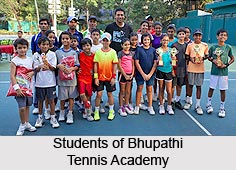
Bhupathi Tennis Academy: The Bhupathis established The Bhupathi Tennis Academy in 1995. Ex-Chief Minister of Karnataka, S. M. Krishna, a tennis lover is the Chief Patron of the Academy. The Academy is situated 25 minutes away from the city center. Major training facilitates of the Academy include the 3 Plexi Cushion Courts & 3 Clay Courts. Presently, the academy has 14 faculty members. Other noteworthy facilities include dormitories for 24 trainees and a tennis specific diet. Air-conditioned rooms are provided in summer. The members are provided individual cupboards, shoe racks as well as study tables.
Members are provided with aerobics, yoga, speed and power training. In addition, jogging track and sprint track can also be made use of. The Academy is affiliated with schools as well. Table tennis, snooker, pool and other indoor games like chess, darts, carrom and bridge can also be played. There is also a library facility. Among the main players to benefit from the Academy include Mahesh Bhupathi, Rohan Bopanna, Sania Mirza. Some of the prominent names to have visited the Academy include Bjorn Borg, Guillermo Vilas, Pat Cash, Henri Laconte, Vijay Amritraj, Ross Case, Leander Paes, Anand Amritraj, Mansour Bahrami.
The Academy hosts the Nike Junior Tour National Masters. The training procedure includes 4-5 hours of tennis along with physical training provided by a qualified trainer. There are drills, tie-break practices, service and return practices among others. The Board Of Advisors include Mr. Dayanand Pai (Patron), Mr. Sanjay Mehra, Mr. Pavan Kapoor, Mr. Mohan Kharbanda, Mr. Hemu Javeri; Mr. Prakash Padukone, Mr.Milind Nulkar, Mr. V. Sukumar & Mr. Dinesh Reddy.
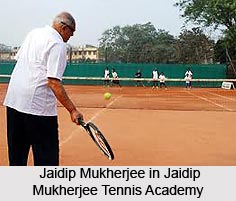
The Jaidip Mukerjee Tennis Academy: Jaidip Mukerjee, too followed suit to discover and groom tennis talent in the northern part of the country. The Jaidip Mukerjee Tennis Academy, which offers top-class facilities, is in the heart of Salt Lake, away from the hustle and bustle of the Eastern metropolis. Over 100 boys and girls in the age group of five to 15 train there. In fact Jaidip Mukerjee has two academies; the second one being the Himalayan Tennis Academy. A deep desire to keep the Indian hopes floating in today`s world of tennis, the father and son duo started a tennis academy in Chennai, the Krishnan Tennis Center in 1995, on the lines of the academies run in the U.S.
The Krishnan Tennis Centre: The Krishnan Tennis Centre was established in 1995 by the famous father-son duo of Ramanathan Krishnan and Ramesh Krishnan. The Krishnan Tennis Centre has most of modern facilities along with professional management. Players at the tennis centre are provided training by veteran coaches who make use of the new training methods. The Centre trains everyone from amateurs to juniors, collegiate players and even professionals.
For the benefit of outstation players, the centre also conducts special camps. Also there are different training methods for professionals and amateurs. The training sessions are normally for 2 hours in the morning and 3 hours in the evening. Some of the major facilities at the Krishnan Tennis Centre are the eleven courts; 9 are quick-dry clay courts and two are synthetic surface courts. Five of the courts are fully lit. Further, there is a Clubhouse inclusive of change rooms and shower facilities The Fitness centre is quite well equipped while accommodation facility is also provided to outstation players if requested for.
Such various Indian academies can surely prove very fruitful for the various domestic and international tournaments. Thus, apart from the many tennis tournaments held in India, the comprehensive list is as follows:
ITF Men`s Satellites, (various venues) (Hard Court)
WTA Bangalore Open, Bangalore (Hard Court)
ITF "Bhavna Swarup Memorial" Women`s Circuit Event, Muzaffarnagar (Grass Court).
ITF "BPCL" Women`s Circuit Event, Delhi (Hard Court).
ITF "ONGC" Junior International, (Clay Court).
ITF "Adidas" Junior International, (Hard Court).
ITF "Sunny Enclave" Junior International, (Hard Court).
"Chennai Open" ATP, Chennai (Hard Court).
AITA "S.B.Saurashtra" Nationals, Delhi (Grass Court).
ITF "BSNL" Men`s futures, (Hard Court).
ITF "Microsoft" Men`s futures, (Hard Court).
ITF "Adidas" Junior International, (Hard Court).
ITF "MSLTA" Junior International, (Hard Court).
ITF "Poona Club" Women`s Circuit Event, Pune (Hard Court).
ITF "NECC" Women`s Circuit Event, (Hard Court).
ITF "MSLTA" Women`s Circuit Event, (Hard Court).
AITA "DSCL" Hard Court Nationals (u16 Boys/Girls, u14 Boys/Girls), Delhi.
AITA "DSCL" Hard Court Nationals (Men, Women, u18 Boys/Girls), Delhi.
WTA "Sunfeast Open", Kolkata (Indoor Hard Court).
ITF Women`s Challenger, Indore (Hard Court).
ITF "NRE Coke" Women`s Circuit Event, Ahmedabad (Hard Court).
ITF "MSLTA" Women`s Challenger, Mumbai (Hard Court).
ITF "DHFL" Women`s Circuit Event, Mumbai (Hard Court).
ITF Men`s Futures, (Hard Court).
WTA "Indian Open", Hyderabad (Hard Court).
ITF "SAIL" Junior International, (Hard Court).
That apart, India also hosts a number of Davis Cup matches. The procedure to enter the World Group for the Davis Cup is described below.
1. The first 8 teams comprise 1st round tie winners from the preceding year`s World Group.
2. Meanwhile, the other 8 losers will have to take part in a 16-team World Group Play-off competition.
3. The other teams in this Play-off competition include winners of Zonal Group I sections (2 teams from Asia/Oceania Group I, 2 from Americas Group I, and the remaining 4 from Europe/Africa Group I).
4. A draw is used to determine the Play-Off ties. The 8 winners from among them the make it to the World Group the next year and the losers make it to Group I in their Zone.
5. The top 8 nations who make it to the World Group are seeded. Depending on various factors, Davis Cup Committee decides upon the seeding.
6. The major clinching factors here include the ITF Davis Cup Nations Ranking, performance in recent Davis Cup matches, ranking of the players for their respective countries, adaptability of the team`s players on different surfaces as well as their strength in doubles.
The first eight round ties in World Group are played on home and away knockout basis. The ties take place on weekends in early part of the year. The victorious sides make it to the quarterfinals, also played on a home and away knockout basis, over a weekend in the summer. Meanwhile, the eight losing teams from round one take part in the World Group Play-Off ties. The eight qualifiers from the Group I Zonal regions also participate in this stage. World Group Play-Off ties are also played on a home and away knockout basis over a same weekend and so are the World Group semi-final ties. The World Group Final is played towards the end of year. Selection of the ground for the abovementioned ties is either made by lot or is hosted by one of the competing sides.
In the World Group, World Group Play-Off ties, and Groups I and II, each tie comprises of 5 matches played over 3 days. Two singles matches are played on the first day, the doubles match on the 2nd and the reverse singles on the final day. All matches are best of five sets. Things are different In Groups III and IV. Only three matches (2 singles and 1 doubles) are played in a tie to determine the winner. Also these matches are best of three sets.
The next level after the World Group is the Zonal Competitions. The teams here are divided into three zones: the Americas Zone, the Asia/Oceania Zone and the Europe/Africa Zone. Even in the zones, there is a further division with four groups in each zone - Group I being the highest and Group IV the lowest. In all the zones, Groups I and II work on a home and away knockout basis. The winning teams advance until one or more nations are promoted to Group I from Group II, and to the World Group Play-Off ties from Group I.
Teams failing in the first round in Groups I and II have to take part in one or more play-off rounds till one or more losing teams are demoted. Groups III and IV battle it out against each other in a round robin format at one venue. In the Europe/Africa Zone, the groups are split between two venues. Once the round-robin matches end, play-offs take place to establish the final standings in the group and teams are promoted or relegated accordingly. In the Asia/Oceania and Americas Zones, the first two make it to the next group while the last two get relegated one group below. As is logical, there are no relegations from Group IV.
Like in the other groups, teams in Groups I and II also are played ties on a home and away basis. Meanwhile, ties in Groups III and IV are in a round robin format in all three zones. A tie takes place in a solitary venue over a week except in Europe/Africa zone, where ties are played at two venues. Davis Cup Committee is the final authority on the dates and the venues.
Some facts about the Davis Cup and Indian players are as follows:
India first played in the Davis Cup way back in 1921.
Leander Paes has been India`s most successful player in the Davis Cup with 78 wins.
Ramanathan Krishnan has won the most singles matches (50).
Leander Paes has been involved in the most doubles wins.
Paes and Bhupathi have been the India`s most successful doubles pair with 20 wins to their credit.
Ramanathan Krishnan and Jaidip Mukherjee have featured for the country in the most number of ties with 43 each.
India`s recent Davis Cup performances include a 1-4 loss to Korea, Rep and 3-2 win over Pakistan.
Among the greats who represented India in the pre-Independence era include Mohd Sleem, the Fyzee brothers, Ghaus Mohammed, K. Prasada and J. Charanjiva.
Overall, India`s has a pretty impressive record in the Davis Cup. They have made it to the finals thrice in 1966, 1974 and 1987.
|