
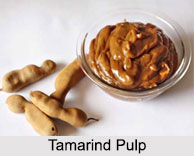
 Tamarind Pulp is traditionally popular in India as condiment added to many dishes like Rasam, Sambhar, chutneys, curries, etc. It is a thick extract made from tamarind. The pulp of ripe fruit of Tamarind tree is commonly used as condiment in many Indian dishes particularly South Indian dishes.
Tamarind
Tamarind Pulp is the thick pulp of ripe fruit of Tamarind which is commonly used as condiment.
Introduction
Etymology of Tamarind
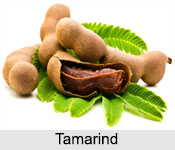 The botanical name of Tamarind is "Tamarindus indica Linn." and belongs to the family of "Leguminosae". The fruit has different names in every states of the country. The Indian names of Tamarind in different languages are "Imli" in Hindi, Punjabi, Urdu; "Ttali" in Assamese; "Tentul" in Bengali; "Ambli" in Gujarati; "Hunise Hannu" in Kannada; "Puli"in Malayalam and Tamil; "Chinthappandu", "Chinta", "Amlika" in Telugu; "Chinch", "Chincha"in Marathi; "Tentuli" in Oriya and "Yamadutika", "Amli", "Abdika" in Sanskrit.
Properties of Tamarind
Tamarind is a very valuable commodity in the world because of its nutritional components. These include a significant level of vitamin C, E, and B, calcium, iron, phosphorous, potassium, manganese and dietary fibre. There are also a number of organic compounds that make tamarind a powerful antioxidant and anti-inflammatory agent.
Uses of Tamarind
 Uses of Tamarind are many and very beneficial to mankind. Its uses comprise culinary uses, medicinal value, carpentry uses and many more. Tamarind belongs to the Leguminosae family and its botanical name is Tamarindus indica. Tamarind is a long bean-like pod belonging to the vegetable order, but is treated like a fruit. The name is derived from the Arabic "tamar", meaning a "dry date fruit".
Culinary Uses of Tamarind : The fruit pulp of Tamarind is edible and popular. It has a wide spread use to make `chutney`, jam, jelly and sauce. Tamarind has several usages in making of Indian dishes. The fruit pulp is sour and acidic. Ripened tamarinds are sweeter and are used to make delicious desert items. The pulp is needed to make Worcestershire sauce.
In Regional cuisines, such as Rajasthan, Maharashtra, Tamil Nadu and Andhra Pradesh, Tamarind is used to make rasam, sambhar, vatha kuzhambu and puliyogare. In Andhra Pradesh and Tamil Nadu, tender leaves of tamarind are used with lentils, and it is also dried and used in place of ripe tamarind for mild flavour. In southern parts of Kerala, mostly in the coastal belt, it is added to fish curry, masalas and ground coconut for flavouring.
Medicinal Uses of Tamarind : Apart from the culinary uses, Tamarind is largely used for its medical benefits. Tamarind is used in Indian Ayurvedic medicine to treat gastric and digestion problems, and in cardio protective activity. In animal studies, tamarind has been found to reduce serum cholesterol and blood sugar levels.
As per human study, tamarind intake delays the progression of skeletal fluorosis by enhancing excretion of fluoride.
Other medicinal uses comprise Anthelminthic (expels worms), antimicrobial, antiseptic, antiviral, asthma, astringent, bacterial skin infections (erysipelas), boils, chest pain, cholesterol metabolism disorders, colds, colic, conjunctivitis (pink eye), constipation (chronic or acute), diabetes, diarrhoea (chronic), dry eyes, dysentery (severe diarrhoea), eye inflammation, fever, food preservative, food uses (colouring), gallbladder disorders, gastrointestinal disorders, gingivitis, haemorrhoids, indigestion, insecticide, jaundice, keratitis (inflammation of the cornea), leprosy, liver disorders, nausea and vomiting (pregnancy-related), paralysis, poisoning (Datura plant), rash, rheumatism, saliva production, skin disinfectant/sterilization, sore throat, sores, sprains, sunscreen, sunstroke, swelling (joints), urinary stones, wound healing (corneal epithelium).
Carpentry Uses of Tamarind : Tamarind fruit pulp is used to polish the brass shrine furniture, removing dulling and the greenish patina that forms. The Tamarind tree wood is of bold red colour. For its density and durability, tamarind heartwood is used in making furniture and wood flooring.
Tamarind trees can be found in a large number in south India. They are used to enhance the shade of the roads. The seed oil of tamarind is used to linseed oil. It is suitable for making paints and varnishes. The Tamarind woods are also used as fuel in the ovens of brick factories which require high temperatures.
Recently updated articles in Food in India

Mehboob Alam Khan
Mehboob Alam Khan is a renowned culinary historian, chef, and educator dedicated to preserving Hyderabad's rich gastronomic heritage. Celebrated for r...
Assamese Cuisine
Assamese Cuisine is a mixture of different indigenous styles with regional variations and considerable external influences. Assamese use simple and fl...
Tamarind
Tamarind Pulp is the thick pulp of ripe fruit of Tamarind which is commonly used as condiment.
Food in Mauryan Period
Food in Mauryan Period largely includes the food and drinks during 300BC to 75 AD which has been extensively discussed in Arthashastra, rock edicts of...

Shilarna Vaze
Shilarna Vaze, also known as Chef Chinu, is a celebrated chef, entrepreneur, and sustainability advocate. Co-founder of Gaia Gourmet, she blends globa...
Related articles in Food in India
Food in Ancient India
Food in Ancient India has been largely agro based as the society in India in the ancient times was primarily agro based. The food of ancient India ref...
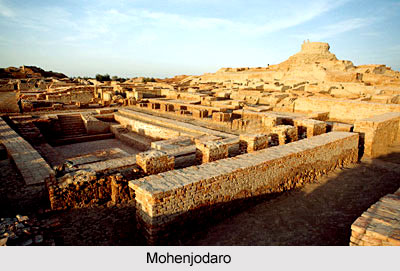
Food in Indus Valley civilization
Food in Indus Valley civilization largely depicts the agrarian culture of ancient India. As this had been one of the earliest civilisations of India,...

Indian Regional Cuisines
The intriguing style of different cooking style contributes to the diversity of the Indian regional cuisines.
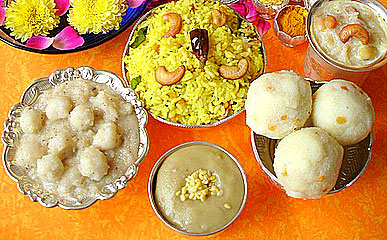
Indian Festive Foods
Indian Festive foods augmenting the richness of Indian festivals, have gained popularity.
Ancient Buddhist Cuisine
Ancient Buddhist Cuisine has been well described in the early Buddhist works in which food has been classified into four categories.