


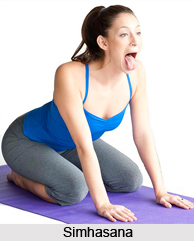
 Simhasana is one of the major meditative Yoga asanas, first described in the Yoga Yajnavalkya (200 BC). It alleviates a number of medical conditions including diabetes. It is one of the first four (and most important) of the 84 asanas taught by Lord Shiva, according to the Hatha Yoga Pradipika. Simhasana is one of the major meditative Yoga asanas, first described in the Yoga Yajnavalkya (200 BC). It alleviates a number of medical conditions including diabetes. It is one of the first four (and most important) of the 84 asanas taught by Lord Shiva, according to the Hatha Yoga Pradipika.
Meaning of Simhasana Simhasana, translates as the 'Lion Pose', from Simha (lion in Sanskrit). The student imitates the lion with his jaws thrown wide apart and his tongue fully stretched out. Practice of Simhasana A sequential process for performing Simhasana is given below: * The student has to fully stretch out his legs on the seat. Then he has to bend one of his legs; suppose the right one in the knee, and folds it on the thigh. * Now the right foot is to be moved below the left buttock, so that the individual can sit upon the right heel without any discomfort. * For this purpose, the sole of the right foot is turned upwards with the hands, and with the left knee the right foot is raised and placed under the left buttock, all the while the student resting himself on the right buttock only. * When the right foot is satisfactorily arranged below the left buttock the individual lifts up the right buttock from the ground, and puts his complete body weight upon the right heel. * In this position the upturned sole of the right foot will show itself partially from behind and the toes will be seen to spread a little beyond the thigh. * When one feels secure on his right heel, he shall bend his left leg, and anteriorly crossing the right leg from below, sets the foot under the right buttock, so as to sit on the left heel. * Then the left toes can be spread out beyond the right thigh and the individual finds himself sitting evenly on both the heels. * The final posture of Simhasana is considered to be of prime importance. The jaws are thrown wide open and the tongue is to be stretched out to its utmost limit'. The eyes are fixed either between the eyebrows as in the Frontal Gaze, or on the tip of the nose. * Then, instead of the right leg, the left can anteriorly cross it from below. Effects of Simhasana The Simhasana has great therapeutic effect when practised with the Tongue-Lock in rapid succession. Simhasana is a very valuable exercise as a preparation for the three Bandhas, Uddiyana, Mula and Jalandhara. The opening of the jaws and the drawing out of the tongue make the muscles of the neck elastic, thus facilitating the formation of the Chin-Lock. While in the posture of Jalandhara Bandha, the pressure on the knees exerted through the hands, the bracing up of the spine and the throwing out of the chest, provide a sort of control over the abdominal recti. This prepares the person for Uddiyana where one lifts up the buttocks with a view to hold the spine erect and sitting lightly on the heels usually tends to the contraction of the pelvic muscles to facilitate the practise of Mula Bandha. Thus, the Lion Pose or Simhasana is a fine exercise preparatory to the three Bandhas Precautions in practice of Simhasana The sole and the toes of the posture of Simhasana depict the back view of the lion pose. In order to secure the required ease and comfort, which must be present in every Yogic pose, the individual hereafter puts his whole weight on the thighs and especially on the knees, which are made to rest on the ground. This gives a little forward inclination to the whole trunk, the buttocks being lifted up from behind. The muscles of the arms and forearms are eventually stiffened, the elbow-joints are fully extended and the palms are made to cover their corresponding knees, the fingers being spread out to imitate the broad paws of the lion. The trunk along with the spine is supposed to be held erect, the chest is to be thrown out, and the braced up shoulders are to be made to exert gentle pressure on the knees through the upper extremities. During the pose of Simhasana, breathing becomes mainly oral, most of the air from the lungs being expelled through the mouth in exhalation and most of the air being drawn into the lungs the same way in inhalation. The nasal passage is very sparingly used for the incoming and outgoing breath. Yogic physical culturists recommend taking this exercise in the end of the daily program. The maximum time to be devoted to it should not exceed three minutes. |
| |||



Simhasana Yoga Asana
| Simhasana is a meditative posture where the practitioner imitates the poise of a lion. |
| ||||||||||||||||||||||||||||

