


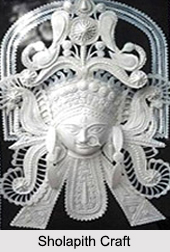
 Sholapith is derived from a 'reed' that is available in the marshy wetlands of Andhra Pradesh, West Bengal, Tamil Nadu and Assam. This craft is popularly known as sholapith in West Bengal and netti in Tamil Nadu. The core of this reed is white in colour and is exposed when the outer layer of the stalk is shaved. The core which is light, porous, soft, and pliable can be shaped to suit the imagination of the artisans. The artisans shape this reed into many objects like scaled down models of churches, temples and mosques, carved images of Maa Durga during Dusserha in Bengal, marriage headgear, flowers and garlands, and toys and mobiles. Flowers of a large variety are made from shola. The crown of the deities is made in paper pulp with the paper decoration fixed on it. It is one of the most impressive forms of ornamentation. Sholapith is derived from a 'reed' that is available in the marshy wetlands of Andhra Pradesh, West Bengal, Tamil Nadu and Assam. This craft is popularly known as sholapith in West Bengal and netti in Tamil Nadu. The core of this reed is white in colour and is exposed when the outer layer of the stalk is shaved. The core which is light, porous, soft, and pliable can be shaped to suit the imagination of the artisans. The artisans shape this reed into many objects like scaled down models of churches, temples and mosques, carved images of Maa Durga during Dusserha in Bengal, marriage headgear, flowers and garlands, and toys and mobiles. Flowers of a large variety are made from shola. The crown of the deities is made in paper pulp with the paper decoration fixed on it. It is one of the most impressive forms of ornamentation.
Origin of Sholapitha Craft The Sholapitha plant is recognized by the shallow layer of leaves that float on the marshy water. These are then dried thoroughly. Good quality pith is pure white and smooth with a soft bark and no nodes. Kath, the Knife, is used to shave the outer cover of the stalk, so that the white core is exposed. The stalk is cut into cylindrical pieces, so that the white core is left after the outer layer is peeled off. Then it is pared and turned into a sheet. Dozens of such sheets are rolled within the other and the consolidated roll is tied tightly at both ends, into two and on the cut side v-shaped indentations are made with a sharp knife. These sides are dipped in coloured solutions and dried. From the roll, the worker tears out an inch in length pieces by holding the uncolored end between the thumb and the index finger, twisting the pith piece into a flower. Once the flat sheets are made, a dozen of these can be tied tight at one end and cut into pieces to create various shapes, both geometrical and floral. 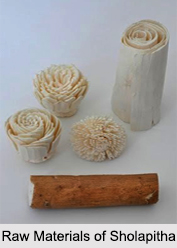 Procedure of making Sholapitha products
Craftsmen spend months on a piece, carefully carving out the details. No part of the Sholapitha is wasted and leftover bits are used for making various designs of flowers, birds, and animal figures. Several flowers are made, like Jasmine, Rose, Chrysanthemum etc. These are strung on a thin wire to make crescent shaped veni (strangled flowers) with a wire fastener to go round the bun of hair. Slit tin foils are used for extra decoration, which is cut into different sizes and pasted to the pith pieces. Glass beads are also used for this process. Sometimes thin gold and silver threads are strung into the pith flowers to embellish them. The coloring on the finished product is done with bright colored paint. Use of Sholapitha Craft Sholapith items form an integral part of the major religious rituals in West Bengal. The finest examples of the skill can be seen during the Durga Puja celebrations. Traditionally the artisans have also crafted ritual and decorative items like garlands, conical topors, or the head-dress worn by young boys during their naming ceremony and by bridegrooms, and the mukut worn by the bride. In Tamil Nadu the craft flourishes in pockets of Thanjavur, Karaikkal, Tiruchirapalli, Nagapattinam, Pudukottai and in the Union Territory of Pondicherry. Entire families are engaged in the craft. Artisans from Tamil Nadu even make model townships and replicas of temples, churches, and mosques, along with other architecturally significant buildings, complete to the smallest detail. An interesting feature of the shola is that it was the material used during British times for the production of the Sola Topi which was a necessary article of headwear as protection from the hot mid-day sun. 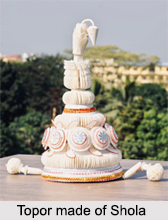 Classification of Sholapith Craft
Sholapith craft products can be classified into some categories according to their uses. Those are, Religious Activities: Sholar mala (Sholapith garlands), chandmalas (literally moon garlands with filigree discs linked into elaborate chains), Kadam flower, Laxmi jhara. Here religious and historical aspects are kept in mind while making these craft. Other crafts are Bisohari pot, Dharmachata, Jhara, Jati, Laxmi Mukhra, Mashan, Mandush, Melli, Patimour, Rash rachana, Rash tree etc. Marriage Rituals: Conical topors (worn by young boys during their naming ceremony and by bridegrooms) and the sithi mukut (worn by the bride), Sholar mala (Sholapith garlands). Death Rituals: Phulghor, Rathghor is used in death rituals famous in Ghatal, Siddha (East Medinipur), Bhandergacha (Howrah). Decoration Purpose: Ornaments of sholapith (idol/ deity decoration), mask of sholapith (Gamira dance and Malpaharia dance), Sholapith flowers (home decoration), sholapith toys and dolls (during rash jyatra) etc. Utilaterian Items: Sholapith hat, packaging purpose, repairing clock etc. Shola Hat is famous in Kaligunj (Nadia). Birth Ritual: Rajbansi community used Cytol pot on the birth rituals of a new born child and during marriage rituals. This is famous in Kaligunj (Coachbihar) and Kharibari (Darjeeling). Models: Sholapith model and decorative items (faces of gods and goddesses, elephant howdahs, peacock boats, palanquins). This craft is famous in Khagra, Baharampur (Murshidabad), and Banibon (Howrah). Implements and Raw Materials of Sholapith These craft requires no complicated tools. The tools used are simple and comprise of knives of different sizes and shapes, small batali, paper cutting scissors, needle, wire cutter, measuring tape, plastic scale and geometry box. In West Bengal the iron knife called kath, is used to shave the outer cover of the stalk, so that the white core is exposed. The stalk can be shaved further into thin or thick sheets and shaped with a knife or scissors. A piece of wood (Bali kath) is also required for sharpening kath with the help of sand. Sholapith work is popularly known as ‘Sholar Kaj’. The people engaged as sholapith craftsmen are known as Malakar, meaning “maker of garland”, probably because they made garlands of shola for idols and for the noble class. The Malakars belong to the Nabasakha group of artisan class and they are involved in this craft from generations. |
| |||



Home > Art & Culture > Indian Crafts > Crafts of Indian States > Crafts of West Bengal > Sholapitha Craft
Sholapitha Craft
| Sholapitha is the craft of West Bengal where flowers and other variety of articles are made from shola. Shola is a plant products that comes from Tropical montane forests of the hilly regions. The flowers from the plants are processed to form sponge like material for making crafts. |
| ||||||||||||||||||||||||||||

