


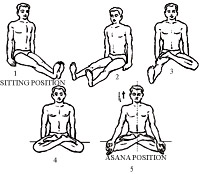
 Samasana is a meditative Yoga Asana that aids the practitioner's concentration and meditation. It is nearly identical to the Swastikasana, which has a history dating back to the 2nd century BCE. It is presumably a minor variation on the older pose. Samasana is a meditative Yoga Asana that aids the practitioner's concentration and meditation. It is nearly identical to the Swastikasana, which has a history dating back to the 2nd century BCE. It is presumably a minor variation on the older pose.
Meaning of Samasana 'Sama', in Sanskrit means 'equal or equilibrium'. In this asana the external organs of the body are positioned in such a way that they stand divided into two, hence the posture is termed as Samasana. Yoga Texts and Samasana There are few mentions of the Samasana in the Yogic canon, indicating that it is a modern variant of some other Yoga Asana, and its similarity to Swastikasana lends further credence to such a surmise. The Swastikasana is a fairly ancient posture, mentioned first in the Yoga Yajnavalkya (200 BCE), the first yoga text to describe an assortment of asanas. It was later also mentioned regularly in several ancient texts like the Puranas, and was also included in the asana compendium of the Hatha Yoga Pradipika, a definitive Hatha Yogic text compiled around 1400 AD. Practice of Samasana There is very little difference between Svastikasana and Samasana. However, in Samasana one heel rests on the other heel. The body remains in a symmetrical position while practicing Samasana. A sequential process for performing Samasana follows * The person should sit with both legs extended together in front, hands by side. Fingers should remain together. * Then, one has to fold the right leg at the knee. Holding the right ankle by right hand and toes by left hand, one has to turn it upward and place it in line with the navel. The sole should remain upward and toes should remain on the ground. * Similarly the person has to fold the left leg and hold the ankle by left hand and toes by right hand. * Now one should keep left heel on the heel of right leg. Toes of the left leg are arranged between the right thigh and ankle. Sitting straight, one must keep hands on respective knees in 'Jnanamudra'. * While returning back to the original position, the person should first extend the left leg, and then bring right leg in original position. Samasana greatly helps to maintain an erect posture. The backbone's functioning is greatly improved thanks to the posture's rectitude. Dhyana Mudra in Samasana further helps in stabilizing pulse beats. Consequently muscle strain is reduced, which in turn reduces the strain on the heart. One's breathing also slows down and on the whole, the posture helps the person concentrate better. People suffering from hydrocele or enlargement of testicles should not practice Samasana. |
| |||



Samasana Yoga Asana
| Samasana, or the balanced pose, is a meditative yoga asana maintaining the body’s equilibrium, by dividing the external organs evenly about the sternum. |
| ||||||||||||||||||||||||||||

