


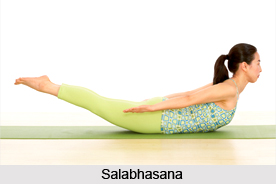
 Salabhasana is a cultural yoga asana that mimics the shape of a locust in its final position. The muslces stretched in this posture are rested in the Bhujangasana or cobra pose, and this posture is especially effective in treating abdominal disorders. Salabhasana is a cultural yoga asana that mimics the shape of a locust in its final position. The muslces stretched in this posture are rested in the Bhujangasana or cobra pose, and this posture is especially effective in treating abdominal disorders.
Practice of Salabhasana * The person is required to lie prone on his seat with his soles looking upwards and his fingers clenched. * Then he has to stretch his hands along his body so that his shoulders and the backs of his fists touch the ground. * The person either rests his chin, mouth and nose on his seat; or his chin alone, the head being thrown a little backward. * Then with a full stimulation the person has to stiffen his whole body; and try to raise his lower extremities backwards, putting his whole weight on the chest and hands. The wrists especially feel the burden of the lifted legs. * Throughout the exercise the breath is held in and the knees and are kept stiff and straight. In this practice the sacrum shares the fate of the legs and is a little raised with them. * If the individual finds that he can no longer hold in his breath, he should slowly lower down his legs, relax his muscles, and gradually start to exhale. * When respiration becomes normal, the person is ready to proceed with the next pose. The pose of Salabhasana may be repeated three to seven times with advantage. Care should be taken not to strain the lungs by unduly prolonging the posture. Of all the yoga asanas, it is only Salabhasana which requires a sudden movement of the lower extremities during its practice. But here too no violence should be done to the legs. The action though sudden should be done very smoothly. The trunk and the upper extremities that were put into action during the 'Cobra Pose' previously, are kept to the seat in this posture; whereas the lower extremities that were passive in the 'Cobra Pose' were actively used in this exercise. Salabhasana is a fine exercise for the pelvis and the abdomen and benefits the human systems in many more ways. |
| |||



Home > Health > Yoga > Yoga Asanas > Types of Yoga Asanas > Cultural Asanas > Salabhasana Yoga Asana
Salabhasana Yoga Asana
| Salabhasana, or the locust pose, is a cultural yoga asana that is instrumental in curing abdominal problems, and plays a complementary role to Bhujangasana, or the cobra pose. |
| ||||||||||||||||||||||||||||

