


|
Time of Performance There is the Vasantarasa for the full-moon day of Holi, and the Kunja rasa which is performed on the Rakhi-Purnima in the month of August. Then there is the Maha rasa which is performed on the full-moon day of the Karthika Purnima in the month of October-November. King Chandrakirti added the Nitya rasa, and gopa rasa. These dances follow a definite pattern which gives full scope for single performance. This dance of Manipur is performed in front of the temples. In temple premises, such as, Shri Shri Govindaji in Imphal Ras Lila is commonly performed during Krishna Janmashtami, Basanta Purnima and Karthika Purnima. Literature of Rasa The literature is Vaishnavite, simultaneously giving full scope to the actors to present the various nayikas of the Indian aesthetic tradition and the several Sthayi Bhavas mentioned in Natyashastra. Through the various episodes of the rasa a dominant mood called Karuna is created. By presenting a transitory state a configuration is produced of a dominant state of being. Through each sequence the dancers present several vyabhichari Bhavas. The various rhythms of the bhangis give full scope to the dancer to present variations on a given theme. The songs of Jayadeva from the Gita Govinda or Vidyapati's Padavali or the works of other poets of the Bhakti school are woven into the rasa dances. Dance of Krishna 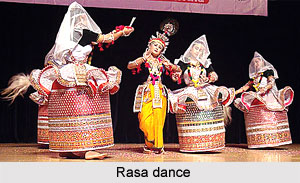 The dance of Krishna and the cowherds forms another group where only an episode of the playful Krishna is presented. The two goshta bhangis along with the goshta nartana or the gopa rasa complete the repertoire of Manipuri dance. Many episodes of playful Krishna are presented; it may be the episode of killing the demon Bakasura or the story of the playful child stealing butter. The vatsalya bhava is dominant and an ecstatic mood is created. These episodes are enacted by the dancer impersonating Krishna. The aim is to present the ambivalence of the human attitude to this child-god. Ultimately the actor who enacts the role either of Krishna, or Yashoda, or gopis represents humanity looking up, yearning for identity with the God. According to the history of Manipuri classical dances the traditional Rasa Lila was of three varieties: the Tal Rasak, the Danda Rasak and the Mandal Rasak. In all these three forms of Rasa Lila the story depicted revolved around Lord Krishna and his divine love, Radha. The dance of Krishna and the cowherds forms another group where only an episode of the playful Krishna is presented. The two goshta bhangis along with the goshta nartana or the gopa rasa complete the repertoire of Manipuri dance. Many episodes of playful Krishna are presented; it may be the episode of killing the demon Bakasura or the story of the playful child stealing butter. The vatsalya bhava is dominant and an ecstatic mood is created. These episodes are enacted by the dancer impersonating Krishna. The aim is to present the ambivalence of the human attitude to this child-god. Ultimately the actor who enacts the role either of Krishna, or Yashoda, or gopis represents humanity looking up, yearning for identity with the God. According to the history of Manipuri classical dances the traditional Rasa Lila was of three varieties: the Tal Rasak, the Danda Rasak and the Mandal Rasak. In all these three forms of Rasa Lila the story depicted revolved around Lord Krishna and his divine love, Radha.
Costumes of Rasa Dance The costumes of Rasa Lila of Manipur are vibrant and are quite captivating to look at. As far as the dancers are concerned both male and female dancers are part of this splendid act. The richness of the costumes, the poise, the moving music and the devotion with which Rasa Lila is performed is sure to strike an emotional chord. Manipuri dance evokes a permeating mood of devotion, deep yearning and Karuna. It symbolizes the pangs of separation from the Godhead and reunion with Divinity. Finally all humans are gopis ever seeking, ever desiring, ever yearning for the God who gives the illusion of being personal to each human being and is yet above all of them. Manipuri has a delicate grace and beauty which is full of the intricate complexities of sinuous curves. It is the embodiment of Bhakti as far as its theme and spirit is concerned. The delicate movements, the crescendo of the music and the grace of the dancers make the performance truly a divine one. |
| |||



Home > Art & Culture > Indian Dances > Classical Dances of India > Manipuri Dance > Rasa Dance of Manipur
Rasa Dance of Manipur
| Rasa dance of Manipur is undoubtedly the origin of the classical dances in Manipur. |
| ||||||||||||||||||||||||||||

