


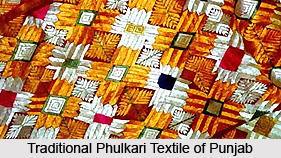
 Phulkari Craft in India literally implies floral embroidery, or floral craft, from the two words 'phool' which means flower and 'karai' which means stitch, or embroidery. The craft of Phulkari is an ancient craft of undivided Punjab and garments employing this craft are quite sought after throughout India. One will come across simple and scanty Phulkari motifs on shawls, headscarves and 'odhanis' or 'dupatta', which are ideal for daily utility. Phulkari Craft in India literally implies floral embroidery, or floral craft, from the two words 'phool' which means flower and 'karai' which means stitch, or embroidery. The craft of Phulkari is an ancient craft of undivided Punjab and garments employing this craft are quite sought after throughout India. One will come across simple and scanty Phulkari motifs on shawls, headscarves and 'odhanis' or 'dupatta', which are ideal for daily utility.
Phulkari crafts are also dominant in certain costumes which cover almost the entire body, which are known as 'Baghs', meaning garden. Phulkari is an art of decorating shawls, dupattas with embroidered floral motifs. Phulkari Craft in India was a significant portion of every woman's life, intricately linked to it through ancient customs, traditions and rituals. Baghs were elaborately crafted garments which were presented as gifts to brides in Punjab, and offered as a part of the dowry. Women loved to adorn themselves with Baghs, or other types of Phulkari crafted costumes during marriages, festivals and other special occasions. There is a custom among married Punjabi women to deck themselves in colourful Phulkari garments, to use Phulkari to celebrate the birth of a child, and are even draped on the corpse of a woman on the funeral pyre, if she has died while her husband is still alive. 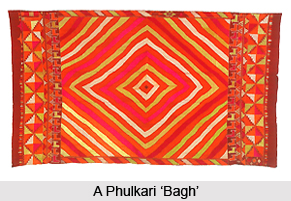 History of Phulkari Crafts in India
According to certain scholars, the craft of Phulkari originated from Iran, where it is popularly named 'Gulkari'. However, there are other opinions which assert that Phulkari craft migrated from Central Asia. It is believed that the 'Jat' tribes ushered this beautiful craft in India. Since 15th century, this traditional craft has been existent in India, and this embroidery technique dates back to 2000 years. Rig Veda and other ancient religious texts like Mahabharata and Guru Granth Sahib contain references of this craft. Several Punjabi folk songs and the famous romantic epic tale of 'Heer Ranjha' have also mentioned about Phulkari crafts. During the regime of Maharaja Ranjit Singh, Phulkari craft flourished in Punjab as the ladies would engage themselves in weaving this craft at their leisure, as they bonded with their friends, relatives or neighbours over banter. Elderly women of Punjabi households inculcated the art of stitching Phulkari to their children, who passed it on to their future generations. Silk threads or 'pat' were utilized in composing the deft motifs and patterns on dupattas, shawls or Baghs. 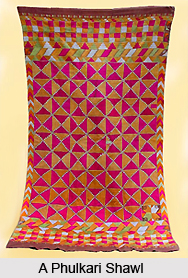 Concentration of Phulkari Crafts in India
Part of Northern Punjab, particularly Chakwal and Hazara manufacture some of the very best Phulkari crafted garments and Baghs. The states of Haryana, Punjab and Gujarat boast of rich Phulkari crafts, prevalent since ages. The silk threads which are used to stitch Phulkari are obtained from Kashmir, Bengal (now West Bengal) and the nation of Afghanistan. The region of Patiala in Punjab is a sought after location which is renowned for its magnificent Phulkaris. Features of Phulkari Crafts of India The main characteristics of Phulkari embroidery are use of darn stitch on the wrong side of coarse cotton cloth with coloured silken thread. The silk threads in golden yellow, crimson, red, orange, green and pink are usually used for the embroidery. It is worthy to note that a single strand was used at a time, each part worked in one colour and the varied colour effect is obtained by clever use of horizontal, vertical or diagonal stitches. The Phulkaris of Punjab are of two types, one carrying a regular row of stylized motifs either of flowers, fruits or birds and other carrying a rich repertoire of the folklore and motifs taken from everyday life. The centre often carries a stylized lotus form the two cross borders at the two cross borders at the ends carry rows of stylized lotus form, the two cross borders at the ends carry rows of stylized animals and bird forms, or flowers. The remaining surface is covered with a variety of motifs: a train on wheels carrying human forms, birds and animals rushing across the horizon, while peacocks move across the surface and strange mythical birds and animals mingle together in harmony. In the past, Phulkari craft was purely domestic craft, which was never sold outdoors, in markets. Various shades of red and the red colour itself is highly favoured as the appropriate colour for Phulkari clothes, as red is considered one of the most auspicious colours in Hinduism and Sikhism. Brown, white, black and blue are the other popular colours which employ Phulkari art. Aged Punjabi ladies are quite fond of wearing white coloured Phulkari crafts. 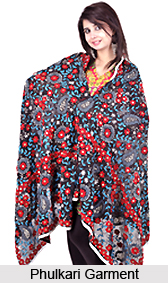 Process of Making Phulkari Crafts of India
The Punjabi Phulkari is of a spectacular nature. The word means flowering and it creates a flowery surface. The Phulkari stitch derives its richness from the use of darning stitch placed in different directions - vertical, horizontal and diagonal. Embroidery is done from the reverse side. The pattern is controlled by counting of thread, but quite often the outline of pattern is embroidered on the cloth in green thread. The needle picks up only one thread at a time, so that the back of pattern is delineated with single lines of colour in extremely fine stitches. In the front the stitch ranges from A1/2 to A1/4 cms in size. The stitching is done with silk thread, though occasionally cotton threads in white and green are used, and sometimes even woollen. A peculiarity of Phulkari is that the fabric itself is used geometrically as an inner decoration, so that the medallions and diamonds, etc are not just patterns sewn on but become an integrated combination of colours, yellow and madder brown. This is only possible where absolute accuracy in thread counting is observed. In Bagh work the stitch is so refined that the embroidery becomes the fabric itself. The quality of the workmanship is measured by the smoothness at the back that can only result from the evenness of the stitches. The smaller the stitch, finer is the quality of the embroidery. Apart from scarves and dupattas or shawls, Phulkari work is also done on shirts, 'salwar kameez' and bed covers. The Government of India is making attempts to promote this unique craft by organizing numerous exhibitions, fairs and training programs across the nation. Today, several fashion designers are introducing Phulkari crafts into a variety of accessories like bags, shoes, 'jootis', table mats, jackets, cushion covers, slippers and children's garments. The organisation of Punjab Small Industries and Export Corporation (PSIEC) enables the local women of Punjab to sell their Phulkari crafted products for higher profits, in order to encourage Phulkari artisans to keep their tradition alive. |
| |||



Home > Art & Culture > Indian Crafts > Crafts of Indian States > Crafts of Punjab > Phulkari Handicraft
Phulkari Handicraft
| Phulkari craft in India is a traditional embroidery process indigenous to Punjab which creates beautiful hand-woven motifs on shawls and odhanis from Punjab. |
| ||||||||||||||||||||||||||||

