


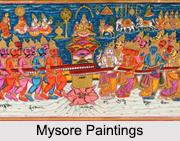
 Mysore Painting is an established art form which developed in today’s form in the city of Mysore in South India. It accepted huge support in the Mysore royal court and today, the authentic traditional pieces are prized for their complicated brushwork and aesthetic colours. Mysore paintings are the emblems of beauty originating from the classical South Indian painting in the town of Mysore, Karnataka. Mysore paintings are recognized for their style, muted colours and interest to feature. Mysore Paintings of India create utilize of thinner gold leaves and need much more hard work. Mysore Painting is an established art form which developed in today’s form in the city of Mysore in South India. It accepted huge support in the Mysore royal court and today, the authentic traditional pieces are prized for their complicated brushwork and aesthetic colours. Mysore paintings are the emblems of beauty originating from the classical South Indian painting in the town of Mysore, Karnataka. Mysore paintings are recognized for their style, muted colours and interest to feature. Mysore Paintings of India create utilize of thinner gold leaves and need much more hard work.
History of Mysore Painting The individual school of Mysore painting developed from the paintings of Vijayanagar times through the sovereignty of the Vijayanagar Kings. The leaders of Vijayanagar supported literature, art, architecture, religious and philosophical conversations. Vijayanagara School of painting was way apart from their ancestral path showers in the artistic map of India. The pupil of this cult mastered their art in drawing war scenes, folk dances, animal hunting, commercial transactions and everyday life of the common people. The Mysore and Tanjore traditional paintings are the offshoots of the Vijayanagara School. These paintings are renowned for their sophistication, subdued colours and attention to detail. The fame of Mysore School of painting reached its uppermost indicates under the regulation of Raja Krishna Raja Wodeyar. Raja Woodeyar of Mysore was well known for his considerable involvement to patronize art and encourage artists. The Mysore kings were ruling the princely state from Srirangapattana and Raja Wodeyar employed several painters from Vijayanagara and thus laid a sound foundation of Mysore Traditional Painting. These painters were also assigned allied work in decoration, preparing banners, doll making, gold work, painting the temple cars, preparing portraits of rulers, deities and saints. The Mysore kings that followed also encouraged this style of painting. Local available raw materials were the main ingredients of paintings, hair of the squirrel was used as brushes by tying them with a silken thread and inserting them in the narrower end of a quill. These artists were engaged in showcasing these eye-catching paintings on temple walls, banners and also palace walls. He had constructed two shrines, one at Srirangapatna and the other at Ganjam for Nimishamba Devi, the Goddesses which are worshipped by the artists. Mysore art was given a major impetus during the reign of Mummadi Krishnaraja Woodeyar who rose to power after the death of Tipu Sultan in 1799 AD. These paintings showed a pictorial description of subjects and depicted the scenes and figures of the Hindu mythology on palaces of rich and royal community, the household of the merchants and the noble class. On the walls of Jagan Mohan Palace the attractive Mysore paintings can be seen. Features of Mysore Painting Mysore Paintings are considered by fine lines, involved brush strokes, polished description of figures and the careful use of clear vegetable colours and shiny gold leaf. The paintings are designed to encourage feelings of commitment and humbleness in the spectator. The painter’s creature skill in giving appearance to a variety of emotions is so of supreme significance to this style of painting. Artists used to fix 10-20 layers of newspaper and on that, they paste the drawing sheet over which they apply the paste of purified flour (Maida) to create a support for painting before. The earliest painters in Mysore prepared their individual materials. The colours were from natural resources and were of vegetable, mineral or even organic source such as leaves, stones and flowers. Brushes were made with squirrel hairs for delicate work but for drawing superfine lines a brush made of pointed blades of a particular range of grass had to be used. Due to the long-lasting class of the mud and vegetable colours used, the original Mysore paintings still retain their cleanness and shine even today. The first step the artists do is to make a preliminary sketch of the image on the base, which comprises of a cartridge paper pasted on a wooden base. After that, they make a paste of zinc oxide and Arabic gum, recognized as 'gesso paste'. This paste is used to provide a little raised result of carving to those parts of the painting which need decorations and is allowed to dry up. Next, gold foil is pasted on the outside and the rest of the painting is organized with the help of watercolours. After the painting is completely dried, it is covered with a thin paper and rubbed lightly with a flat soft stone. Even the support was formed of paper, wood, wall and cloth, before the single cartridge paper base used now. The drawings were made with the help of charcoal, which was prepared by burning tamarind brushwood in an iron pipe. Centers of Mysore Painting The Mysore School of paintings survives in Mysore, Bengaluru, Narasipura, Tumkur, Sravanabelagola and Nanjangud. Themes of Mysore Painting The themes for most of the Mysore Paintings are the Hindu gods and goddesses and scenes from Hindu myths. Other themes include pictures from Hindu epics such as the Mahabharata, the Bhagavad Geeta and the Ramayana. One more popular and common theme is Lord Ganesha sitting on his throne. Some of the characteristic themes in these paintings are Dashavatar, Lakshmi, Saraswati, Rajarageshwari, Sri Rama, Kodanada Rama, Tandavashwera and Vishvarupadarsha. Famous Paintings of Mysore Painting The most extraordinary and famed Mysore painting is the depiction of the Lord Shrinath, who is believed to be a personification of Lord Vishnu. The stunning paintings of Mysore such as Goddess Saraswati playing lute (Veena), Goddess Lakshmi bestowing a wealth of prosperity on her devotees, child Krishna etc. actually catch the interest of the spectators. Famous Painters of Mysore Painting There are numbers of painters are there and some of the popular contemporary Mysore painters. B.P. Ramakrishna is one of the conventional artists in Mysore with about 35 years of practice. Mr. Anand teaches many students and encourages this painting. He works on a variety of subjects ranging from Gods, Goddesses and Dussehra Festivals. He also does painting by mixing Tanjore and Mysore traditional painting styles water painting, oil painting, recreation of Ravi Varma’s paintings and photography. Ms. Chandrika is the daughter of Shri Ramanarasaiah and has been trailing her father’s footsteps. She works on subjects stated in shlokas. M. Ramanarasaiah was the curator of Jayachamarajendra Art Gallery for a long time and has performed the most of the paintings related to the Mysore Royal Family. Mr. Ramanarasaiah was the palace artist and was also in charge of the exhibits of the gallery. He is a very famed Mysore artist. He has done a lot of paintings depicting Mysore culture and tradition, having the same subject. Sri K.S. Shreehari proved his knowledge in the paintings of such interesting themes like a wind mystery like 'Panchanaari-Turaga'. One of his works entitled 'VirataVishwaroopa' testifies to his eye for minute’s details. |
| |||



Mysore Painting
| Mysore Paintings are the emblems of beauty originating from the classical South Indian paintings. |
| ||||||||||||||||||||||||||||

