


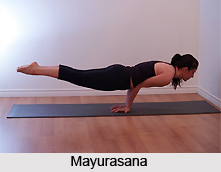
 Mayurasana or the 'peacock pose' is one of the most visually appealing asanas in Yoga. It has been described in major classical yoga texts and enjoys an extended history in yoga practice. Mayurasana or the 'peacock pose' is one of the most visually appealing asanas in Yoga. It has been described in major classical yoga texts and enjoys an extended history in yoga practice.
Meaning of Mayurasana The posture is called Mayurasana because it imitates the demeanor of a peacock with his heavy plumage stretching behind him. 'Mayura' means a peacock in Sanskrit. Yoga Texts and Mayurasana Several prominent Yoga treatises mention and describe the Mayurasana. The Hatha Yoga Pradipika, a major Hatha Yogic treatise of the 14th century, describes it in detail, after which the posture is mentioned in virtually every subsequent text. The yoga upanishads describe the posture, as does the Gheranda Samhita. The Hatha Ratnavali is significant in including the Mayurasana in its list of 84 classic yoga asanas taught by Lord Shiva. Practice of Mayurasana * The student has to kneel on his seat and bring together his forearms down up to the wrists. * Then the elbow-joints are put to be in close contact with each other, so that they provide a suitable fulcrum to support the horizontal body, during the full display of the pose. * The palms and fingers are made to take the place of the feet and the claws of the peacock. The position of the claws, however, is reversed, the palms being given a backward direction. * The fingers, when arranged must afford a very good contrivance for adjusting the balance of the whole body. * On the fulcrum thus prepared, the body is stretched out in a straight line parallel to the seat. * The elbows are to be place d on the abdomen just below the umbilicus. * The forearms should not stand exactly at right angles to the ground, but are a little inclined to the front. * The head is raised and the chin thrown out in order to counterbalance the heavy legs. * The whole body is held like a horizontal bar resting on a fulcrum. Effects of Mayurasana Mayurasana usually checks the flow of the abdominal aorta and thus diverts a liberal blood supply to the digestive organs, making them healthier. These organs are further toned up by the increase in the intra-abdominal pressure. Mayurusana is a very good measure against 'ptosis' of the abdominal organs and against dyspepsia. Its usefulness, however, is limited, because in advanced cases of dyspepsia the patient becomes excessively weak to undergo the strain which Mayurasana necessarily involves. Precautions in the practice of Mayurasana A beginner should hold his breath in Mayurasana so long as the pose lasts. Quite an amount of muscular energy is required for this asana, especially in the initial days; and this energy can best be had with controlled breath. But as the practice advances and the muscles get into the habit of doing this type of work, less energy is required and then the breath may be allowed to flow as usual even while the pose is being maintained. While practicing Mayurasana, if a small quantity of water that may be lingering in the colon starts ejecting, a change can be done to the technique. The legs, instead of being held together and parallel to the ground, are to be spread out and raised that imitates a proud display of the peacock's plumage. Parallel and horizontal legs in Mayurasana require the anal sphincters to be fully contracted. This is quite desirable when the pose is to be practised for itself, because it helps to increase the intra-abdominal pressure which is one of the advantages sought after in Mayurasana. But when the exercise is done as a sequel to colon flushing, its aim is to drive out the lingering liquid from the larger bowel. This requires the anal sphincters to be in an undisturbed condition. In order to make this relaxation possible the legs must be spread out. It is to be remembered that the muscles of the buttocks remain contracted even in this position. This contraction, however, does not prevent the ejection of the colon liquid, if the anal sphincters are completely relaxed. The partial contraction of the muscles of the buttocks with a concurrent relaxation of the anal sphincters requires some practice in muscle control. |
| |||



Mayurasana Yoga Asana
| Mayurasana, a cultural asana imitates the posture of a peacock and aids in improvement of circulatory system. |
| ||||||||||||||||||||||||||||

